
home > bibliography > José Luis Turina, three years later
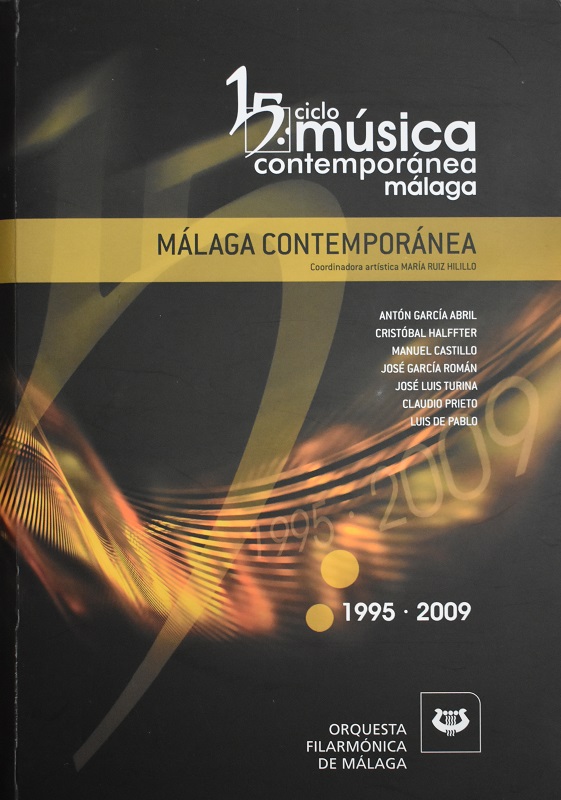
José Luis Turina, tres años después / José Luis Turina, three years later
By José Luis TemesInterview published in the program book for the 15th Contemporary Music Cycle of the Málaga Philharmonic Orchestra (January 2009)
- Believe me, I'm not exaggerating when I say it was the best thing that's happened to me in my life as a composer.
With these unambiguous words, José Luis Turina recently shared with us, in an informal conversation, his heartfelt memories of the 12th Contemporary Music Cycle in Málaga, in January 2006, where he and his work served as the central theme. In that event, no fewer than 17 of his compositions were performed; a CD featuring five of his orchestral works was published, and a book was released, covering his biography, a brief aesthetic analysis, and a detailed catalog of his works.
By the time these lines are read, three years will have passed since those events. However, certain moments from that cycle remain vividly etched in Turina's memory:
- All of the concerts were excellent, and I cannot express enough gratitude to the organizers and performers for those unforgettable sessions. But perhaps I remember a few moments more vividly: for example, the premiere -fourteen years after its composition- of Notas dormidas for solo harp, in an unforgettable rendition by Cristina Montes; or the Violin Concerto with Ara Malikian, in a version so different from that of its original recipient, Víctor Martín. Or the Spanish premiere of Concerto da chiesa for cello and strings, with Miguel Jiménez as soloist.
Yet it's evident that, with the passage of time, some of these works -or at least certain passages- might have seemed to the composer to be, perhaps, improvable, redundant, less successful, or… who knows… deserving of a few adjustments, right?
- Yes, but I'm already quite used to that. Not just with this cycle, but anytime I listen to my own music. There are always things you feel the need to improve, but…
In exchange, we invited Turina to engage in a little immodesty: we asked him to share a moment when he felt genuinely proud that the music he was hearing had come from his own pen. We know his answer may sound a bit boastful, but we promise not to hold it against our usually modest José Luis:
- Well, if we're being immodest… [laughter]… I enjoyed listening to my Three Terzettos very much. I think they turned out quite well… although much of that impression is due to the superb rendition by the Arbós Trio, to whom the piece is dedicated.
However, on the other hand, José Luis Turina admits that he did not feel influenced by reading about his life journey, even in the biographical book that was published alongside this Cycle. He tells us he read it "almost in the third person", without it influencing his future work -at least not consciously- through a reflection on his past.
For readers of that book, we inform you that there have been no major shifts in the daily life of our composer, based on the framework laid out in its last pages: a life professionally divided between creating new scores and his day-to-day work as the Artistic Director of the Spanish National Youth Orchestra (JONDE), a role into which he pours much of his daily enthusiasm and effort:
- I absolutely don't regret having to perform this work every day. For me, it's far more than a way to earn a regular income. Music education for young people has been a constant throughout my life: from teaching as a professor at the Madrid Conservatory; through my work in administration, contributing to the drafting of the new Music Education Act, which has greatly influenced new generations of Spanish musicians; and now, for the past eight years, as a manager at the head of JONDE, supporting young people as they transition from student life to professional life, which is an extremely delicate period.
- But surely you must miss having more time to compose…
- Of course! I would like to have more time for composing, but I would decline the idea of dedicating myself solely to creating music; it would distance me from the reality of musical practice -and even from the social reality around me- which I think would not be a good thing.
Without a hint of flattery, we express to Turina the widespread praise for his work over recent years at the helm of JONDE. However, it is clear that, from his perspective, there may be some unfulfilled goals, some areas for improvement:
- Undoubtedly: I believe our most pending goal is JONDE's international reach. The orchestra's daily work is solid, but we lack the means to take it beyond our borders, to take it regularly outside of Spain, where young musicians could measure themselves and exchange experiences with their foreign peers. This is especially important, considering the recent development of youth orchestras in the various Autonomous Communities of Spain. It's true that JONDE has achieved some international milestones -our performances in Berlin, Vienna, and Amsterdam are unforgettable- but I still think this is the least developed area of our activities.
The other pillar of our protagonist's work today, as previously mentioned, is his creative work:
- In the three years since the 12th Cycle in Málaga, I've composed six works. Among them, my longest orchestral piece, Tour de manivelle: nearly fifty minutes of orchestral music.
In fact, with Tour de manivelle, Turina responded to a commission from the Community of Madrid Orchestra and the Teatro de la Zarzuela to create music inspired by five short silent film scenes directed in the early 20th century by Teruel native Segundo de Chomón. Turina's piece, crafted scene by scene -almost frame by frame- from the original footage, presented a significant challenge, though it also had the advantage that the musical form (always a challenge for a contemporary composer) was practically dictated by the narrative structure of the scenes.
But there were, of course, other works of a smaller scale as well:
- Yes, Tour de manivelle was the most extensive and ambitious piece of this period, but sometimes smaller works require as much or more effort than the ' big ones'. During these years, for example, I've composed Hércules y Cronos for brass and percussion, commissioned by the Galicia Symphony Orchestra, which premiered in La Coruña outdoors before an audience of more than four thousand; also, Saeta for marimba, of which Juanjo Guillem performs an impressive version; or Tres villancicos, which challenged me to a difficult Christmas synthesis between a more conventional -almost childlike- language and my own aesthetic. Also Viaggio di Parnaso for piano trio and Virado en sepia, an educational piece for violin and cello.
And finally, another orchestral work, La Commedia dell'Arte... [which this article serves to introduce].
- Yes, this was the result of a commission from the Málaga Philharmonic Orchestra. The commission allowed me to do something I've found appealing recently: to revisit some of my past works -in this case, from 22 years ago- and rework them for different instrumental forces. It's not just a simple orchestration exercise; you must approach the new piece with a fresh perspective, almost as if starting from scratch. The same goes for a version for two pianos that I just finished of the first series of Variaciones y tema, originally written for violin and piano.
I don't think it's too bold to say that José Luis Turina now holds a central position in Spanish musical composition: always distanced from experimentalism or extreme radicalism, but also far from "neoconservatism". He's no longer a young composer -forgive me, José Luis, but as our mutual friend Tomás Marco says, this is no longer a matter of DNA but rather of your ID-. But he still has a generation above him in age, still happily active. Perhaps for this reason, his music was chosen to inaugurate a new and significant recording collection recently launched by the BBVA Foundation in collaboration with the VERSO label. José Luis Turina is once again at the heart of Spanish musical progress with this CD titled José Luis Turina: Retrato. Another honor to add to your musical biography, right?
- Yes, honestly, I've always felt and continue to feel well-regarded. And I haven't even mentioned the performers -I've had remarkable luck with them throughout my career-. I've often said that the standout performances of my music have been far more frequent than the occasional minor disappointment.
Finally: a dream for the future, as a composer:
- To have time and peace of mind to compose without the clock breathing down my neck, without looking at the calendar to see how many weeks are left until a commission is due.
August 2008