
inicio > discography > CD José Luis Turina. A Portrait

Enlace YouTube
JOSÉ LUIS TURINA
By José Luis Temes
(Notes to the CD José Luis Turina. A portrait, published as No. 1 of the collection "Spanish and Latin American Composers of Contemporary Music" by the BBVA Foundation – 2008)
José Luis Turina is one of the most engaging figures of the generation of Spanish composers born during the nineteen fifties, along with other such notable colleagues as Francisco Guerrero, Alfredo Aracil, Jorge Fernández Guerra, José Manuel López and many others. It is also quite clear that the mere listing of those others points to the musical heterogeneity of this group, undoubtedly a factor which has enriched the Spanish musical aesthetic in these recent years.
Grandson of the renowned Joaquín Turina -one of the truest representatives of Spanish nationalism around Manuel de Falla at the beginning of the twentieth century-, José Luis was born in Madrid in 1952. Following brilliant studies in the capital's Conservatory, and although he initially planned to focus on his career as performer, his public appearance as the composer of Crucifixus (1979) began what has proved to be an outstanding creative record. It has been said a thousand times that the key to the success of his works -unquestionably one of the most successful and widely-heard composers of his generation- arises from his skill in synthesising tradition and modernity; there may be some truth in that, but we may like more to discover the reason for this consideration of a "sure value" in his music in the mix of innovative restlessness and solid craftsmanship, so that his music always has plenty to say, even to those not given to novelties of language.
José Luis Turina has combined his work as composer with a variety of management posts, always with the common denominator of musical education and a concern to train the new generations: first as lecturer in the Madrid and Cuenca conservatories, then in the drafting of the new musical legislation (the LOGSE) which so substantially transformed the entire teaching of music in Spain and currently as Artistic Director of the Spanish National Youth Orchestra.
The generic title of this Compact Disc is "Portrait", seeking to provide an image of the composer's musical thinking in terms of various quite different instrumental groupings: the symphony orchestra, string orchestra, instrumental ensemble and solo music (here specifically music for harpsichord).
THE WORKS ON THIS DISC
Punto de encuentro ("Meeting Point") comes very early in the composer's catalogue, dating from 1979, when Turina was still a student in the last years of Composition studies at the Madrid Conservatory, and so was supervised by his then teachers, Antón García Abril and Román Alis.
It is in fact a set of variations, a form which was to become habitual in Turina's output, albeit here using a procedure which is much concealed, difficult for a listener to access. And while using a very different grammar, almost antithetical, today Punto de encuentro resembles a renewal of this variation process taken up in masterly fashion in Schoenberg's Op. 31 Variations. The score is dedicated to Ricardo Uría, classmate of Turina at the Madrid Conservatory.
The composer Tomás Marco met José Luis Turina at the premiere of Crucifixus - referred to shortly and, as he has written, "suddenly discovered a new and powerful talent combining undeniable personal invention and well-crafted finish not always apparent in the most talented young composers of the time". A couple of years on, Marco was appointed Managing Director of the Spanish National Orchestra and Chorus.
These facts lie at the source of what must be considered one of José Luis Turina's best works and among the finest Spanish symphonic compositions of the second half of the twentieth century. In response to the commission from the National Orchestra for premiere in February 1984 under its new Chief Conductor Jesús López Cobos, Turina composed Pentimento. This is one of the few works in his output whose title, which preceded the composition, explains the compositional process. "Pentimento" is a term used by painters to describe a material process in oil painting in which part of a work erased and painted over tends, with time, to reappear through what replaced it, as if the painting "repents" of the second version and the first seeks to manifest itself anew.
This pictorial phenomenon is translated by Turina as an antithetic dialogue between a string quartet not solo but which "emerges" from the ample instrumental mass and a large orchestra. If the orchestra appears to articulate a current language, as in any work of our times, little by little nostalgia for the Romantic past can be glimpsed in the form of a somewhat Wagnerian discourse assigned as already said to the violin, viola and cello front desks. The work is dedicated to Tomás Marco.
Contemporary with Punto of encuentro -a month either way-, Crucifixus was a finalist in the Arpa de Oro (Golden Harp) Composition Competition held annually by the Spanish Confederation of Savings Banks. Although the work was not among the prizewinners, many recall that concerto (January 1979) as the first public appearance of someone known almost exclusively as the grandson of Joaquín Turina, who had been one of the most significant Spanish composers of the first half of the twentieth century. For the writer, mention of the pre- miere of Crucifixus has the further personal value of recalling meeting the protagonist of this disc.
When Turina wrote Crucifixus, he was still a composition student at the Conservatory, but this work was not the upshot of academic work as such: Carmelo Bernaola suggested to him during one of the Santiago de Compostela courses that he compose a work for that com- petition. As soon as he returned from Santiago, Turina started and completed the composition in just a few days and showed it to Bernaola, who advised his student on some aspects, although he was unable to follow the detail of those staves closely with Turina. "Crucifixus" obviously means "crucified", but the religious vocation of this music begins and ends with its title, the result of a double interval which takes a cross-form on the stave, used by Bach as interval pattern in some of his religious works. It is for string orchestra -twenty players- and piano.
Octeto de agua ("Water Octet") is the outcome of a 2004 commission from the Canal de Isabel II Foundation. It must be made immediately clear that this is not however an original work, but rather a transcription for eight wind instruments (2 oboes, 2 clarinets, 2 bassoons and 2 French horns) of Turina's own music from nearly ten years earlier for a quartet of basset horns (an older variant of the clarinet some are trying today to revive) entitled Cuatro cuartetos ("Four quartets"). The reason for this second version is also very clear: for such an uncommon ensemble, the original was condemned to obscurity. However, from now on, and based on a conventional grouping, the new score -which Turina dedicated to Alicia Núñez- was able to lead a normal life.
This is not however a mere change of instrumentation. The characteristics of the timbre of the new ensemble benefit the work in terms of light and variety, much as if a black and white photograph were to appear in colour. And above all, with a new feature, the main challenge of this version: if the original quartet was for four identical instruments of homogeneous timbre, this new one uses four different and also quite distant timbres (each doubled) -and note the absence of the flute.
While training at the Madrid Conservatory, José Luis Turina studied and graduated in harp- sichord under the Professorship of Genoveva Gálvez. This interest in the harpsichord led in 1988 to the Concerto for harpsichord and small orchestra entitled Variations and differences on themes of Boccherini.
In June the following year, he composed Due essercizi ("Two exercises"), which he dedicated to his harpsichord teacher, two very short pieces, each on a very specific and simple idea: the first ("Praeludium") is a play of chords in arpeggio form, written in unmeasured notes which are grouped according to the player's criterion, much like Louis Couperin's Free preludes, while the second ("Sonata") is a slippery perpetuum movement of semiquavers in lively time, using various technical procedures typical of the Essercizi of Domenico Scarlatti.
Eleven years on, in June 2000, Turina returned to this instrument, now at the bidding of María Teresa Chenlo, the Uruguayan harpsichordist long resident in Spain and always keen to inclu- de new works in her repertoire. For her he composed L'art d'être touché par le clavecin, subtitled Sonata for harpsichord, a highly virtuosic score a long way from the simplicity of the Due essercizi.
The title plays with that of the famed collection of harpsichord pieces composed by the great François Couperin at the beginning of the eighteenth century: L'art de toucher le clavecin ("The art of playing the harpsichord"); but Turina makes the verb reflexive and uses it to mean "to move": L'art d'être touché par le clavecin, which would translate as "The art of being moved by the harpsichord".
Contemporary Spanish and Latin American Music, gathered in a collection of records
By Susana Gaviña
(Review published in the newspaper ABC. Madrid, July 9, 2008)
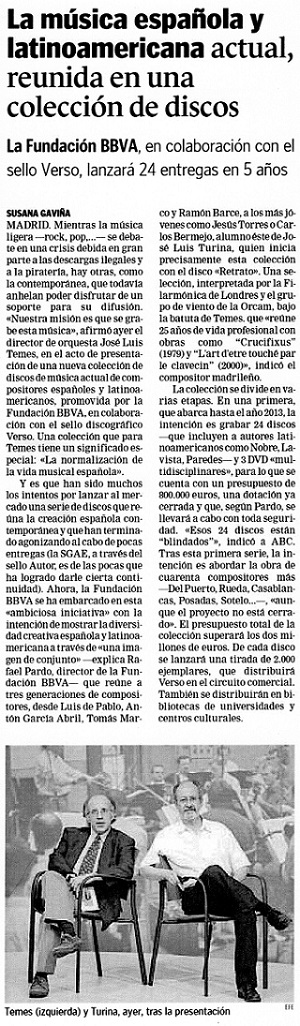
The BBVA Foundation, in collaboration with the Verso label, will release 24 volumes over 5 years
While light music -rock, pop, and the like- struggles with a crisis brought about largely by illegal downloads and piracy, there are other genres, such as contemporary music, that still long for a tangible medium for their dissemination. «Our mission is to have this music recorded». stated conductor José Luis Temes yesterday at the presentation of a new collection of recordings of contemporary works by Spanish and Latin American composers, promoted by the BBVA Foundation in collaboration with the record label Verso. For Temes, this collection holds a special significance: «The normalization of Spanish musical life».
Indeed, there have been many attempts to launch onto the market a series of records gathering contemporary Spanish creations, most of which have ended up fading away after only a few releases (SGAE, through its Autor label, is among the few that have managed to give it some continuity). Now, the BBVA Foundation has embarked on this «ambitious initiative» with the aim of showcasing the creative diversity of Spain and Latin America through «a comprehensive overview», explains Rafael Pardo, director of the BBVA Foundation -an overview that brings together three generations of composers, from Luis de Pablo, Antón García Abril, Tomás Marco, and Ramón Barce, to younger figures such as Jesús Torres or Carlos Bermejo, the latter a student of José Luis Turina, who is in fact the one to open the collection with the album «Retrato». This selection, performed by the London Philharmonic and the Orcam wind ensemble under the baton of Temes, «brings together 25 years of professional life with works such as "Crucifixus" (1979) and "L’art d’être touché" par le clavecin" (2000)», noted the Madrid-born composer.
The collection is divided into several stages. In the first, running until 2013, the goal is to record 24 discs -including works by Latin American composers such as Nobre, Lavista, and Paredes- and 3 «multidisciplinary» DVDs, with a budget of 800,000 euros, already allocated and, according to Pardo, guaranteed to go ahead. Those 24 discs are «secured,» he told ABC. After this initial series, the plan is to take on the work of forty additional composers -Del Puerto, Rueda, Casablancas, Posadas, Sotelo, and others- «although the project is not yet closed». The total budget for the collection will exceed two million euros. Each disc will have a print run of 2,000 copies, which Verso will distribute through commercial channels. They will also be made available to university libraries and cultural centers.
José Luis Turina. A Portrait
By David Rodríguez Cerdán
(Review published on the website of La Quinta de Mahler, 2008)
Verso presents a monograph dedicated to José Luis Turina, grandson of the maestro Joaquín and one of the exponents of the generation of Spanish composers born in the 1950s. A selection of his work, synthesizing tradition and modernity, is gathered here under the generic title "Portrait," offering a multifaceted image of his art: symphonic format, chamber and ensemble music, and solo composition are all featured in an album superbly defended by such powerful ensembles as the London Philharmonic Orchestra. At the helm is the tireless advocate of the house, José Luis Temes.
If there is one quality that stands out in José Luis Turina's work, it is his taste for eloquence, for anti-rhetorical expression. For some time now, in classical music, a bad habit has spread -perhaps due to the abstruse and extreme nature of many compositions today- of overlooking the engagement with the listener, as if this commitment were nothing more than a burden from the past, happily overcome. And while this deference cannot be demanded of every work written, it seems evident that in many where it could be expected, there is a preference to avoid it, to cover up the seams or triviality.
Turina is to be commended for offering us pieces that, despite their inherent rigor and turbulent progressions, do not falsify their seams and craftsmanship; rather, the opposite is true. Since in his case, the distance between the realization of a piece and its conception is never insurmountable, the Madrilenian does not need to sermonize or persuade. His works, framed in a post-expressionist aesthetic with a typically Latin influence, transparently reflect this reconciliation of means and ends, as evidenced by the varied work in this admirable album, drawn from various recordings over time (and what recordings!) under the stewardship of Temes, which dignifies them with correctness and honesty.
In the symphonic Pentimento (1983), the projected purpose (the aesthetic-artistic formulation of nostalgia and recurrence) is precisely aligned with the procedure (the flourishing and disintegration of a musical veil in the form of a romantic quartet). In the grand tableau of Punto de encuentro (1979), intelligibility and concreteness depend on the euphonious arrangement of dynamic proportions (the transition between the sforzando and ritardando is exemplary) and the organizing role of the marimba, upon which the themes and effects sway. By timbral contrast, the string piece Crucifixus (1979) asserts this philosophy by reiterating a motif whose notation resembles, in a Bach-like manner, a cross, while in the Octeto de agua (1994/2004), a transcription of the Cuatro cuartetos for corni di bassetto, the timbre of the doubled sound device refers, in a Stravinskian way, to exemplary liquid and conversational games. As a final flourish, the Uruguayan harpsichordist María Teresa Chenlo displays her digital prowess in the Due essercizi (1989) and L'art d'être touché par le clavecin (2000) for harpsichord, in which Turina's art is laid bare, stripped of spurious prose.
PUBLICATION DATE
08/07/2008
PERFORMERS
María Teresa Chenlo, harpsichord
London Philharmonic Orchestra
Poznan Philharmonic Orchestra
Iuventas Orchestra
Wind Group of ORCAM
José Luis Temes, conductor
CONTENT
José Luis Turina (b. 1952)
1. Punto de encuentro 1979 (21'01'')
2. Pentimento 1983 (11'08'')
3. Crucifixus 1979 (14'04'')
4. Octeto de agua 1994/2004 (13'20'')
5. Due essercizi 1989 (9'11'')
6. L'art d'être touché par le clavecin 2000 (9'24'')
1 CD - DDD - 78'07''
Collection "Spanish and Latin American Composers of Current Music"
By Francisco de Paula Cañas Gálvez
(Article published on the Forumclásico website in February 2013)
With more than thirty titles in its catalog and nearly five years of fruitful and successful dissemination, concert, and recording work behind it, the BBVA Foundation, in collaboration with the Madrid-based label Verso, culminates the first phase of the "Spanish and Latin American Composers of Current Music" Collection, one of the most ambitious cultural projects supporting the performance and dissemination of classical and contemporary music in recent decades in our country. In light of the significant successes achieved during this period and the enormous potential for development and future growth that this ambitious program holds for the dissemination of so-called avant-garde music in today’s society, as well as for the performers who bring it to life, we present below the main outlines of this attractive program, which has already been fully established both within and outside our borders as an indisputable reference point for contemporary Spanish and Latin American music.
The Culmination of Five Years of Work
As the first phase of the BBVA Foundation's collaboration agreement with the Madrid-based label Verso in the "Spanish and Latin American Composers of Current Music" Collection draws to a close, it is time to take stock of the path traveled and to propose future plans for one of the most brilliant and solid cultural projects of recent years in the field of avant-garde musical creation. Born with the aim of revitalizing and promoting the works of composers and performers of contemporary music and opening up to society the most innovative current musical concerns and proposals, the results obtained in these and other aspects have been truly remarkable.
One of the project's main contributions has undoubtedly been the goals achieved in the promotion, editing, and recording of the works of composers belonging to three different generations, with the release of a total of thirty-three monographic compact discs dedicated to the works of Carlos Bermejo, José Luis Turina, Manuel Balboa, Eddie Mora, Antón García Abril, Luis de Pablo, César Camarero, José Luis Greco, Eduardo Morales-Caso, Jesús Torres, Tomás Garrido, Alfredo Aracil, María de Alvear, Alejandro Moreno, Fabián Panisello, Jacobo Durán-Loriga, Jorge Fernández Guerra, José Río-Pareja, Ramón Barce, Eduardo Armenteros, Gonzalo de Olavide, Ramón Lazkano, Tomás Marco, José Manuel López López, Gerardo Gombau, Santiago Lanchares, Joan Guinjoan, Miguel Trillo, Cristóbal Halffter, and Miguel Pons.
A prominent, indispensable role in all this has been played by a roster of world-class performers with long careers behind them, including, among a long list of absolutely renowned artists, Grupo Instrumental Siglo XX, Cuarteto Leonor, Trío Arbós, Plural Ensemble, RTVE Symphony Orchestra and Choir, Camerata del Prado, Orquesta y Coro de la Comunidad de Madrid, Ensemble Residencias, Cuarteto Bretón, pianists Alberto Rosado and Yukiko Sugawara, cellist David Apellániz, mezzo-soprano Elena Gragera, accordionist Iñaki Alberdi, and conductors such as José Luis Temes, José Ramón Encinar, and Arturo Tamayo.
In addition to the recordings, which are essential for bringing these rarely performed repertoires closer to music lovers, between July 2008 and June 2012, the BBVA Foundation hosted the launch events for fourteen albums at its magnificent headquarters in the Palacio del Marqués de Salamanca in Madrid. These events were attended by the composers and performers themselves, who played a selection of different pieces from each of the presented albums for about forty minutes, as well as representatives from the Foundation and Verso and numerous guests. Intellectual diversity, multiculturalism, and, fundamentally, aesthetic, creative, and interpretative plurality could be the hallmarks of this phase, which now concludes with great success from both the public and the most demanding specialized critics at the national and international levels.
A Project Open to the Future
The achievements reached are commendable and undoubtedly stem from well-executed work and, very particularly, from the leadership and sponsorship of the BBVA Foundation in the field of cultural and artistic patronage. Here, the roles of its director, Rafael Pardo, and the Foundation's Director's Office and its director, Anabel Gorroño, stand out. It is also essential to highlight Verso's extensive professional experience in the editing of Spanish and Latin American musical heritage, with milestones such as the publication of the villancicos and other liturgical pieces by Jerónimo de Carrión, the sacred music of Juan Montón y Mallén, the orchestral work of Enrique Fernández Arbós, or the first edition of the Ten Symphonies by Ramón Garay, a historical recovery of one of the most important monuments of the still little-known Spanish Classicism, again supported by the BBVA Foundation and presented in the Chamber Hall of the National Auditorium of Music in October 2011 by the Córdoba Orchestra under the baton of José Luis Temes.
In parallel with this work, Verso has also made a determined commitment to the most avant-garde musical creation of our time, supporting and promoting the most outstanding composers and performers of contemporary music on the Spanish scene. As a result, and presenting exclusively the collection "Spanish and Latin American Composers of Current Music", Verso has been present at the most relevant industry fairs (I and II "Professional Meeting of Contemporary Music of Alicante" held in September 2010 and 2011, coinciding with the 26th and 27th editions of the Alicante Music Festival, or the 19th and 20th editions of "Estampa-Arte Múltiple. International Fair of Contemporary Multiple Art. Sound-In" held in Madrid in October 2011 and 2012), affirming itself as one of the greatest contributions of the independent recording industry to the culture of our country.
Thus, the realization of the following phases of this ambitious project is absolutely essential to consolidate the BBVA Foundation's initiative within the framework of the great cultural challenges of the coming years, but also for the necessary dissemination of Spanish and Latin American contemporary musical heritage, an immense and growing heritage that would otherwise, especially in the current economic crisis we are experiencing, be seriously compromised by factors entirely unrelated to creative and interpretative talent. The proven excellence of the project and the interest it has generated over the years in various cultural spheres, the commitment and sensitivity of the BBVA Foundation to promoting knowledge and interdisciplinary research (a role recognized with the 2012 Medal of Honor from the Royal Academy of Fine Arts of San Fernando) in its different facets within the conditions and possibilities offered by today's complex and changing society, the roster of composers who are and will be part of this ambitious program, the careful selection of performers, and the reliability of the professionals who materialize all this in excellent recording work allow us to glimpse, ultimately, a promising future for this collection of "Spanish and Latin American Composers of Current Music," destined to become an indisputable reference for the most avant-garde repertoires.

Photo: Inauguration of the collection (2008). From left to right: José Luis Turina (Composer), Rafael Pardo (Director of the BBVA Foundation), José Miguel Martínez (Director of the Verso label), and José Luis Temes (Conductor).