
Concerto da chiesa
For cello and stringsCommentary
Recording
Download score
Commentary
In 1997 I received, through the cellist Carlos Prieto, a commission from the Mexican Ministry of Culture to compose a work for cello and strings to be premiered by him.

Cellist Carlos Prieto (México, 1937)
Returning to the classic model of four slow-fast-slow-fast movements that made up the old “sonata da chiesa”, and which I had already used in my work for viola and piano, composed in 1987 and thus titled, I adopted that form for this new concertante work, articulated therefore in four parts of which the first and third, on the one hand, and the second and fourth, on the other, present several elements in common, by contrast or by similarity.
The first movement is a divisi texture of first violins, seconds and violas, which canonically progress from the upper register to the middle register as the solo cello gradually conquers it to give way to the entrance of the next instrument in the orchestra. The material is an alternation of held notes and rapid arabesques; the latter gradually grow, stealing value from the long notes, until towards the end of the movement they disappear completely, leaving only an agitated texture of very fast notes in those three sections of the orchestra. A grand crescendo, joined at the end by the cellos, links this movement with the second, a lively 3/4 scherzo, in which the soloist's virtuosic interventions are accompanied by a more conventional treatment of the rest of the orchestra. The movement is divided into three sections, of which the second, of a contrasting nature, is preceded by a brief cadenza of the cello. The third, an abbreviated repetition of the first, merges with a coda in which the soloist's material, subjected to a repetitive procedure of continuous accumulation, leads directly into the third movement, after a crescendo in which the rest of the orchestra, for elimination, reaches a unison on the note A.
The third movement, in adagio tempo, somewhat inverts the roles of the orchestra with respect to the first one, since this time it is the lower strings (violas, violoncellos and double basses, always in divisi) that accompany the soloist's interventions, which on this occasion they cover the entire range of the instrument. And unlike the first movement, in which the orchestra gradually increased its texture by progressively substituting the long notes for very short ones, in the third movement the reverse proceeds, progressively eliminating the instruments of the orchestra, and reducing the number of short notes by increasing consequently the value of the long ones. A new cadenza links the end of the third movement with the beginning of the fourth and last one, which is nothing more than a reworking of the second movement (in Presto tempo, therefore), but with the material varied to adapt it to the 4/4 beat. At the end of it, a great variation of the same coda takes place, more extensive and with greater virtuosity of the soloist, which puts an end to the work.

Premiere of the Concerto da Chiesa (San Petersburgo, 2003)
The Concerto da Chiesa was composed between the months of December 1997 and January 1998, and was premiered in Saint Petersburg on October 23, 2003 by its dedicatee, the Mexican cellist Carlos Prieto, and the Hermitage Orchestra conducted by Alexis Soriano, within the “Evenings of Spain” Festival.

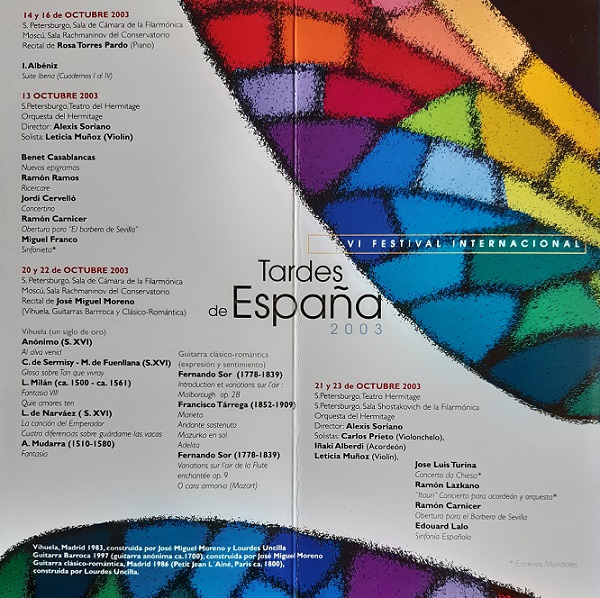
Program of the premiere of the Concerto da Chiesa (St Petersburg, October 21, 2003)

First page of the Concerto da Chiesa
Recording
Premiere recording: Carlos Prieto and Hermitage Orchestra (Cond.: Alexis Soriano)