
The Parnassus Trio (Yamei Yu, violin;
Michael Gross, cello; Chia Chou, piano)
Viaggio di Parnaso
For Violin, Cello and PianoCommentary
Recording
Video
Reviews
Download score
Commentary
Composed between the months of August and November 2005 commissioned by the Autonomous University of Madrid for its cycle of concerts corresponding to the 2005-06 academic year, this trio for violin, cello and piano was born voluntarily conditioned from the beginning both by the learned character of its recipient entity as well as by the name of the group in charge of its first interpretation.
On the one hand, this work brings together a series of aspects related to the transfer to musical composition of elements and procedures from the world of literature. My interest in everything that allows us to relate music and language goes back to my first works, and once a long period focused on the musical use of elements closer to spoken language and its eminently musical aspects has been surpassed, perhaps it opens with this trio another closer to written language, both in terms of what is strictly rhetorical, as well as in what is openly literary and, more specifically, poetic. In this way, the two movements that make up this work reflect from their titles that attempt to bring literary aspects closer: The first is titled Three Oxymorons, and in it they follow one another, without a solution of continuity (to the point that the last two are intertwined), three sections that recreate in one way or another the contradictions referred to by said term, and in which the irreconcilable timbre difference between the strings and the piano serves as a material support for its realization. In the first, Allegro mesto (= joyful sad) two antagonistic ideas are superimposed, represented by the light and fast movement of the piano, on one side, opposite the melody of long notes on the strings, of a certain nostalgic evocation. In Agitato tranquillo (= fluttered calm), strings and piano seem to live in two different conceptual worlds, which is even reflected in the duality of tempi and character: rigorous and well measured for the piano, and very rubato for the violin and cello. Lento presto (= Slow fast) follows a similar treatment, which constitutes a kind of scherzo in which both instrumental groups develop speeches that are clearly far from each other.
For its part, the second movement recreates in its basic formal aspects the strophic structures of a sonnet and some ovillejos, in which each mini-section would be equivalent to a verse of one poetic form or another, but intertwined with each other in such a way that it is practically impossible to distinguish them, so interpenetrated as they are. Only the recurrence of certain thematic materials can shed, at times, some light on the final formal journey.

Cover of the first edition of the Viaje del
Parnaso by Miguel de Cervantes (1614)
On the other hand, the name of the Parnassus Trio itself, in charge of the Madrid premiere of this work and to whom it is dedicated, fits wonderfully with this whole world of rhetorical and poetic artifice that serves as conceptual support for the composition. And playing with Cervantes' Viaje del Parnaso would have been more than enough if it hadn't been for the fact that the reference to an earlier tradition that this long poem implies made even more suggestive the idea of recreating in the same way, starting from the very title, the countless evocations present in music.

Fragment of the Viaggio di Parnasso by Cesare Caporali (1578)
Hence the Italian title of the composition, which thus departs from the work of Cervantes to situate the (nostalgic?) game in the Viaggio di Parnaso, a somewhat shorter poem published in 1578 by Cesare Caporali di Perugia, inscribed in the satirical-allegorical tradition of classical descent, in which an autobiographical narration, in eight chapters, of a fantastic journey to Mount Parnassus, aboard a galley captained by Mercury, undertaken to defend it from the poetasters by many good poets who, gathered together there with Apollo, emerge victorious from the battle. Viaggio where, therefore, we must place the immediate antecedent of the famous Viaje of Miguel de Cervantes.
Viaggio di Parnaso was premiered on March 4, 2006 in the Symphony Hall of the National Music Auditorium in Madrid, within the 33rd Cycle of Great Authors and Performers of Music of the Autonomous University of Madrid. The score is dedicated to its performers, the Parnassus Trio.
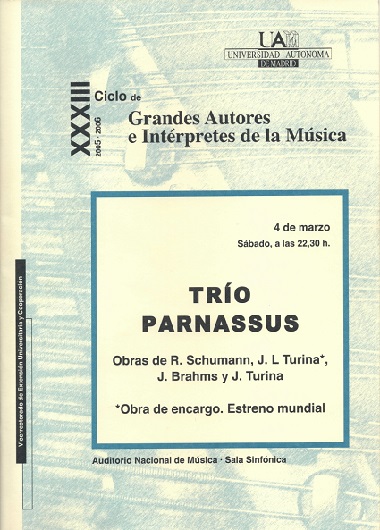

Program of the premiere of the Viaggio di Parnaso
(Madrid, March 4, 2006)
In February 2025 the CD José Luis Turina. Piano trios was published on the SACRATIF label, in which the interpretation of the Arbós Trio includes the works composed up to that date for piano trio: Trío (1983), Three trios (2003) and Viaggio di Parnaso (2005), along with the pedagogical works Compound movement and Tango.

Cover of the CD by the Arbós Trio (2025)

First page of the first movement of Viaggio di Parnaso

First page of the second movement of Viaggio di Parnaso
Recording
Recording: Trío Arbós (CD "José Luis Turina. Piano trios". Sacratif, 2025)
I. Tres oxímoros
II. Soneto y ovillejos
Video
| Cycle "150 anniversary of the Section of Music of the Royal Academy of Fine Arts of San Fernando" Main Hall of the RABASF; September 28, 2023 Ravel Trio (Dobrochna Banaszkiewicz, violin; Suzana Stefanovic, cello; Héctor J. Sánchez, piano) |
Reviews
The wisdom of the dominator of his resources
By Luis Suñén
(Review published in the newspaper El País. Madrid, March 6, 2006)
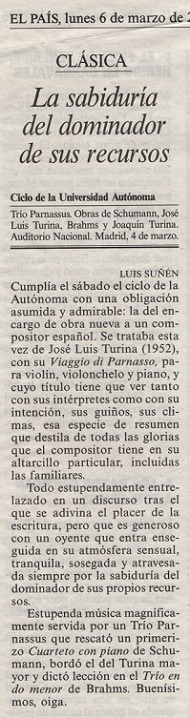
The Autonomous University cycle was completing on Saturday with an assumed and admirable obligation: that of commissioning a new work to a Spanish composer. This time it was José Luis Turina (1952), with his Viaggio di Parnaso, for violin, cello and piano, and whose title has to do as much with its performers as with its intention, its winks, its climates, that kind of summary that exudes all the glories that the composer has in his private altar, including family ones.
All stupendously intertwined in a speech behind which the pleasure of writing can be guessed, but which is generous with a listener who immediately enters its sensual, calm atmosphere, always crossed by the wisdom of the dominator of his own resources.
Stupendous music magnificently served by the Parnassus Trio, which rescued a first-time Piano Quartet by Schumann, nailed that of the Turina major and gave a lesson in the Trio in C minor by Brahms. Very good, listen.
Two Madrilenian masters
By Álvaro Guibert
(Review published in the newspaper La Razón. Madrid, March 8, 2006)
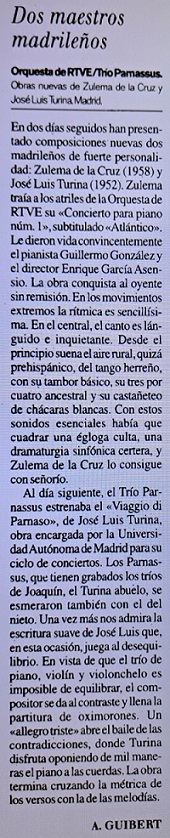
On two consecutive days, two Madrilenians of strong personality presented new compositions: Zulema de la Cruz (1958) and José Luis Turina (1952). [...]
The following day, the Parnassus Trio premiered «Viaggio di Parnaso», by José Luis Turina, a work commissioned by the Autonomous University of Madrid for its concert series. The Parnassus, who have recorded the trios of Joaquín, the grandfather Turina, also devoted the same care to the grandson's. Once again, we are struck by José Luis's gentle writing which, on this occasion, plays with imbalance. Given that the piano, violin, and cello trio is impossible to balance, the composer turns to contrast and fills the score with oxymorons. An «allegro sad» opens the dance of contradictions, where Turina delights in opposing the piano to the strings in countless ways. The work ends by crossing the meter of the verses with that of the melodies.
JOSÉ LUIS TURINA PREMIERES TRÍO
By Arturo Reverter
(Review published in no. 207 of the magazine Scherzo. Madrid, April 2006)
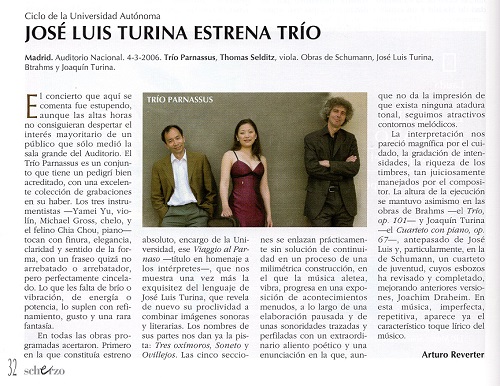
The concert discussed here was stupendous, although the late hours did not manage to arouse the interest of the majority of an audience that only measured the large room of the Auditorium. The Parnassus Trio is an ensemble that has a well-accredited pedigree, with an excellent collection of recordings to its credit. The three instrumentalists -Yamei Yu, violin, Michael Gross, cello, and the feline Chia Chou, piano- play with finesse, elegance, clarity and a sense of form, with a phrasing perhaps not captivating, but perfectly chiseled. What they lack in verve or vibrancy, energy or power, they make up for with refinement, taste and a rare whimsy.
In all the programmed works they were right. First, in what was the absolute premiere, commissioned by the University, thatViaggio al Parnaso -title in homage to the performers-, which once again shows us the exquisiteness of José Luis Turina's language, which once again reveals his proclivity to combine sound and literary images. The names of the parts of it already give us the clue: Three oxymorons, Sonnet and Ovillejos. The five sections are linked practically without a solution of continuity in a process of a millimeter construction, in which the music flutters, vibrates, progresses in an exhibition of small events, throughout a leisurely elaboration and sounds traced and outlined with an extraordinary poetic spirit and an enunciation in which, although it does not give the impression that there is any tonal tether, we follow attractive melodic contours.
The interpretation seemed magnificent to us due to the care, the gradation of intensities, the richness of the timbres, so judiciously handled by the composer.
[...]
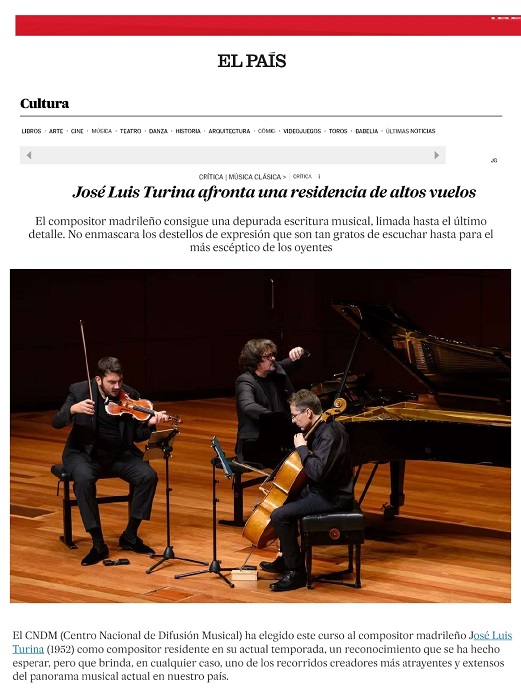
José Luis Turina faces a high-flying residence
By Jorge Fernández Guerra
Review published in the newspaper El País (Madrid, january 17, 2024)