
inicio > discography > CD José Luis Turina. Piano trios

José Luis Turina. Piano trios
Complete music for Piano trio (SACRATIF, 2025)Text of the booklet of the CD
CD presentation video
Radio program
Reviews
Text of the booklet of the CD
José Luis Turina: Piano trios
By Juan Carlos Garvayo
(Text from the booklet of the SACRATIF CD including the complete piano trios by José Luis Turina performed by Trío Arbós)
The surname Turina has played a decisive role in shaping the current Spanish chamber music repertoire through the creation of significant works for classical ensembles, among which the piano trio stands out. If we include the youthful Trio in F by Joaquín Turina, the Sevillian composer wrote a total of four works for this ensemble -a repertoire that, together with his Quartet Op. 67, has been recorded and performed countless times by the Trio Arbós throughout its nearly 30 years of existence. His grandson, José Luis Turina, has also explored the piano trio with excellent results: three major works and two smaller ones attest to this. The relationship between the Trío Arbós and this corpus has also been intense. As dedicatees and first performers of his Tres tercetos, José Luis Turina's trios have been a constant presence in this ensemble's repertoire, now culminating happily in this recording of his complete works for piano trio.
Elémire Zolla states that «tradition is that which is transmitted, especially from one generation to another [...], with the dead being more alive than those in whom their blood circulates, the deluded who can easily invent what is pure revival and create speeches that move with the appearance of novelty, to the extent that the archaic voice that already pronounced them in antiquity is forgotten». Tradition, however, can be understood at different levels or as different «traditions»: from the merely customary in familial, local, or cultural orders to the realm of the great Tradition (with a capital T), which addresses the grand existential questions concerning humanity in its insatiable search for truth and beauty. The aesthetic concerns of Turina himself -like those of any great artist worthy of the name- often revolve around the weight and relevance of tradition in his work. It is no coincidence that his inaugural speech at the Royal Academy of Fine Arts of San Fernando is titled Tradition and Intertextuality in Music, where he advocates for an honest and informed intertextuality (borrowing), considering it a marvelous source of knowledge that, through an enjoyable and natural dialogue with the past not devoid of playfulness, revitalizes tradition.
As early as 1983, a composer just entering his thirties clearly expressed in the notes to his Trio his concerns and aspirations regarding this issue: «Contemporary creation not only does not emerge ex novo, but its validity is given by its more or less explicit reliance on tradition. For that reason, it is compelled to operate in two seemingly contradictory but ultimately complementary directions: toward the future, laying the foundations for a new language through research into new procedures and resources, and toward the projection of the results thus obtained onto the past». Indeed, this early Trio is a masterful first contribution to the genre (considering that José Luis Turina began his musical studies at just 17!). Its three movements explore their relationship with classical musical forms: a canon between violin and cello with calm interjections from the piano; a scherzo for the second movement; and a sort of sonata form for the third. All of this serves as the inseparable framework of a melodic and harmonic language marked by a personal lyrical, expressive, and dramatic imprint. The premiere of this work took place on December 4, 1984, as part of the 7th Chamber Music and Polyphony Cycle at the Teatro Real in Madrid, performed by the now-extinct Trío Mompou, to whom it is dedicated. There are prior phonographic recordings by both this ensemble and the also disbanded Trío Bretón.
Form and content, structure and expressive substance are constants in the work of José Luis Turina. They were also fundamental for his grandfather, who, in his inaugural speech as an academic, wrote that «musical works are built like buildings». Joaquín, a staunch defender of the legacy of his master d'Indy, skillfully twists classical forms to suit his expressive needs. José Luis, moreover, invents them when the artistic purpose requires it. This is the case with Tres tercetos, a work written for the Trío Arbós in 2003. Tres tercetos> is part of a sequence of works preceded by Dos duetos for cello and piano and Cuatro cuartetos for four basset horns. Its architecture emerges from a quasi-fractal concept in which each movement, traced without a break (Trio, Triduo, Triple), develops the elements presented in the previous movement with increasing complexity and duration. The result, in the composer's words, is «a sort of formal zigzag, whose most accurate graphical representation would be that of a large distorted Z». The musical material seethes between intricate and restless counterpoint, a marked rhythmic character, and lyrical passages of a certain stasis. Recognizable motifs and textures appear and disappear at various stages of development, creating a dizzying sensation of a living being in metamorphic process. The highly virtuosic instrumental writing enhances the brilliance of this work, particularly representative of «one of the most fascinating and prolific creators on today's musical scene in our country» (Jorge Fernández Guerra). Tres tercetos was premiered by the Trío Arbós at the 19th Alicante Music Festival on October 2, 2003.
Maurice Ravel titled the second movement of his trio Pantoum, thus alluding to the identification between that Malay-origin verse form and the formal structure of his scherzo. José Luis Turina, in a way, follows this tradition in his Viaggio di Parnaso, linking rhetorical figures (Tres oxímoros) or literary verse forms (Soneto y ovillejos) with his own composition. In the author's words: «This work brings together a series of aspects related to the translation into musical composition of elements and procedures from the literary world. My interest in anything that connects music and language dates back to my earliest works». In the first movement of this work, Turina generates antagonistic ideas ranging from the movement's very title, Allegro mesto (joyful sad), to deliberately divergent musical dynamics between piano and strings: rapid and light piano figurations against the long, nostalgic lines of the strings; strict tempo in the piano and rubato in the strings; or the agitated counterpoint of the strings against the serenity of the piano in the Lento presto. The second movement is perfectly defined by Turina himself: «It recreates in its basic formal aspects the strophic structures of a sonnet and ovillejos, where each mini-section corresponds to a verse of one or the other poetic forms, yet they are so interwoven that distinguishing them is practically impossible». This literary metagame also extends to the title of the work itself, as it references the Trío Parnassus -which premiered the piece on March 4, 2006, at the National Auditorium of Madrid-, linking both to Cervantes' celebrated Viaje del Parnaso and its predecessor, the poem by Cesare Caporali di Perugia, which lends its Italian title to this trio.
The significant work Turina has carried out over the years in the field of musical pedagogy in Spain, first as an advisor to the Ministry of Education and later as artistic director of the Spanish National Youth Orchestra, is reflected in the two works that complete this album. Conceived as repertoire for conservatory students newly introduced to chamber music, Tango has enjoyed enormous popularity in its various versions, from the original 1997 composition for two violins and cello (premiered by his sons Luis and Guillermo) to nearly a dozen transcriptions for different instrumental ensembles, including a piano trio version (2007). Movimiento compuesto, written to celebrate the 50-year professional career of Félix Hazen, references the physics term for the combination or superposition of two or more simple movements. A perfect analogy for the summation of individuals in pursuit of a common goal, defining the beautiful work of true chamber music performers.
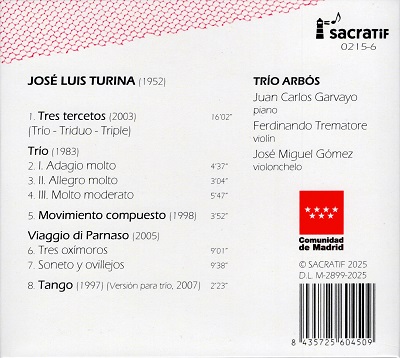
Back cover of the CD José Luis Turina: Piano trios
(SACRATIF, 2025)
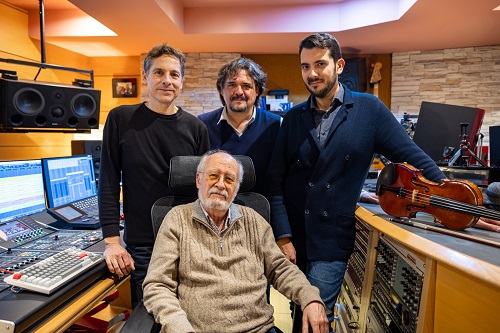
With the Trío Arbós, at the end of the recording (December 6, 2024)
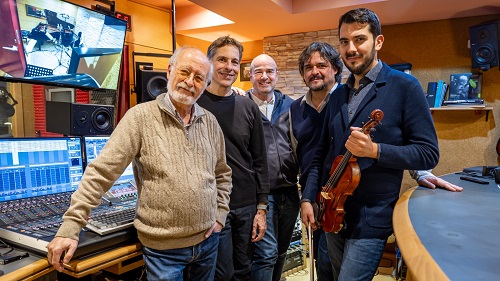
With the Trío Arbós and Javier Monteverde, sound engineer and director of
Cezanne Productions
CD presentation video
| Presentation of the CD in the Auditorium of the Royal Academy of Fine Arts of San Fernando (Madrid, April 22, 2024) Speakers: Juan Carlos Garvayo and José Miguel Gómez (members of the Trío Arbós), Tomás Marco (presentation) and José Luis Turina Youtube link |
Radio program
Interview with Juan Carlos Garvayo conducted by Jesús Trujillo and broadcasted on La Dársena program of RNE Classic Radio on April 24, 2025
Recording
Reviews
The Arbós Trio dedicates its new album to José Luis Turina
(Article published in the online magazine Doce Notas, April 2, 2025)
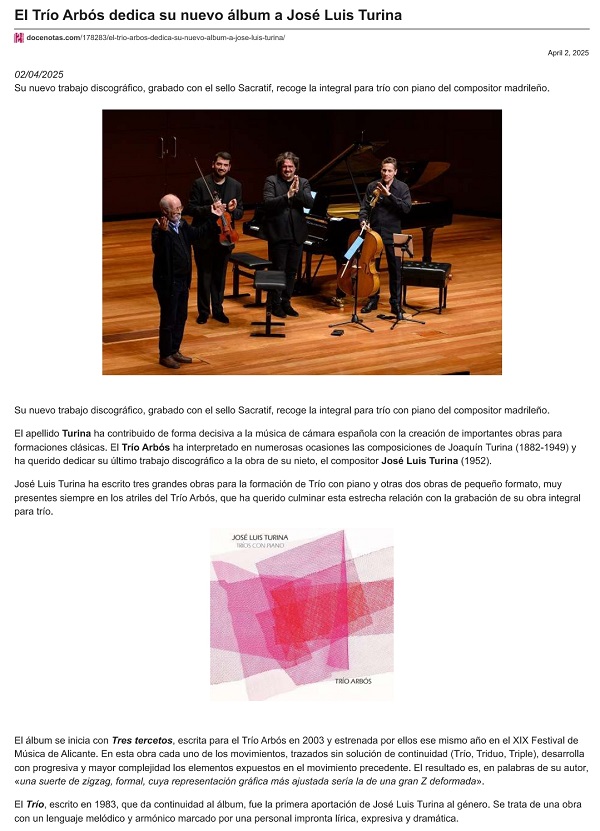
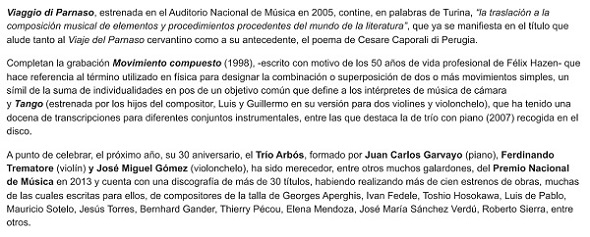
Their new recording, released by the Sacratif label, presents the complete works for piano trio by the Madrid-born composer.
The Turina surname has played a decisive role in Spanish chamber music through the creation of major works for classical ensembles. The Arbós Trio has frequently performed the compositions of Joaquín Turina (1882–1949), and now dedicates its latest album to the work of his grandson, composer José Luis Turina (b. 1952).
José Luis Turina has written three substantial works for piano trio, along with two shorter pieces that have long been a fixture in the Arbós Trio's repertoire. This close relationship has culminated in the recording of his complete works for this ensemble.
The album opens with Tres tercetos, composed for the Arbós Trio in 2003 and premiered by them that same year at the 19th Alicante Music Festival. In this piece, each movement -played without pause (Trío, Triduo, Triple)- develops, with increasing complexity, the material introduced in the previous one. The result is, in the composer's own words, «a kind of formal zigzag, whose most accurate graphical representation would be that of a large, distorted Z.»
Following this is Trío (1983), Turina's first contribution to the genre. This work is marked by a melodic and harmonic language imbued with a deeply personal lyricism, expressiveness, and dramatic flair.
Viaggio di Parnaso, premiered at the National Music Auditorium in 2005, reflects what Turina describes as "the transposition into musical composition of elements and procedures drawn from the world of literature." This is already suggested by the title, which alludes both to Cervantes' Viaje del Parnaso and to its predecessor, the poem by Cesare Caporali di Perugia.
Rounding out the album are Movimiento compuesto (1998) -written as a tribute to Félix Hazen's 50-year professional career-, which refers to the physics term for the combination or superposition of two or more simple movements. It serves as a metaphor for the merging of individualities in pursuit of a common goal, a defining feature of chamber musicians. The final piece, Tango, originally premiered by the composer's sons, Luis and Guillermo, in its version for two violins and cello, has been transcribed a dozen times for various instrumental ensembles. Among these, the 2007 version for piano trio -featured on this recording- is especially noteworthy.
As the Arbós Trio approaches its 30th anniversary next year, the ensemble -comprising Juan Carlos Garvayo (piano), Ferdinando Trematore (violin), and José Miguel Gómez (cello)- has garnered numerous accolades, including Spain's National Music Award in 2013. Their discography includes over 30 albums, and they have premiered more than 100 works, many of them written specifically for the group by renowned composers such as Georges Aperghis, Ivan Fedele, Toshio Hosokawa, Luis de Pablo, Mauricio Sotelo, Jesús Torres, Bernhard Gander, Thierry Pécou, Elena Mendoza, José María Sánchez Verdú, and Roberto Sierra, among others.
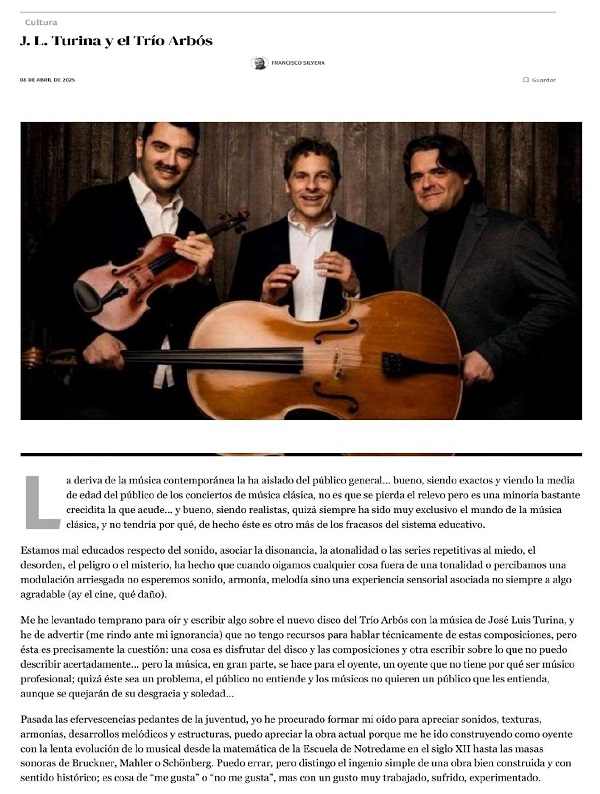
J. L. Turina and the Trío Arbós
By Francisco Silvera
(Review published in the online magazine Diario 16 Plus, April 8, 2025)
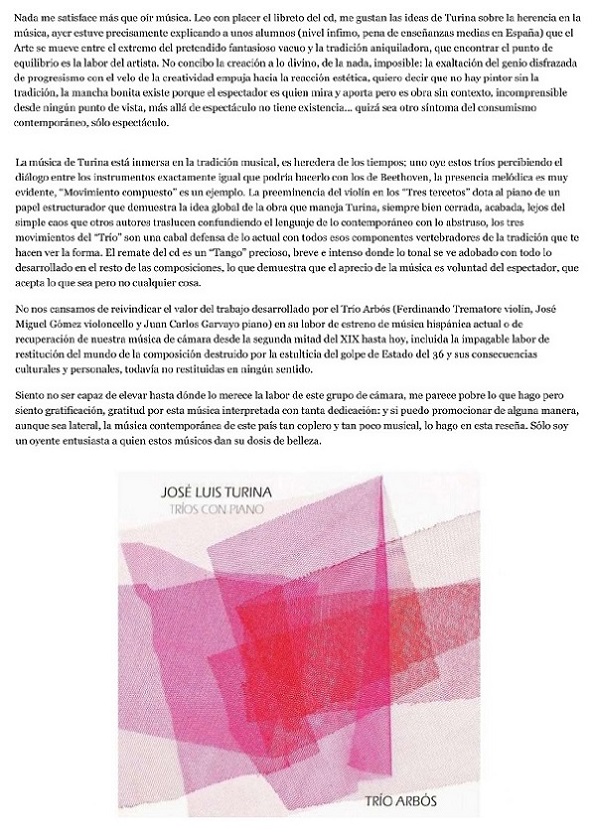
The drift of contemporary music has isolated it from the general public... well, to be precise, considering the average age of classical music concertgoers, it's not that generational renewal is being lost, but rather that the audience is a rather grown-up minority... and well, being realistic, perhaps classical music has always been very exclusive, though it shouldn't be. In fact, this is yet another failure of the education system.
We are poorly educated when it comes to sound. Associating dissonance, atonality, or repetitive series with fear, disorder, danger, or mystery has led to a situation where, when we hear anything outside of tonality or perceive a bold modulation, we don't expect sound, harmony, or melody, but rather a sensory experience not always tied to something pleasant (oh, cinema -how much damage it has done).
I got up early to listen to and write something about the new album by the Trío Arbós featuring the music of José Luis Turina. And I must confess (I surrender to my ignorance) that I lack the technical resources to discuss these compositions in depth. But this is precisely the point: it's one thing to enjoy the album and the compositions, and another to write about something I can't adequately describe… but music, in large part, is made for the listener -a listener who need not be a professional musician. Perhaps that's the issue: the audience doesn't understand, and musicians don't want an audience that does18:36 13/04/2025 understand—though they'll complain of their misfortune and loneliness...
Having outgrown the pedantic fervor of youth, I've made an effort to train my ear to appreciate sounds, textures, harmonies, melodic developments, and structures. I can appreciate today's music because I've built myself as a listener, through the slow evolution of music from the mathematics of the Notre Dame School in the 12th century to the sound masses of Bruckner, Mahler, or Schönberg. I may be mistaken, but I can tell the difference between mere cleverness and a work that is well-constructed and historically meaningful; it's a matter of "I like it" or "I don't," but with a deeply cultivated, hard-earned, and experienced taste.
Nothing satisfies me more than listening to music. I read the CD booklet with pleasure, and I really like Turina's ideas on heritage in music. Just yesterday, I was explaining to some students (very low-level ones -tragically typical of Spain's secondary education system) that Art moves between the extremes of vacuous fantasy and annihilating tradition, and that the artist's task is to find the balance point. I can't conceive of creation as something divine, from nothing -impossible. The glorification of genius disguised as progressiveness under the veil of creativity drives us toward aesthetic reactionism. What I mean is, there is no painter without tradition; the pretty blotch exists because the viewer is the one who observes and contributes, but it is a work without context, incomprehensible from any perspective -it exists only as spectacle, and nothing more... maybe another symptom of contemporary consumerism: just spectacle.
Turina's music is steeped in musical tradition; it is heir to its times. When you listen to these trios, you perceive the dialogue between instruments just as you would with Beethoven's. The melodic presence is very clear –"Movimiento compuesto" is an example. The prominence of the violin in the "Tres tercetos" gives the piano a structural role that demonstrates Turina's overarching vision -his works are always well-rounded, complete, far from the simple chaos that other composers convey by confusing the language of the contemporary with the obscure. The three movements of the "Trío" are a solid defense of the contemporary, containing all those structuring elements of tradition that let you perceive the form. The album ends with a beautiful "Tango", brief and intense, where tonality is seasoned with everything developed in the other compositions -demonstrating that musical appreciation is ultimately a matter of the listener's will: one can accept anything, but not just anything.
We never tire of praising the work carried out by the Trío Arbós (Ferdinando Trematore, violin; José Miguel Gómez, cello; and Juan Carlos Garvayo, piano) in their efforts to premiere contemporary Spanish music and recover our chamber music from the second half of the 19th century to today -including their invaluable work in restoring the world of composition that was destroyed by the idiocy of the 1936 coup d'état and its cultural and personal consequences, which still remain unrepaired in every sense.
I regret not being able to elevate the work of this chamber group to the level it deserves. What I do seems poor, but I feel grateful -gratitude for this music performed with such dedication. And if I can promote, even indirectly, the contemporary music of this country -so full of pop-folk and so little musical- then I do so with this review. I am only an enthusiastic listener to whom these musicians offer a dose of beauty.
The Piano trios of the young Turina
By Pablo Vayón
(Review published in Diario de Sevilla, April 27, 2025)
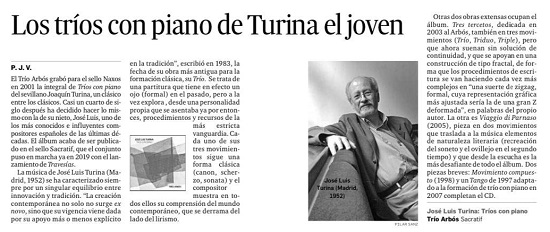
The Trío Arbós records the complete piano trios of Madrid-born José Luis Turina
In 2001, the Trío Arbós recorded for the Naxos label the complete Piano Trios by Joaquín Turina of Seville, a classic among classics. Almost a quarter of a century later, they have decided to do the same with the works of his grandson, José Luis, one of the best-known and most influential Spanish composers of recent decades. The album has just been released on the Sacratif label, which the ensemble launched in 2019 with the release of Travesías.
The music of José Luis Turina (Madrid, 1952) has always been distinguished by a unique balance between innovation and tradition. "Contemporary creation not only does not arise ex novo, but its vitality depends on its more or less explicit grounding in tradition," he wrote in 1983, the date of his earliest work for the classic trio ensemble, his Trio. It is a score that indeed keeps one (formal) eye on the past, while simultaneously exploring -through a personal style already firmly established at the time- techniques and resources from the strictest avant-garde. Each of its three movements follows a classical form (canon, scherzo, sonata), and in all of them the composer demonstrates his understanding of the contemporary world, which leans towards lyricism.
Two other substantial works round out the album. Tres tercetos, dedicated to Trío Arbós in 2003, also structured in three movements (Trio, Triduo, Triple), but performed here without a break, is based on a fractal-type construction, in which the writing procedures become increasingly complex "in a kind of formal zigzag, whose most accurate graphic representation would be that of a large, distorted letter Z", in the composer's own words. The other piece is Viaggio di Parnaso (2005), a two-movement work that incorporates literary elements into the music (recreating the sonnet and the ovillejo form in the second movement) and which, from a listener's perspective, proves the most challenging piece on the album. Two short pieces -Movimiento compuesto (1998) and a Tango from 1997 adapted for piano trio in 2007- complete the CD.
Piano Trios and Quartets: A Spanish chamber music
By Álvaro Guibert
(Review published in section El Cultural of the online newspaper El Español. April 30, 2025)
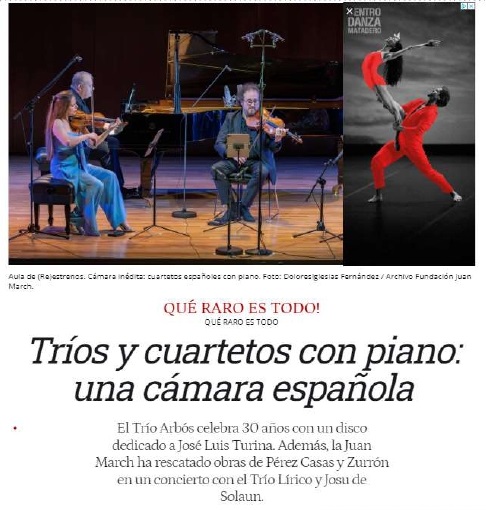
In the world of chamber music, alongside the string quartet -monochrome in its timbre- there are also ensembles with piano (trio, quartet, and quintet), where the disparity in sound and tone color both torments and inspires performers and composers, to the benefit of listeners. In recent days, two major new contributions have emerged from the world of Spanish chamber music with piano.
The Trío Arbós, our great piano trio now celebrating its 30th anniversary, has just released a CD featuring all of José Luis Turina's works for this ensemble -magnificently performed.
The album offers a full portrait of a composer who describes himself as bipolar, capable of composing, depending on the occasion, in a spontaneous and playful manner -as in the flavorful Tango- or with a constructivist and rigorous mindset, within abstract formal frameworks. At times, even arithmetical, as in the case of the Tres tercetos, a true conceptual/musical apotheosis of the number three, of the trinity -or, as Aristotle might say, of "threeness". In this same pursuit of turning numeral adjectives into substantive concepts and probing their essence, Turina has also composed Dos duetos and Cuatro cuartetos. Shifting from arithmetic to logic, in Viaggio di Parnaso, Turina squeezes out the thousand creative possibilities that spring from contradiction. As is well known, if we accept, for example, that 1 equals 2, then we can go on to prove anything else, no matter how absurd it may seem. In art, we might say that the spark produced by the clash of opposites opens the door to nearly everything, as in the sections of the Viaggio titled Allegro mesto (cheerful sad), Agitato tranquillo (agitated calm), or Lento presto (slow fast).
In a more traditionally structured work, such as his Trío from 1983, we also find conceptual flashes. The final movement is titled Molto moderato (very moderate), and it follows two extreme pieces of music: one very slow, Adagio molto, and another very fast, Allegro molto. We call something "moderate" when it is not "very" anything. Moderate is the opposite of "very", but then, what is very moderate?
In any case, the great contradiction in Turina's music -the clash that enriches and enlivens it- is that, for some reason, the conceptual rigor of his structure always reaches the listener with uncommon expressive power. I would say Turina's bipolarity is, in fact, simultaneous, because rather than alternating, his Hyde and Jekyll sides (hard and soft, solid and fluid, serious and entertaining) usually appear at the same time. The Tango, for example, while playful, is astonishing in its construction. Turina is a double composer and, for that very reason, a unique one. He is double, like the Baroque dance from which that name comes -always appearing in mirrored form, recto and verso.
[...]
Living musical history
By Miguel Ángel Pérez Martín
(Review published in the online magazine Doce Notas, May 17, 2025)
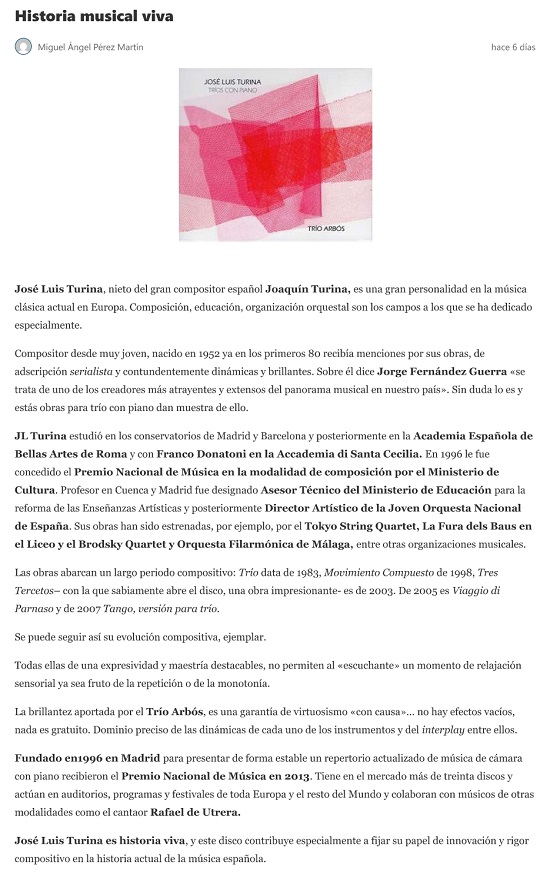
José Luis Turina, grandson of the great Spanish composer Joaquín Turina, is a prominent figure in today's European classical music scene. Composition, education, and orchestral organization are the fields to which he has especially dedicated himself.
A composer from a very young age, born in 1952, by the early 1980s he was already receiving recognition for his works -serialist in style, powerfully dynamic, and brilliant. Jorge Fernández Guerra says of him, "he is one of the most engaging and wide-ranging creators on the musical scene in our country". Without a doubt, he is, and these works for piano trio are proof of that.
J.L. Turina studied at the conservatories of Madrid and Barcelona, and later at the Spanish Academy of Fine Arts in Rome, as well as with Franco Donatoni at the Accademia di Santa Cecilia. In 1996, he was awarded the National Music Prize in the composition category by the Ministry of Culture. A professor in Cuenca and Madrid, he was appointed Technical Advisor to the Ministry of Education for the reform of Artistic Education, and later became the Artistic Director of the Spanish National Youth Orchestra. His works have been premiered by, among others, the Tokyo String Quartet, La Fura dels Baus at the Liceu, and the Brodsky Quartet with the Málaga Philharmonic Orchestra.
The works included span a long compositional period: Trío dates from 1983, Movimiento Compuesto from 1998, Tres Tercetos -wisely chosen to open the album and an impressive piece- is from 2003. Viaggio di Parnaso is from 2005, and Tango, in its piano trio version, from 2007.
His compositional evolution, exemplary in nature, can clearly be traced through them.
All the pieces are notable for their expressiveness and mastery, offering no moment of sensory relaxation -neither through repetition nor monotony.
The brilliance brought by the Trío Arbós guarantees virtuosic performance "with purpose"… there are no empty effects, nothing is gratuitous. A precise command of each instrument's dynamics and of the interplay between them is evident.
Founded in 1996 in Madrid to establish a consistent platform for a contemporary piano chamber music repertoire, Trío Arbós received the National Music Prize in 2013. They have released more than thirty albums and perform in concert halls, on programs, and at festivals throughout Europe and beyond. They also collaborate with musicians from other genres, such as flamenco singer Rafael de Utrera.
José Luis Turina is living history, and this album significantly contributes to securing his role of innovation and compositional rigor in the contemporary history of Spanish music.
José Luis Turina. Piano Trios (Melómano de Oro)
By Laura Núñez del Campo
(Review published in Melómano magazine, June 2025)
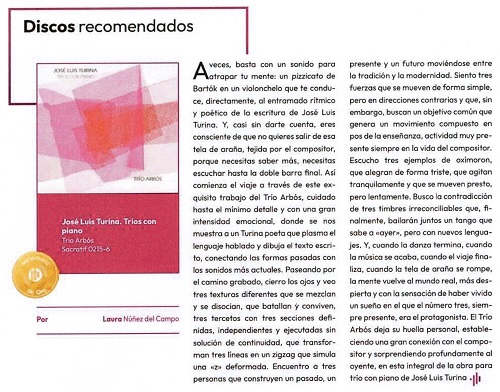
Sometimes, a single sound is enough to capture your mind: a pizzicato by Bartók on a cello that leads you straight into the rhythmic and poetic fabric of José Luis Turina's writing. And almost without realizing it, you become aware that you don't want to escape that spider's web spun by the composer, because you need to know more -you need to listen all the way to the final double bar. Thus begins the journey through this exquisite work by the Trío Arbós, meticulously crafted down to the smallest detail and imbued with deep emotional intensity, where we encounter a poetic Turina -one who gives voice to spoken language and sketches written text, bridging past forms with the most current sounds. As I wander down this recorded path, I close my eyes and see three distinct textures blending and separating, clashing and coexisting -three trios with clearly defined sections, independent and played without interruption, transforming three lines into a zigzag that resembles a distorted «z». I find three individuals building a past, a present, and a future as they navigate between tradition and modernity. I feel three forces moving simply, yet in opposing directions, and still pursuing a shared goal -a compound motion aimed at teaching, an activity that has always played a central role in the composer's life. I hear three examples of oxymoron -joy that is tinged with sadness, stillness that stirs, music that moves swiftly yet slowly. I seek the contradiction of three irreconcilable timbres that, in the end, come together to dance a tango that tastes of «yesterday», though spoken in new languages. And when the dance ends, when the music fades, when the journey concludes, when the spider's web breaks, the mind returns to the real world -more awake and with the feeling of having dreamed a dream in which the number three, ever present, was the true protagonist. The Trío Arbós leaves its personal mark, establishing a profound connection with the composer and deeply moving the listener in this complete recording of José Luis Turina's works for piano trio.