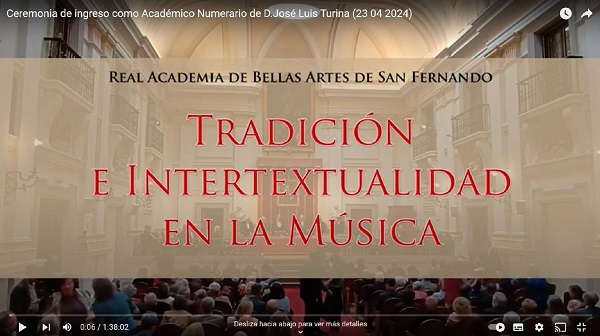

Tradición e intertextualidad en la música / Tradition and intertextuality in music
Entrance speech as Full Member of the Music Section of the Royal Academy of Fine Arts of San Fernando, delivered on April 23, 2023Reply by José Ramón Encinar
Download PDF of the speech
Score of the Elegy (in memory of Antón García Abril)
Recording
Video
To Pilar,
from truth
For the artist, the most difficult thing is not to achieve the innocence and freshness of childhood. The hardest thing is to create within a tradition; to expand the momentum and richness of its current.
(Auguste Rodin. Quoted by Fernando Zóbel in Notebook, Galería Juana Mordó, Madrid 1974)
Fora de la Tradició, cap veritable originalitat.
Tot lo que no és Tradició, és plagi.
(Eugenio d'Ors, "Glosari, Aforística de Xènius," XIV, La Veu de Catalunya, 31-X-1911)
Masterpieces are not single and solitary births; they are the outcome of many years of thinking in common, of thinking by the body of the people, so that the experience of the mass is behind the single voice.
(Virginia Woolf, A Room of One's Own, chap. 4 [trans. Guillermo Tirelli])
INTRODUCTION
Ladies and gentlemen of the Academy, ladies and gentlemen:
As I take possession today of a seat as a full member of the Music Section of the Royal Academy of Fine Arts of San Fernando, I am overcome by many varied emotions and reflections. Among them is my gratitude to those who proposed me at the time -until now merely colleagues and friends, and from today also companions within this Institution. I enter thanks to the trust placed in me by a magnificent performer and pedagogue, Joaquín Soriano; a distinguished writer, director, and screenwriter, Manuel Gutiérrez Aragón; and a rigorous musicologist and often-feared critic, José Luis García del Busto. I publicly thank the three of them for the confidence they once showed in nominating me, and in fair reciprocity I commit myself not to disappoint them in the fulfillment of the tasks entrusted to me in the future.
No less moving is the thought of those who preceded me in holding Medal No. 30, which will be bestowed upon me at the end of this ceremony. In 1901 it was awarded to Emilio Serrano; in 1943, to Father Nemesio Otaño; in 1958, to guitarist Regino Sáinz de la Maza; and in 1983, to Antón García Abril, whom I have the great honor of succeeding.
This moment also intertwines with the fact that my grandfather, the composer Joaquín Turina, held a seat in this very Academy with Medal No. 19, having been appointed to the vacancy left by the resignation of Manuel de Falla. He was officially admitted in August 1939 and held it until his death ten years later. The medal was then passed on to Benito García de la Parra, and from 1956 until his death in 1973 it belonged to Julio Gómez, who became related to my grandfather through the marriage of one of his daughters, Concha, to my grandfather's eldest son, Joaquín -thus strengthening a bond that was not only professional but also familial, one of which I am part together with the other members -brothers and cousins- of the generation of the children and grandchildren of those two great artists.
In addition to sharing the same medal, Julio Gómez also succeeded my grandfather as professor of composition at the Royal Conservatory of Madrid, where in the early 1950s he taught, among many other students, Antón García Abril, who in turn succeeded him in the chair beginning in 1971. In García Abril's own words, Julio Gómez "was a teacher who taught you the humanity of music" above and beyond any particular technique or aesthetic. And that, precisely, would be my own assessment of my years (1977–1981) under the composition chair of Antón García Abril -years of vertigo, in which the conclusion of my academic training overlapped with the public presentation of my first works as a composer, so closely intertwined that in my memory the end of one stage and the beginning of the next have merged into a single continuum.
Antón García Abril was a great teacher in that sense. In just a few early sessions, he could detect the potential of each and every student before him, and in a certain way he adapted the rigor of his teaching to the particularities, requirements, and aims of each one. Perhaps he did not teach, as he said of Don Julio, "the humanity of music," but he certainly taught "with humanity", bringing to his classes a manner at once personal and personalized, tailored to the needs of his students.
After completing my academic studies, and following a four-year interlude as professor at the Conservatory of Cuenca, from 1985 onward we became colleagues on the faculty of the Royal Conservatory of Music of Madrid. That, together with many activities we shared as colleagues (concerts, interviews, talks and round tables, juries in various composition competitions), laid the foundation for a fine friendship and excellent professional rapport -both of which endured until the pandemic cut us off physically and, sadly, ended his life on March 17, 2021.

With Antón García Abril
(Madrid, National Auditorium, February 24, 2017)
Given the importance of his vast output, fortunately well known and widely disseminated, I do not think it necessary to dwell here further on his figure as a composer of so many and diverse facets; instead, I have preferred to focus on my memory of him as a person and to highlight, above all, the final occasions when we had close contact. All of these took place in the context of the Spanish National Youth Orchestra, of which I was artistic director from February 2001 to March 2020, and in which we welcomed Antón García Abril as guest composer at the September 2002 session (with the premiere of his concerto for two pianos and orchestra Iuventus); at the January 2009 session (with the performance of The Sea of Calms); and at the January 2014 session (with the Three Scenes from the Ballet "La Gitanilla"). On all three occasions I was a firsthand witness to the joy he felt at being able to spend a few days in close coexistence with the orchestra, supervising rehearsals, conversing with the performers, and sharing in the end a resounding success thanks to the young musicians' talent, the intrinsic worth of his works, and the deep rapport that emerged in just a few days between composer and performers. He was a happy composer who knew how to show gratitude for the commitment of his interpreters, giving of himself entirely to them. I will never forget his presence at the JONDE in those three working periods, just as I am certain none of those fortunate enough to share in his mastery -and his humanity- will forget it either.
For all these reasons, to deliver now this inaugural address in order to take up the seat left vacant by his passing, in the very place where nearly thirty years ago I heard him read his Defense of Melody upon taking possession of Medal No. 30 of this Royal Academy, only a few months before the 150th anniversary of the creation of the Music Section that I now join, is for me an immense honor, filled also with memories, emotion, and profound affection for his memory.
|
* * * |
I. TRADITION, PLAGIARISM, AND PASTICHE
Of the countless subjects on which I could have focused this address, I have chosen the one that would undoubtedly be the topic of my doctoral thesis -if, in some unlikely future circumstance, I were ever to write one. For that reason, it seems fitting to take it up here. What follows would not constitute part of such a thesis, but rather serves as a kind of "statement of reasons," or a simple declaration of the intentions that move me now, and would move me if ever I were to approach something of greater depth.
Moreover, as with any creative act, this address has arisen from a need for self-exorcism, to free myself through writing from certain memories and obsessions that had long pursued me and could only be brought to an end by setting them down on paper. There are many of these, but here I will concern myself with only two; and to do so properly, I must go back to as distant a time as June or July of 1963 or 1964 -when I was about eleven or twelve years old. One morning, returning with my father to the family home at No. 7 Alfonso XI Street after a walk through El Retiro, as we passed along the right-hand façade of the Casón, my father, pointing toward the upper part of the building, said to me: "Look at what it says there." I raised my eyes and read, inscribed on the frieze above the first-floor windows: "Everything that is not tradition is plagiarism". At that time I was scarcely twelve years old. I did not know that the author of that phrase was Eugenio d'Ors, and of course I did not understand the meaning of such a categorical statement. Almost sixty years later, I am still not entirely sure that I have fully grasped it, but I am certain that it has given me much to ponder. What helped me find some sense in it was reading, many years later, the complete aphorism, of which until then I had known only the second half -the one carved on the Casón's frieze: "Outside tradition there is no true originality. Everything that is not tradition is plagiarism". The first part "explains" the second, and although d'Ors's reasoning is highly debatable -since aphorisms are never more than half-truths- there is no doubt that its forcefulness is so overwhelming that it can persuade the reader that it is, in fact, an axiom. In any case, it is not so much the severity of the word plagiarism that draws me, but rather the weight that d'Ors assigns to tradition as the necessary starting point for the emergence of something new.

As for the second obsession I wish to exorcize in this speech, I must return to June 2, 1984 -the date of the death in Rome of the painter Fernando Zóbel, with whom I had struck up a friendship during my years as a professor at the Conservatory of Music of Cuenca, a city where he alternated his residence with Madrid for many years. His love of music -he himself played the flute with considerable competence- brought us together at numerous concerts, and especially in the evening gatherings that lasted until the early hours of the morning in Plaza Mayor de Pío XII, after the classes and recitals of the two summer courses I was tasked with organizing, as secretary of the Conservatory, in 1982 and 1983. Zóbel was a beloved figure in Cuenca, both in the select artistic milieu and in the broader popular sphere. It was therefore no surprise that, days later, his mortal remains were received with an overwhelming silence by a massive crowd gathered before the Cathedral, where Monsignor Federico Sopeña -who some years afterward would hold the position of Director of this Royal Academy- officiated the funeral. At its conclusion, virtually the entire population of Cuenca walked in procession -always in the deepest silence- to the San Isidro cemetery, where he was buried in a breathtaking site overlooking the gorge of the Júcar River. (As the tombstone was being sealed, Father Sopeña whispered in my ear, not without a touch of dark humor: "What a place to resurrect!")

Just a few days earlier, the direction of the Cuenca Semana de Música Religiosa had entrusted me with the commissioned work for the 1985 edition, the Festival's no. 24th. And it was precisely during the procession that accompanied on foot the mortal remains of Fernando Zóbel to the San Isidro cemetery that the seed emerged of the work on which I would labor in the months to come: a Requiem Mass, which ultimately bore the title Exequias (In memoriam Fernando Zóbel), whose final movement -following the customary six (substituting, however, the formidable "Dies Irae" sequence with a hopeful "Alleluia", as prescribed by the new liturgy) was a Procession to the cemetery.
Exequias was written for a chamber choir (20 voices) and a small orchestra of 25 players. Each movement was preceded by the Gregorian chant of the requiem mass, subsequently developed -sometimes purely instrumentally, at other times with interventions by the mixed choir. Only in the final movement did the Gregorian choir join the ensemble. Yet what was most significant was that Gregorian chant permeated to a great extent the instrumental, or choral-instrumental, movements. Thus, in the opening Introit, an 11-part ricercare for strings was interrupted in the central section by the presence of Te decet hymnus, Deus in Sion, reworked atonally; in the third movement, an essentially choral Alleluia, the Gregorian chant previously sung by the male choir gave way to an extensive section in which the long melismatic melody of the Alleluia, sung in unison by the full mixed choir, unfolded and accompanied itself, creating a complex 20-voice polyphonic fabric; in the Offertory, a Gregorian melody was harmonized tonally, alternating with string passages written in strict dodecaphony, in a sort of deliberately strained chorale-variation through the coexistence, in the foreground, of the atonal, the tonal, and the modal. And in the final movement, Processio ad coemeterium, it was the Gregorian choir itself that joined the mixed choir to maximize the presence of the liturgical chant that served as its foundation.
The premiere, held on Holy Wednesday, April 3, 1985, in the Old Church of San Miguel in Cuenca, featured an outstanding performance by the Coro Villa de Madrid, the Schola Gregoriana Hispana, and the Madrid Symphony Orchestra, all conducted by José Ramón Encinar. It was met with great success from the audience, as well as in the reviews of the leading press of the day. Yet within a few days, I heard echoes of a critique circulated in a very specialized sphere, virtually confined to the festival itself. According to its author, Exequias was nothing more, aesthetically, than a "pastiche" -well crafted thanks to its technical values, but a pastiche nonetheless.
A pastiche! The blow was devastating. At that moment, the word carried for me all the pejorative weight it had accumulated over decades, and none of its virtues -and that was, without a doubt, the critic's intention in applying it. For a long time I lived haunted by this idea, which, owing to my lack of experience and self-assurance, cast serious doubt upon the validity of my aesthetic position and, with it, upon the music I had written and the much more I still had yet to write. Composed at barely 32 years of age, Exequias was without question my most ambitious work in scale, though others of smaller dimensions had demanded no less effort, and in them too I had reworked elements from the past. Were those also pastiche? Suddenly, everything I had done up to that point was shaken, to the extent that I even considered whether I should radically change my aesthetic convictions -or cease composing altogether.
Fortunately, that period, though intense, was not excessively long, and though painful at first I am now glad, with the perspective of time, to have overcome it, for it helped me to relativize the environment around me and thus my place within it. Because of my late vocation -I began studying music at the age of seventeen, when at that age it would have been desirable to begin higher studies- it fell to me to come of age as a composer at a time of full "postmodernity", when a small crack was opened through which the concepts of nostalgia and melancholy -hitherto proscribed- soon slipped in, allowing for a return in artistic creation to a certain "humanization" (to borrow Ortega's term), and music was no exception.
After listening repeatedly to the recording of my work and searching for every possible aesthetic justification, I soon began to ask myself whether the problem raised by the critic who reproached me for having composed a pastiche really lay in my music, or whether it was rather to be found in a set of prejudices accumulated over decades concerning that term. A little more than two centuries earlier, pastiche had been a common practice, sanctioned by custom and even "demanded" by audiences who only asked composers to stitch together a spectacle whose plot and music would allow them to enjoy their favorite singers, without much caring about the provenance or authorship of what was sung. As a result, we have, for example, more than a dozen titles of pastiche operas signed by Händel, a composer whose own works, in turn, were "dismantled" after his death by later composers who did not hesitate to do with his arias and choruses exactly what he had himself done, with enormous success, with those of earlier authors.
That practice of that form of pastiche eventually fell into disuse, and the term soon acquired the pejorative connotations with which it is applied when, as in the case of Exequias, it is used to criticize the employment of elements extraneous or heterogeneous to the act of original creation by someone who nevertheless works with them to forge an entirely new work -one in which recognizable elements of tradition, both popular and cultivated, converge, in what amounts to a form of acknowledging their importance by conferring upon them "posterity" through their insertion into later works. Even the Royal Spanish Academy seems to reinforce this pejorative sense, when in its primary definition it describes pastiche as imitation or plagiarism -thus assimilating both concepts and leaving no room for even the slightest nobility in its use as a creative procedure. It is in this latter sense, however, that I have sought to embrace it in much of my later work, fully convinced that I was doing the right thing in using it so as always to endow the resulting composition with a valid meaning. This is the very same aesthetic line in which, in the second decade of the last century, a new nationalism -cultivated rather than popular in origin- was initiated by Manuel de Falla, who, following the path intuited by Pedrell, in his Retablo de Maese Pedro did not hesitate to look back to Spain's Renaissance and Baroque past and, by wisely combining them with his own highly personal language, to create one of the most original works of the time, thereby opening the door to a practice -the use of cultivated tradition- that has since persisted in Spanish composition, in parallel with what has taken place elsewhere in the world (let us recall that El retablo coincides in time with Stravinsky's Pulcinella). Thus Guerrero, Correa de Arauxo, Cabanilles, Mudarra, Victoria, Bruna, Soler, Scarlatti, Boccherini... have become companions in the journey of several generations of Spanish composers -myself included- who over the last hundred years have occasionally cultivated what we now euphemistically call borrowingpastiche has accrued over decades.
II. MUSIC AND TEXT
Borrowing (préstamo, in Spanish) is, without a doubt, a word destined for great success -not only because its use is still so recent that it has not yet become tainted with disrepute, but also because, although initially reserved for the field of literature, it proves perfectly applicable to a broader context. Just as the English term originally derives from the linguistic practice of borrowing words from another language for use in one's own, so too it is quite common in the history of Literature to extend the same practice to a larger text for its incorporation into a different context, with which it may maintain various types of relationships depending on the degree of resemblance and on its greater or lesser functionality. In this case we speak of intertextuality, an ancient practice whose concept within literary theory is relatively recent, and one that by analogy can be extended to any of the other arts.
And it becomes evident -and we musicians are privileged in this respect- that the purest application of the concept of intertextuality in its literary sense is to be found precisely when the abstract meaning of musical discourse is enriched by the concrete meaning of a text, in an absolute symbiosis between the two codes. Music and language share a natural synaesthesia, to the point that it could even be claimed that the former derives from the latter -or at least that both spring from a common root; this is masterfully recreated at the end of Chapter 23rd of Los pasos perdidos, where Alejo Carpentier places in the mouth of the Cuban musicologist who narrates his novel what I consider the best description of the mythical origin of music:
|
[...] But suddenly everyone starts to run. Behind me, beneath a tangle of leaves hanging from branches that serve as a roof, they have just laid down the swollen, blackened body of a hunter bitten by a rattlesnake. Fray Pedro says he has been dead for several hours. Nevertheless, the Sorcerer begins to shake a gourd filled with pebbles -the only instrument these people know- in an attempt to drive away the emissaries of Death. There is a ritual silence, a silence that prepares for the incantation and carries the expectation of those waiting to its very peak. And in the vast jungle, filled with nocturnal terrors, the Word emerges. A Word that is already more than a word. A word that imitates the voice of the speaker, and also the one attributed to the spirit inhabiting the corpse. One comes from the enchanter's throat; the other, from his belly. One is deep and murky, like the underground bubbling of lava; the other, of medium pitch, angry and harsh. They alternate. They answer each other. One rebukes when the other groans; the belly voice turns sarcastic when the one from the throat seems insistent. There are guttural portamentos stretched into howls; syllables that suddenly repeat themselves again and again, creating rhythm; trills abruptly cut by four notes that form the embryo of a melody. But then comes the vibration of the tongue between the lips, the inward snore, the offbeat gasping over the rattle. It is something that lies far beyond language and yet is still far removed from song. Something that ignores vocalization, yet is already more than word. When prolonged, it becomes horrible, dreadful -that clamoring over the corpse surrounded by mute dogs. Now, the Sorcerer confronts it, bellows, strikes his heels against the ground, in the rawest outbreak of a malediction that is already the profound truth of all tragedy -the primordial attempt to struggle against annihilating forces that obstruct man's designs. I try to hold myself apart, to keep my distance. And yet I cannot escape the ghastly fascination this ceremony exerts upon me... Before the stubbornness of Death, which refuses to release its prey, the Word suddenly softens and loses heart. From the mouth of the Sorcerer, the Orphic enchanter, the Threnody rattles and falls convulsively -for such, and nothing else, it is a threnody- leaving me dazzled by the revelation that I have just witnessed the Birth of Music. |
For many years I studied this aspect of language in depth, with the aim of understanding it in order to draw consequences applicable to the setting of a text to music. I focused particularly on melodic aspects and on the logic that governs the chain of accents which gives speech its meaning -whether declarative, interrogative, exclamatory, or conclusive to varying degrees. And, applying an eminently musical ear rather than a linguistic one, I thought I understood the mechanism of speech that precedes the emission of an accent and allows it to be shaped exclusively by melodic means, and not at all by rhythmic or dynamic ones, as is so often claimed. To know that microscopic aspect of speech, as well as the macroscopic aspect of the succession of intonation according to the sense of discourse, allowed me to draw a series of conclusions which, while respecting the principal melodic lines of the text, permitted their controlled manipulation for artistic purposes, so that speech and song might mutually enhance one another.
Throughout my career I have composed many vocal works, but there are two in particular that I enjoyed the most, and which best illustrate the model of intertextuality that interests me: that which occurs in the texts themselves, and that which arises as a result of setting them to music. The first dates back to 1992, when the Department of Romance Languages at Colgate University in New York commissioned me to write a work for voice and a small chamber ensemble to commemorate the 500th Anniversary of the Discovery of America. The result was a cycle entitled Three Sonnets, in which I turned my attention to our undoubtedly most celebrated poets of the "Golden Age" (Lope de Vega, Góngora, and Quevedo), until I found a text by each of them that astonished me with its modernity, and which therefore proved especially attractive as the basis for a contemporary work.
The first of the sonnets, by Lope de Vega, constitutes a perfect example of absolute pastiche, insofar as not a single verse in it belongs to Lope himself. Rather, in a display of culture, technique, and ingenuity, he gathers different verses from Horace, Ariosto, Petrarch, Camoens, Tasso, Il Serafino, Boscán and Garcilaso, and stitches them together into a rigorous sonnet that he makes his own by assigning it number 112 of his Rimas (1602).
|
HORACIO, ARIOSTO, PETRARCA, CAMOES, TASSO, EL SERAFINO, BOSCÁN Y GARCILASO Le donne, i cavalier, le arme, gli amori, en dolces jogos, en pracer contino, fuggo per piú non esser pellegrino, ma su nel cielo in fra i beati chori; dulce et decorum est pro patria mori: sforçame Amor, Fortuna, el mio destino; ni es mucho en tanto mal ser adivino, seguendo l'ire e il giovenil furori. Satis beatus unicis Sabinis, parlo in rime aspre, e di dolceza ignude, deste pasado ben que nunca fora. No hay bien que en mal no se convierta y mude, nec prata canis albicant pruinis, la vita fugge, e non se arresta un ora. |
|
HORACE, ARIOSTO, PETRARCH, CAMOENS, TASSO, IL SERAFINO, BOSCÁN, AND GARCILASO The ladies, the knights, the arms, the loves, in sweet games, in endless pleasure, I flee, so as never again to be a pilgrim, but rather up in heaven among the blessed choirs; It is sweet and fitting to die for one's country: Love, Fortune, and my destiny compel me; nor is it much, amid such evil, to be a seer, pursuing anger and youthful passions. Happy enough with my modest Sabine fields, I speak in harsh rhymes, stripped of sweetness, of that past good that never truly was. There is no good that does not turn and change to evil, Nor do the meadows of the dog turn white with frost, life flees, and does not pause for even an hour. |
The second work I referred to earlier is my opera D. Q. (Don Quijote in Barcelona), with a libretto by Justo Navarro based on a stage conception by La Fura dels Baus. In it are found the greatest number of the many and varied intertextual experiences I have had throughout my professional life. Beyond those contained in the libretto itself -which so often falls into parody of El Quijote just as El Quijote parodied the chivalric romances whose reading ultimately drives its protagonist mad- there are also inserted into the music quotations and turns of phrase in which the cultivated listener will easily recognize bursts and fragments drawn from Tristan und Isolde, Parsifal, Das Rheingold, The Marriage of Figaro, Madame Butterfly... and even El Retablo de Maese Pedro, among others. Sometimes this is done with a parodic intention, if one wishes, but also as homage or as a reflection on opera as a genre.
Obviously, this is not the proper place to discuss the entirety of that intertextual treatment, but I cannot omit what was undoubtedly for me the most interesting experience -or perhaps the most fitting adjective would be curious-, since I only knew of its existence because José Bergamín had told me about it one August afternoon in 1979, when I visited him at his residence on the Plaza de Oriente to ask his permission to use one of his poems in my work for voice and piano Epilogue of the mystery. I no longer remember clearly in what context, but in the lively conversation that followed the signing of the authorization, he told me several things that powerfully caught my attention, one of them concerning the so-called "monstruos", or false texts with which the composer indicates to the librettist the placement of words and accents, so that once replaced by the definitive text they may be fitted to a previously composed melody as the final lyrics of the piece. And he concluded the matter by saying: "There were monstruos that in the end turned out to be far more ingenious than the text with which the music was later published".
And although in that summer of 1979 my conversation with Bergamín was as entertaining as it was enlightening, I never imagined that some years later -almost twenty- I myself would live through a very similar experience. In the summer of 1998 I had already completed the composition of the first act of D. Q., which was scheduled to premiere at the Gran Teatre del Liceu in Barcelona in October 2000. Throughout that first act, set in a very distant future, Don Quijote is purchased at an auction house in Geneva by a Hong Kong billionaire as a gift for his daughters, who in the second act display him in their private "garden of monsters" located on the terrace of a skyscraper. Imprisoned in a cage "of air and time" (which ultimately became the structure of a zeppelin in the fabulous stage design of the late Enric Miralles), Don Quijote sings from within it his aria of nostalgia for the time in which he once lived, from which he has been torn away in order to be carried into a future world with which he shares nothing.

Justo Navarro
Well then, after having the music of the aria fully composed and fixed in my mind, weeks later I still had not received the text that the protagonist of the opera was supposed to sing in that fundamental section. Pressed by deadlines (we were little more than a year and a half from the premiere), and after repeatedly urging Justo Navarro about the urgency of delivering to me both the aria text and the remainder of the libretto, we finally decided to resort to a "monstruo". For this purpose, he asked me not to give him words or phrases that might condition him, but rather simple sequences of numbers, organized into verses in which the rhythm and internal accents -the métrica, in a word- of the final text would be clear. As an example, this was the sequence I handed him for the first three opening verses of the aria:
|
Three-Two-Three-Six, Thirteen-Fourteen-Fifteen-Sixteen Thirty-Twenty |
|
I know who I am, And I am not who I wish to be, And I know it. |
|
-"I know who I am, and I know that I can be, not only those I have mentioned, but all Twelve Peers of France, and even all Nine Worthies of Fame; for to all the feats they together, and each individually, accomplished, mine shall stand superior". |
This sample of my vocal work is minimal, as befits this session, but I hope it is sufficiently eloquent of the spirit that guides me when choosing the right text to be set to music, and of the ways in which literature and music can weave powerful intertextual relationships -not only with regard to the logic of their discourses, but also in their shared approach to the final artistic product.
II. BORROWINGS, OUR OWN AND OTHERS'
At this point in my remarks, it should already be clear that the ideas I am presenting have been circling in my mind for many years. Yet the springboard that gave them the necessary momentum to be addressed here came from two relatively recent events -both took place in 2021- which, though independent, are closely related. Each stands as proof that the history of art is shaped by a few hundred brilliant artists, creators of thousands of masterpieces, whom the tens of thousands of mere mortals who also make art simply aspire to resemble. For that reason, the pride and vanity of the greatest are easily forgiven, while their occasional humility is all the more admirable. In any case, my intention in bringing forth these two illustrious examples is simply that they lend their authority in support of the thesis of this discourse.
The first does not come from music but from painting, and its origin lies in the exhibition "Mythological Passions", organized by the Museo del Prado in the spring of 2021, where Velázquez's Las Hilanderas (The Spinners) was displayed beside Titian's original Rape of Europa. As we know, Velázquez's canvas is an unmistakable tribute to great artists who preceded him and whose work he deeply admired. Of the three planes that make up the composition, in the first we find a clear reference to two of the ignudi from the Sistine Chapel ceiling by Michelangelo -an insight revealed to us by Diego Angulo Íñiguez, a former academic of this institution. In the second plane, we witness a scene in which three noblewomen look on as Minerva condemns Arachne to spin forever, like a spider. Lest the reference be overlooked, Velázquez places at the foreground of this scene a viola da gamba seen from behind -a clear allusion to Music as a remedy against the sting of the insect. And finally, at the farthest depth of the painting, in a dazzling flourish, the third plane reveals the tapestry reproducing Titian's work. In short: everything in Las Hilanderas points to something beyond itself -yet at the same time all of it is the painting-, an exercise in intertextuality as moving as it is brilliant, which adds to the work an intellectual charge that elevates it from mere virtuosity to a creation brimming with inventive play, engaging the powers of observation in the viewer -or, in the case of music, the listener. It is no longer only the painting or the score that matters: the mastery assumed of the artist runs in parallel with the references to the history of art itself, carrying the result far beyond sheer delight for the eye or the ear. Intertextual play thus becomes a source of enjoyment in its own right, appealing both to the senses and to the intellect -because intertextuality is, inevitably, part of the essence of the human being, who inherits, makes his own, and transmits centuries of history, tradition, and culture by the simple fact of existing in the world.

Velázquez, Las hilanderas (The Spinners) (1657)

Miguel Ángel, Ceiling of the Sistine Chapel (1512)

Tiziano, El rapto de Europa (Rape of Europa) (1559-1562)
The second event was purely musical, and it dates back to November 2020, when -barely a few months after the COVID-19 pandemic- I was commissioned by the Spanish National Orchestra and Choir to prepare a reduced orchestration of Gustav Mahler's Symphony No. 2 (Resurrection), to be performed in October 2021, at the concert commemorating the 50th anniversary of the first appearance of the Spanish National Choir, in October 1971, with that very same work, alongside the National Orchestra, under the direction of Rafael Frühbeck de Burgos, then their principal conductor.
I will not linger here on the details of my reorchestration, which consisted in rewriting for 55 musicians a work conceived for 110, so that it could be performed in accordance with the safety and distancing protocols still in force. What caught my attention, however, as I researched the piece before beginning my task, was something else entirely. For, as so often happens in any form of art, despite its overwhelming grandeur and astonishing unity, Mahler's Symphony No. 2 was not born of a single creative impulse, but from several scattered and widely separated in time. We know that Mahler began the first movement in January 1888, and that once completed it was published and performed as a symphonic poem entitled Todtenfeier (Funeral Rites). It did not become part of the plan for a new symphony until the summer of 1893, when within a few months he completed the three central movements, finishing the work in 1894 with a symphonic-choral finale, inspired by hearing at Hans von Bülow's funeral a chorale based on Friedrich Gottlieb Klopstock's (1724–1803) poem Auferstehn (Resurrect). Mahler borrowed the first two of its five stanzas for his symphony, and completed it with his own deeply moving verses, in a collaboration between literature and music as unusual as it was remarkable.

Gustav Mahler (1860-1911)
Analogously, the arc that stretches from the funeral music of the first movement to the apotheosis of final resurrection does not follow a linear or "logical" creative development, given the disparity of the three central movements, which symbolize the positive and negative aspects of life. The second, a Ländler, is followed by a scherzo in which Mahler reuses the piano accompaniment of his lied Des Antonius von Padua Fischpredigt (St. Anthony of Padua's Sermon to the Fishes). Both this lied and the fourth movement, Urlicht (Primeval Light) come from the cycle of songs based on old German poems collected in Des Knaben Wunderhorn (The Youth's Magic Horn, or if you will, The Boy's Wonderful Trumpet), compiled in 1805 by Achim von Arnim and Clemens Brentano, which fascinated Mahler between 1888 and 1901 -the very years in which he composed the first and last of the twenty-four Wunderhorn songs for voice and piano, and later for voice and orchestra. The overlap of these dates with the composition of his Second, Third, and Fourth Symphonies reveals a close interrelation: Urlicht was excluded from the cycle and settled definitively as the fourth movement of the Second Symphony; the lied on St. Anthony lost its vocal part; and Es sungen drei Engel (Three Angels Sang) and Das himmlische Leben (The Heavenly Life) became the basis for the fifth and fourth movements of the Third (1896) and Fourth (1900) Symphonies, respectively. If we also consider the almost literal quotation, at the end of the scherzo, of the last four measures of Das ist ein Flöten und Geigen (There's a Sound of Flutes and Fiddles), from Robert Schumann's Dichterliebe (Poet's Love), it becomes clear that Mahler's music is a striking example of intertextuality: the use of elements both borrowed and self-quoted, with no prejudice against the supposed sanctity or inviolability of the work of art. Mahler composes, but he also dismantles, cuts, and superimposes his own and others' music, reshaping earlier works -originally conceived with one purpose- so that they may take on new life and function within the broader span of his output.
What is most striking, however, is that several decades later the Italian composer Luciano Berio -deeply impressed by the New York Philharmonic's performance of Mahler's Second Symphony in the 1967–1968 season under Leonard Bernstein- took Mahler's scherzo as a "container" within which to craft the extraordinary collage that became the third movement of his own Sinfonia (1968). Upon Mahler's music, Berio superimposes, seemingly at random, quotations from a dazzling array of sources -Bach, Schoenberg, Debussy, Ravel, Strauss, Berlioz, Brahms, Berg, Hindemith, Beethoven, Wagner, Stravinsky, Boulez, Stockhausen, Ives- alongside spoken and sung fragments (or rather solfeggioed by the eight solo voices) drawn from Samuel Beckett's The Unnamable, together with texts from Joyce and Lévi-Strauss, and even slogans scrawled by students on the walls of the Sorbonne during the Paris uprising of May 1968. Does the use of such a "cut and paste" procedure, layering these fragments over someone else's music, in any way diminish the value of Berio's movement? To my mind, not at all. Neither the intention nor the outcome suggests crude or shameless plagiarism; on the contrary, what emerges is an intellectual work of the highest order, where conception, execution, and result achieve an undeniable stature. Any critique dismissing it as "frivolous" or "superficial" is simply beside the point. And lest there be any doubt, the terminology used to describe the procedure in this work scrupulously avoids the word pastiche, favoring instead collage, thus establishing a parallel with the vocabulary of the pictorial avant-garde that lends the music a further measure of prestige.
Like Velázquez in Las Hilanderas, like Handel a few decades later, like Mahler and Berio more than two centuries after that, the incorporation of another's work into one's own is a constant in the history of art -because it is just as surely a constant in the way human beings think and act. Quotation, borrowing, collage, pastiche… these are but forms of intertextuality, of conversing -as Zóbel might say- with our history, our culture, and our tradition, in order to create a personal and original work that nonetheless remains open to their presence. Such works may take the shape of parody, of course, but also of homage or of a wide-ranging meditation on our way of being in the world -with one foot in the past and the other in the future, striving for that optimal state of vital balance.
CODA
The coda of this discourse is the proper moment to gather its contents and intentions into a summary. I have reached back almost to the beginning of my professional path -now forty years ago- in order to show that my interest in intertextuality has always been bound up with the term pastiche. For that reason, I wish to conclude with one last reference to it, advocating here for the removal of the pejorative connotation that still clings to the word, and for the recognition of another, equally rightful meaning: that of a serious and profound procedure, whereby the enjoyment of a new work of art -into which elements of earlier works, whether one's own or others', are woven- provides genuine pleasure to mind and senses alike. Such delight is shared by both the creator and the listener or viewer to whom the work is addressed, and rests upon a decisive element: knowledge of -and with it, respect for- the tradition in which our culture is rooted.
And since everything that begins must also end, and in the spirit of those old farces that would close with a "forgive its many faults," I have only to say this: if I have illustrated with several examples the most important meanings of the word pastiche -from its historical uses to its disparaging ones- there remains still one more, closer to its negative intent, lest this overview be incomplete. I refer to that definition which describes pastiche as a mere jumble of disparate things, producing neither effect nor order. I sincerely hope this discourse has not stood as too eloquent an example of that.
Thank you very much.
(1) Alejo Carpentier, Los pasos perdidos, ch. 23rd (first edition: Ed. Ediapsa. Mexico, 1953).
(2) As had already happened to me some years earlier with Mudarra's Fantasía X, filled with dissonances and harmonic effects that must have sounded utterly strange to the ears of his contemporaries, when I composed my orchestral work Fantasy on a Fantasy by Alonso Mudarra.
Reply speech by the Most Excellent Mr. José Ramón Encinar Martínez
Most Excellent Lady Academicians, Most Excellent Gentlemen Academicians, Ladies and Gentlemen:
In welcoming José Luis Turina to this Academy today, I know that I am also fulfilling one of the most fervent wishes of Federico Sopeña, a figure of long standing in this house, where he held nearly every position possible -or almost every one. A figure dearly beloved by many of us who today are members of the Academy, to whose formation he was a fundamental contributor; suffice it to recall that José Luis García del Busto, our now indispensable Secretary General, was one of his main disciples; or to mention our elder brother in discipleship, Antonio Gallego, who has occupied almost as many positions in the Academy as his master -our master- before him. I bring this up because many years ago, el Pater, as Federico Sopeña was always called by his students, told me how much he would like to see José Luis Turina and myself as members of the Academy he then presided over.
But today it is not of Federico Sopeña that I must speak. Time will come to restore his figure to the exalted place in the cultural history of this country that he deserves, and from which he has been displaced only by partial, twisted, and self-serving assessments.
I have been asked to begin these words by reviewing the biography of my colleague and, indeed, my very close friend -one might even say bosom friend- José Luis Turina. Personally, I do not believe this to be necessary, but protocol is protocol. Therefore, as swiftly as possible, given its breadth, I shall give account of the trajectory of our new Academician.
Apart from all the Extraordinary Prizes that can be awarded during one's studies at the Conservatory -where he graduated in Madrid in 1981- Turina had already stood out two years earlier, when he became a finalist in the "Golden Harp Trophy" competition of the Spanish Confederation of Savings Banks. In the very year of his graduation, he obtained First Prize in the "Centenary of the Conservatory Orchestra of Valencia" competition, and five years later, the "Reina Sofía Prize" of the Ferrer-Salat Foundation. He has served as Professor of Harmony, Counterpoint and Fugue, Composition, History of Music and Musical Forms, as well as Secretary and Director until 1985 of the Conservatory of Cuenca; Professor at the Royal Conservatory of Music of Madrid, the Professional Conservatory of Music "Arturo Soria," the "Reina Sofía" School of the Albéniz Foundation, and, for twenty-one years, Professor of Analysis at the Higher School of Musical Studies of the Royal Philharmonic of Galicia in Santiago de Compostela. He is a corresponding member of the Academies of Fine Arts of Seville and Granada; he has served on the Music Council of the INAEM; he has held the position of President of the Spanish Association of Youth Orchestras; he has been awarded the Gold Medal of the Royal Conservatory of Music of Madrid and the National Music Prize in 1996, alongside Teresa Berganza. From his extensive catalogue, if one were to highlight a single title, I would point -by weight and by public resonance- to the premiere in October 2000 of the opera commissioned by the Liceu of Barcelona: D. Q. (Don Quixote in Barcelona). And to conclude this enumeration: from February 1, 2001 until February 29, 2020 -nineteen years in all- he was the tireless, brilliant, and dearly beloved by its members Artistic Director of the Spanish National Youth Orchestra (JONDE).

The reading of the reply speech by José Ramón Encinar
José Luis Turina, with his orderly and formal discourse -so natural to him- has made it easier for me to avoid the temptation of dispersion that would be only logical given the multitude of episodes we have shared up until today, and which, I trust, will continue to increase in the future. I shall follow in my commentary, point by point, the "periods" into which José Luis, as though it were yet another musical composition, has structured his intervention.
The discourse begins with a survey of his brilliant family background in the field of music. Neither he nor I had the fortune to meet his grandfather, Maestro Joaquín Turina. We did, however, know Don Julio Gómez -both personally and through the memory, or rather the veneration, of his son, the dearly beloved and much-missed Carlos Gómez Amat, who was almost like an uncle to our Turina. From Don Julio, I came to know many more details through his son than I ever gathered in my numerous encounters with the Maestro himself, whom I often met, by chance of neighborhood proximity, walking along Narváez Street accompanied by his grandson Joaquín, cousin of José Luis, and my grandfather. For his uncommon and notable culture, his sense of humor, his attachment to tradition -Don Julio considered himself, in his own words, a nineteenth-century musician-, I believe that many of the traits of my contemporary stem from that antecedent.
And I continue along the course of his own words: his late vocation. In recounting it, José Luis has spoken with devotion of his teacher, our mourned companion Antón García Abril, praising his extraordinary figure as a professor. Here, let me share a small, intimate revelation: long before the pandemic and its consequences painfully reduced our Academy, Antón García Abril and I discussed the true "necessity" of having José Luis Turina seated among us as soon as possible. How far the Maestro was from imagining that this would come to pass, and moreover, that his former student would occupy the very seat left vacant by his own departure.
In his words, José Luis testifies that his final steps as a student overlapped with his first steps as a professional composer. I still remember how, in his debut at that long-ago Composition Competition of the Spanish Confederation of Savings Banks, he dazzled everyone with his Crucifixus for string orchestra -for its maturity, its clarity of ideas, and above all, for what most astonished at the time: the impressive technical mastery he already displayed, not after leaving the conservatory, but while still completing his studies. So much so that, in an almost incredible situation, there were some who, with the best of intentions, ventured that his command of the craft was so advanced that perhaps this "excess" of technique might stifle the creative gifts of the budding master. Fortunately, experience has more than demonstrated that the danger had been dispelled from the outset by the balanced ensemble of talents of our already colleague. I would add something even more specific. Not only has his strictly musical creativity been evidenced time and again, but the diverse origins of his intellectual stimuli confirm what must be true of any genuine creator: his receptivity to various fields of knowledge, his broad and exquisite culture -something which, by virtue of his discretion and modesty, may go unnoticed by those not close to him. He has shared with us his deep interest in linguistics, though he modestly describes himself as almost a layman in the subject. How close his interest seems to that which Leos Janáček pursued for so many years, with equal purpose and achievements that are now part of music history. In studying the prosody of his own language, Czech, Janáček laid the compositional foundations of his considerable vocal output -a path that I am certain José Luis has studied in depth.
He then introduced us to the extraordinarily attractive world -his world- of intertextuality, something others, with equal justification and a touch more reverie, might call a "hall of mirrors". In this chapter, José Luis recounted how a somewhat ill-intentioned critique disturbed him to the point of plunging him into a crisis -perhaps the first of several, those crises so necessary to every creator- from which he emerged with his convictions happily reinforced. Pastiche? As though the profound mark left by pastiche in the history of music were not enough, the way in which José Luis supposedly employs it already lends ample contemporary prestige to a compositional mode that needs no revaluation. For my part, I believe that music -musical composition- is fundamentally form, and that the mastery with which a composer handles it rightly measures his true talent. Our new Academician is an absolute master in this regard. When, beyond drawing on diverse sources and procedures -as if approaching collage technique, as in his Exequias en memoria de Fernando Zóbel- he resorts to direct quotations with their own integrity as material, as in another work he mentioned, his Fantasia on a Fantasy by Alonso Mudarra, there is no borrowing, still less pastiche. These are extraordinary paraphrases in which, alongside imagination, reigns an absolute command of technique -whether formal, orchestral, chamber, vocal, or instrumental. It is a method, almost a working system, not so different as one might suppose from that practiced, to cite an example, by his teacher in Rome, Franco Donatoni, in his Etwas ruhiger im Ausdruck based on material by Arnold Schönberg.
I return once more to the astonishing craft of José Luis Turina to address the final stretch of my reply, as I take up his mention of the commission he received from the National Orchestra of Spain: to produce a "reduced" orchestration, for fifty-five players instead of the original one hundred and ten, of Gustav Mahler's Second Symphony. It is no surprise that such a commission should have fallen to him, for one of his rare abilities lies in mastering orchestration to such a degree that, when he so chooses -as he has done on several occasions- he can make a reduced ensemble achieve a symphonic sonority, while at other times he has endowed a full orchestra with remarkable transparency, as in many passages of his not sufficiently celebrated Don Quixote in Barcelona. (Parenthesis: in the production of that opera he had both the good and the bad fortune of working with La Fura dels Baus: good, for their extraordinary staging; bad, for the media imbalance between La Fura and the composer, whose figure was not given the prominence he so fully deserved.)
Parenthesis closed. The participation of José Luis Turina is an absolute guarantee of success in every aspect -above all, in his handling of the craft. Thus, he has received commissions as imaginative as they were apparently daring, such as the one entrusted to him by Maestro Jordi Casas: to create a strictly choral version of Luigi Boccherini's Ritirata Notturna di Madrid, originally composed for string quintet and known in several orchestral versions, among them the extraordinary one by Luciano Berio for full orchestra. From there came the extravagant proposal, a true "boutade", which, upon his election as Academician, I playfully and affectionately launched as a challenge for today's investiture: to produce a version for clarinet, violin, and piano trio of Mahler's Symphony of a Thousand.
And, as in the speech to which these words are a reply, I too shall end with a coda, destined to highlight another activity of our protagonist, beyond music yet of considerable importance, both for its solidity and for its longevity. At one point, José Luis Turina was deeply involved in the reform of the system of musical education, and, as always, he did so with utmost dedication. Possibly, it was the only moment in our well-understood companionship when we were not in complete agreement -nor in complete disagreement. For (ah, politics!), as Rafael Alberti once wrote, "…here the game of art begins to be an explosive game". The exact opposite was his passage through the realm of management, specifically as head of the Spanish National Youth Orchestra. I believe that the many successive generations of talented instrumentalists who passed through JONDE in those years all retain the conviction that they were privileged to have had, at the head of the institution, a composer, a musician of the stature of José Luis Turina: an intellectual, an artistic director, and, more importantly, a mentor of the human caliber of our new colleague. They were almost twenty splendid years of musical planning, careful organization of details, and personal dedication -something which, without a doubt, the young musicians who passed through JONDE (and I know this to be true) will never forget.
I must not extend myself further. The joy that José Luis Turina's admission to this Academy gives me is matched only by the brilliance that his presence will add to the Music Section of this house, which in this year 2023 celebrates its one hundred and fiftieth anniversary.
The learned mastery of Joaquín Turina and of Julio Gómez finds today a happy and brilliant continuation in the admission of the new Academician. Welcome, José Luis, to this, your home.

Investiture of Medal No. 30 by the Director of the Royal Academy of
Fine Arts of San Fernando (RABASF), Tomás Marco

Score of the Elegy (in memory of Antón García Abril)


Recording
Recording: Guillermo Turina (live performance recorded at the Royal Academy of Fine Arts of San Fernando, Madrid, April 23, 2023)

Greeting alongside Eva del Campo and Guillermo Turina
at the conclusion of the ceremony
Video
Complete video of the investiture ceremony (April 23, 2023)