
home > list of works > vocal music > a cappella > Per la morte di un capolavoro / For the death of a masterpiece
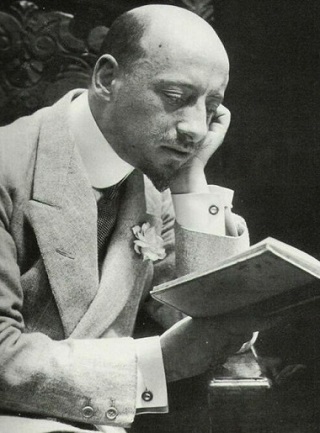
Gabriele D'Annunzio (1863-1938)
Per la morte di un copolavoro / For the death of a masterpiece
(Text by Gabriele D'Annunzio)For Mixed a cappella Choir
Commentary
Reviews
Recording
Video
Download score
Commentary
Written for a cappella choir, it constitutes the final scene of the musical stage production La Raya en el Agua, which inaugurated, in September 1996, the Fernando de Rojas Hall at the Circle of Fine Arts in Madrid after a long renovation process. As the closing of this show, entirely based on the synthesis of antagonistic elements, this final choir aims to propose a reconciliation between two very opposing ideas: the negative view we may have of an author, based on the traits of his character, his aesthetic ideology, or his political stance, and the positive that derives from the beauty of his artistic production. The first four stanzas of the ode "Per la morte di un capolavoro" by D'Annunzio are taken as a symbol, as they constitute a beautiful poem written by a person who is not precisely exemplary from an ethical and political point of view.
In the theatrical performance, the choir must sing their part in a classic and static formation. From the middle of the scene onwards, a series of offstage movements announce the end of the show. These movements may produce sounds and noises, although they should not disturb the listening of the music: the musicians pack up and store their instruments in their cases, leave the pit, and then the hall; the stage elements are silently removed by the stagehands, etc. All these movements and consequent noises are obviously meaningless in a concert performance.
For this scene, the following fragments of D'Annunzio's poem have been used:
|
Foreste su i monti, chiome fragorose di oro di porpora e di croco all'aquilone, su l'aeree fronti immense corone che affoca il foco dei tramonti; rosarii di rose nate su i fonti solitarii ancor tiepidi dell'Estate che vi s'immerse; orti, orti conclusi, pomarii soavi cui l'Autunno pone monili più gravi che quelli di Serse poi che su le gemme celate il bel garzone ebro il pomo punico aperse; voluttà della Terra, o fronde, o fiori, o frutti, gioia di tutti, prole delle Stagioni sacre, portento dell'Acqua e del Sole, fronde fiori, frutti, ecco, ora nati, ora distrutti, chi mai si duole oggi di vostra bella morte? quale corda piange vostri dolci lutti? Vivono le profonde radici nel buio attorte. Ancora brilleran felici i ramicelli, e il suo acre si farà di miele nelle polpe bionde. Ma la creatura infinita, in cui la mente dell'uom fatto dio continuò l'opera della divina Madre e trasfiguró la vitaII sotto la specie dell'Eterno; ma l'effigie pura in cui l'uom solo nell'oblìo di sé mutamente svelò la virtù del dolore sotto la specie dell'Eterno ma il mondo creato sopra la Natura, ove con un gesto l'uom si fe' signore del Fato e congiunse la sua forza antica alla sua bellezza futura sotto la specie dell'Eterno; ma lo specchio dell'Ideale, o Poeti, la misura degli Eroi, la somma dell'Arte, il vertice del Pensiero e del Mistero, il segno visibile dell'Immortale muore, o Poeti, non e più. Perisce e non si rinnovella. Da noi si disparte; non avrà ritorno. S'oscura per sempre nella notte eguale. Fronde fiori frutti nel sereno giorno rivedremo noi, la giovine Terra, la sua genitura, e non l'infinita creatura bella! Piangete, o Poeti, o Eroi, per la luce que non è più, per la gioia che non è più. ... |
Forests on the mountains, resplendent crowns of gold and purple and saffron, on the kite, on airy brows immense crowns that suffocate the blaze of sunsets; rosaries of roses born on solitary springs still warm from Summer in which you immersed; gardens, enclosed gardens, orchards pleasant where Autumn places jewelry heavier than those of Xerxes after the beautiful youth drunken opened the Punic apple on the hidden gems; delight of the Earth, oh foliage, oh flowers, oh fruits, joy of all, offspring of the sacred Seasons, marvel of Water and Sun, foliage flowers, fruits, behold, now born, now destroyed, who grieves today for your beautiful death? Which string laments your sweet mournings? The deep roots live twisted in the dark. The little branches will still shine happily, and its bitterness will become honey in the golden flesh. But the infinite creature, in which the mind of man made god continued the work of the divine Mother and transfigured life under the guise of the Eternal; but the pure effigy in which man alone in the oblivion of himself silently revealed the virtue of pain under the guise of the Eternal but the world created above Nature, where with a gesture man made himself lord of Fate and joined his ancient strength to his future beauty under the guise of the Eternal; but the mirror of the Ideal, oh Poets, the measure of Heroes, the sum of Art, the pinnacle of Thought and Mystery, the visible sign of the Immortal dies, oh Poets, it is no more. It perishes and is not renewed. It departs from us; it will not return. It darkens forever in equal night. Foliage flowers fruits in the clear day we will see, the young Earth, its birth, and not the infinite beautiful creature! Weep, oh Poets, oh Heroes, for the light that is no more, for the joy that is no more. ... |
Fragments of the poem Per la morte di un capolavoro by Gabriele D'Annunzio
(from Laudi del cielo, del mare, della terra, e degli eroi - Second part: "Elettra" -1904-, "La notte di Caprera")
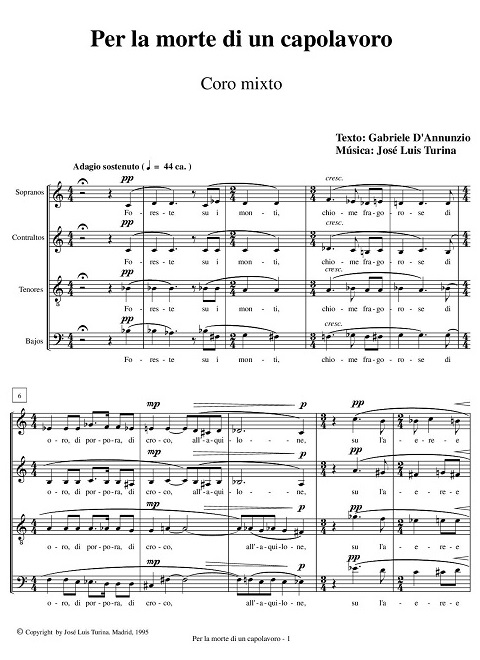
First page of Per la morte di un capolavoro
Reviews
Voices in the cold night
By Luis Suñén
(Review published in the newspaper El País. Madrid, January 15, 2006)

That the main hall of the National Auditorium presented on Friday at 10:30 p.m. on a freezing night a more than acceptable turnout to listen to choral music by two contemporary Spanish composers is enough to suggest that the Orchestra of the Community of Madrid is succeeding in building a loyal subscriber base who are seeing that an original program is the best cure for laziness. [...]
A Small Masterpiece
Another one of our finest composers, José Luis Turina (1952), offers in Per la morte di un capolavoro what its title indicates, that is, a small masterpiece. The beautiful verses of D'Annunzio, even without the scenic aspect of the composer's original idea, are traversed through music that serves them with an admiration that makes one forget, naturally, anything about the author other than the sheer aptness of each word in the poem. Music that grows, that calms, that ebbs and flows with the same gentle intensity as that stripe in the water from which it originates. […]
Aracil and Turina, living voices
By Álvaro Guibert
(Review published in the newspaper La Razón. Madrid, January 21, 2006)
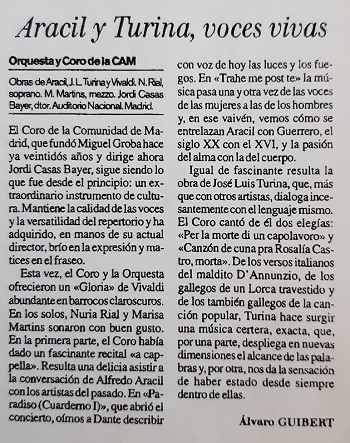
[...]
Equally fascinating is the work of José Luis Turina, who, more than with other artists, engages in an incessant dialogue with the language itself. The [Community of Madrid] Choir sang two elegies by him: Per la morte di un capolavoro and Canzón de cuna para Rosalía Castro, morta. From the Italian verses of the cursed D'Annunzio, from the Galician verses of a cross-dressed Lorca, and from the Galician verses of the popular song, Turina brings forth a precise and exact music that, on one hand, unfolds the scope of the words into new dimensions and, on the other hand, gives us the feeling of having always been within them.
Recording
Recording: Community of Madrid Choir (Dir.: Jordi Casas). Madrid, National Auditorium, January 13, 2006
Vídeo
Magerit Choir and Círculo Ensemble. Conductor: José Luis Temes
Madrid, Fernando de Rojas Hall at the Circle of Fine Arts, September 29, 1996, as part of the premiere of the musical stage production The stripe on the water| 19th scene. Per la morte di un capolavoro |