

The Koan Group in the early 1980s
TÍtulo a determinar / Title to be determined
For SeptetCommentary
Recording
Review
Download score
Commentary
Título a determinar ("Title to be determined") was written in May 1980, during the last weeks of my nine-month stay in Rome, where during that course I attended classes on Improvement of Composition given by Franco Donatoni at the Accademia Santa Cecilia. Those months marked a profound transformation in my aesthetic interests, not so much because of Donatoni's teachings, of which little can be traced in my music, as because of the discovery of the music of Salvatore Sciarrino, in which I saw a fascinating synthesis between the traditional constructive procedures and a timbral realization of them as novel as original that captivated me powerfully. From January of that same year is my string quartet Lama sabacthani?, commissioned by Radio Nacional de España for Easter 1980, and which marks a new point in my way (not so much in the background) of composing: of the long and sustained lines, but made with thick strokes, from my previous works (Crucifixus, Movement), to the atomized, pulverized use of the material, but always at the service of long and equally sustained gestures. In short, and in pictorial slang: it was the transition from the "fat brush" to the fine brush, almost like a miniaturist, with which I have composed all my later music.
The idea of Título a determinar arises from an audition of the famous Beethoven’s Septet, with the intention (somewhat illusory, I must admit it) to serve as a complement to a program performed by a group with an instrumental template as curious and rare as the one used by Beethoven: clarinet, french horn, bassoon, violin, viola, cello and double bass. But the idea goes beyond the pure use of the same instruments, by making the number seven the true constructive axis of the piece.

First page of Beethoven's Septet op. 20
In this way, the main generating cell, insistently exposed from the first measure (by the viola) is made up of seven sounds distributed in seven eighth notes. The work, on the other hand, is structured in seven sections, which although they are almost always contrasting, are in some cases closely related to each other, since above all possible speculation there is always a motor that drives a development (thematic, timbral , interval), as a constant search for a continuity that could not exist without it.
Curiously, both the previous work, the string quartet Lama sabacthani?, and Título a determinar were written in close connection with the Koan Group from Madrid and its director, José Ramón Encinar. The first, commissioned by Radio Nacional de España, as noted above, was recorded by said group and later released over the airwaves in April 1980, while the one that concerns us here was written commissioned by the group itself, to which it is dedicated and who premiered it a year later, on May 25, 1981, at the Madrid Museum of Contemporary Art, performing it a few weeks later at La Rochelle International Festival, France.

Program of the premiere of Título a determinar (Madrid, May 1881)
In 2013, Title to be determined was included in the CD "José Luis Turina. Chamber Music" (CD VRS 2131), published in the collection of Spanish and Latin American Composers of Current Music of the BBVA Foundation, performed by Plural Ensemble conducted by Fabián Panisello.
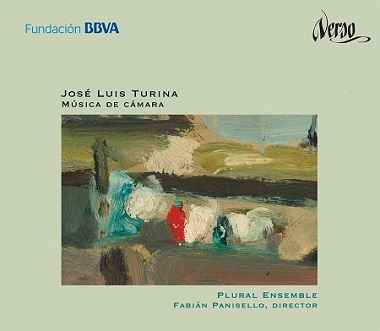
Cover of the CD of Plural Ensemble (2013)
Recording
Recording: Plural Ensemble (Cond.: Fabián Panisello)

First page of Título a determinar
Review
Spring Festival 1981 at the Casa de Velázquez
By Fernando Ruiz Coca
(Review published in the newspaper Ya. Madrid, May 28, 1981)
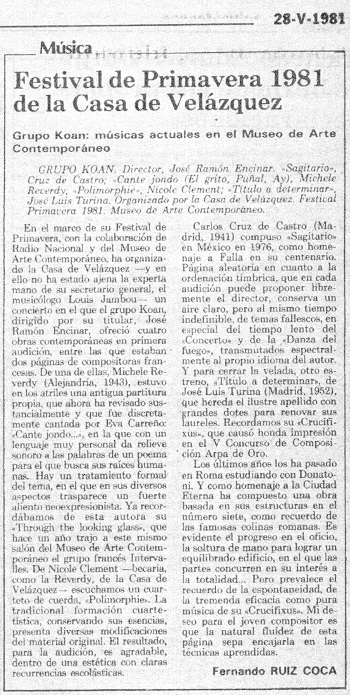
Grupo Koan, contemporary music at the Museum of Contemporary Art
As part of its Spring Festival, and with the collaboration of Radio Nacional and the Museum of Contemporary Art, the Casa de Velázquez -thanks in no small part to the expert hand of its Secretary General, musicologist Louis Jambou- organized a concert in which the Koan Group, under the direction of its principal conductor, José Ramón Encinar, presented four contemporary works in their premiere performances, including two pieces by French women composers. [...]
[...] And to close the evening, another premiere: «Title to be determined» by José Luis Turina (Madrid, 1952), who inherits his illustrious surname with remarkable gifts to renew its laurels. We recall his «Crucifixus», which made a deep impression at the 5th Golden Harp Composition Competition.
He has spent the past few years in Rome studying with Donatoni. And as a tribute to the Eternal City, he has composed a work structured around the number seven, in memory of the famous Roman hills. His progress in craftsmanship is evident, as is his facility in building a well-balanced edifice in which each part contributes its own interest to the whole... Yet the memory of the spontaneity, of the tremendous impact of «Crucifixus» as pure music, still prevails. My wish for this young composer is that he may succeed in fitting the natural fluency of this work into the techniques he has acquired.
Download pdf
(Score and parts without watermarks available at www.asesores-musicales.com )Enlace YouTube