
home > list of works > vocal music > voice & instruments > Soneto Quasi una Fantasía / Sonnet Quasi una Fantasia

Gerardo Diego (1896-1987)
Soneto Quasi una Fantasía / Sonnet Quasi una Fantasia
(On the sonnet "A Beethoven" by Gerardo Diego)
For Voice (soprano) and PianoCommentary
Download score
Commentary
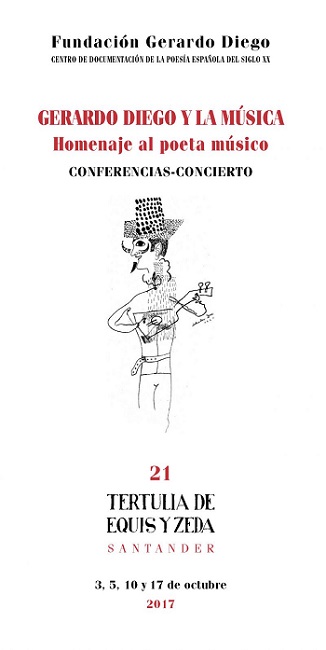
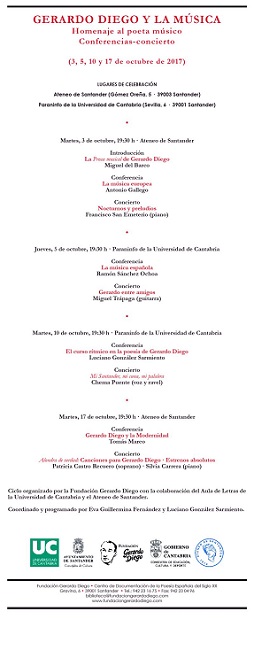
Given the celebration between October 3 and 17, 2017, at the Ateneo de Santander, of a series of conferences and concerts dedicated to the figure of the Cantabrian poet Gerardo Diego (Santander, 1896 - Madrid, 1987) with the generic name of Gerardo Diego and Music. Homage to the poet-musician, organized by the Gerardo Diego Foundation, the coordinator of the cycle, Luciano González Sarmiento, once again asked me to compose a work for soprano and piano that would be part of the last session, introduced by a lecture by Tomás Marco titled Gerardo Diego and Modernity, and completed with the premiere of five new works composed by as many authors on five sonnets by the poet dedicated to composers: To Alejandro Scriabin (Francisco Novel Sámano); To Roberto Schumann (Jacobo Durán Loriga); To Franz Schubert (Consuelo Díez); To Claude Debussy (Tomas Marco); and To Beethoven, whose text was entrusted to me.
I must say that I accepted the commission with great enthusiasm, both because I liked the figure of Gerardo Diego, undoubtedly the most musical of our recent poets, and I found very attractive the sonnet, whose text, from the book of poems Alondra de Verdad, from 1941, reads as follows:
|
Esa luz sobre el mundo, esa alegría que del dolor brotó, firme e ilesa, y ese tullido éxtasis, y esa giratoria guirnalda noche y día, y esa música, en fin, ¿es que reía Julieta así, miraba así Teresa? ¿Son ellas? ¿Eres tú? ¿Qué fiel promesa ilumina esas nubes todavía? Contigo voy, a navegar los lagos de tus sonatas, cálidas de halagos, madres de almas salvadas de la nada. Que al vuelo de la noche desvaría esa música o lumbre enamorada, la luna: quasi una fantasía. |
That light on the world, that joy that sprouted from pain, firm and unharmed, and that crippled ecstasy, and that rotating night and day garland, And that music, well, was Juliet laughing like that, did Teresa look like that? Are they? It's you? What faithful promise lights up those clouds yet? I go with you, to navigate the lakes of your sonatas, warm with flattery, mothers of souls saved from nothing. that to the flight of the night strays that music or fire in love, the moon: quasi una fantasia. |
In that way, the work opens and closes with a very direct reference to the arpeggios of the first movement of Beethoven's sonata, while the voice, starting from the initial melody, evolves freely, reminding throughout the course of the song various fragments of each of the three movements of the original sonata, in an attempt to adapt its character to the multiple dramatic contrasts of the text, which goes from nostalgia to serenity, going through a certain agitation in the second quartet.
|
|

With Jacobo Durán-Loriga, Tomás Marco, Silvia Carrera, Patricia Castro, Consuelo
Díez y Francisco Novel, after the final concert of the repetition of the cycle at the
Real Academy of Fine Arts of San Fernando (Madrid, November 24, 2017)

First page of Sonnet Quasi una Fantasia