
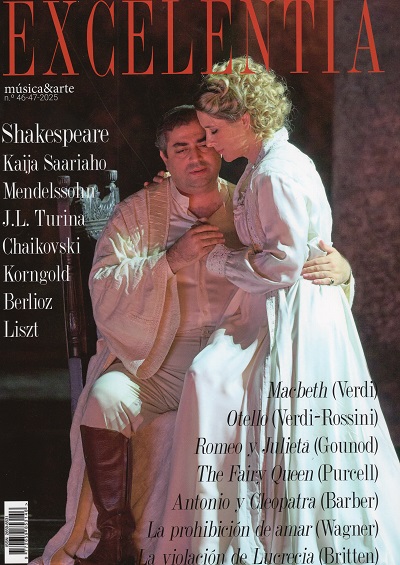
Cover of no. 46-47 of Excelentia magazine
(Madrid, november 2025)
"Cuatro Sonetos de Shakespeare" para voz y orquesta / "Four Sonnets by Shakespeare" for Voice and Orchestra
Article published in no. 46–47 of Excelentia magazine. Madrid, November 2025Introduction
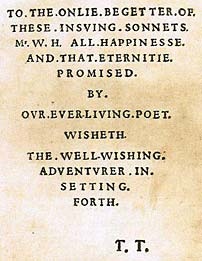
The overwhelming weight of Shakespeare's dramatic output does not, fortunately, prevent the collection of the 154 Sonnets he wrote over the course of several years from shining with its own light. They were published in 1609 by Thomas Thorpe, whose initials ("T.T.") appear enigmatically at the foot of the no less mysterious dedication that opens the edition:
|
To the onlie begetter of these insuing Sonnets, Mr. W. H., all hapinesse and that eternitie promised by our ever-living poet wisheth the well-wishing adventurer in setting forth. |
Of the 154 Sonnets, the first 126 are clearly addressed to a young man ("fair youth"), to whom the poet commonly refers as lord, friend or boy. By contrast, in the following 27 (127–154) the focus shifts to a lady (my mistress) who -as in Sonnet 130, which we will examine later- does not always come off well. Is all this enough to deduce Shakespeare's sexual inclination, to the point that theories have been formulated about his possible homosexuality or even bisexuality? Or, to put it another way: is it correct to assume that the author constantly reveals himself whenever he writes? Would it not be more sensible to think that he is always feigning -and all the more so in the case of a playwright- in order to adapt faithfully to the character he must portray? Romeo speaks like a man and Juliet like a woman, and the text of both lovers was written by the same person, capable of adopting one persona or another depending on the dramatic action. Perhaps the fact that, at the time, female roles had to be played by men generated all kinds of ambiguities that would put our own era's to shame; but it is better to leave such matters to true specialists, while we lovers of poetry simply enjoy these 154 small masterpieces.
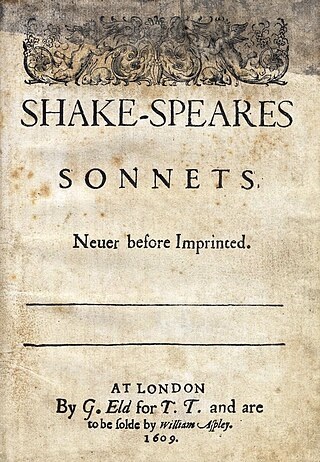
Cover of the first edition of the Sonnets
(London, 1609)
Shakespeare's English is not today's English, and therefore reading him in the original is very difficult even for those of us who more or less speak the language. Fortunately, over the past 150 years a large number of Spanish translations -many of great quality- have appeared, allowing the Sonnets to be disseminated and appreciated in our linguistic sphere. Thanks to the excellent study by Tanya Escudero, "Panorámica de las traducciones de los Sonetos de Shakespeare al español" [https://revistas.uma.es/index.php/trans/article/view/10911/14920], we know that the first Spanish translation was by Matías de Velasco y Rojas, who in 1877 published a prose translation of 37 sonnets. In the years that followed, individual sonnets continued to be translated (interestingly, in 1912 Gregorio Martínez Sierra -or was it María Lej/aacute;rraga?- also translated Sonnet 2 into prose, placing it in the mouth of one of the characters of the comedy El enamorado), and it was not until 1929 that Luis Astrana Marín produced a complete translation of all the sonnets, also in prose. The first complete edition in verse preserving the structure of the original Elizabethan sonnet (hendecasyllables with rhyme scheme ABAB CDCD EFEF GG) was published in 1968 and was the work of the Costa Rican poet José Basileo Acuña.
Other complete Spanish and Latin American editions present translations in the same type of Elizabethan sonnet as the original (Mario Jofré [1976, Argentina]; Pedro Pérez Prieto [2008, Spain]; Andrés Ehrenhaus [2009, Spain/Argentina, with assonant rhyme]); in free verse (Fátima Avad and Pablo Mañé [1975, Spain]; Enrique Sordo [1982, Spain]; José María Álvarez [1999, Spain]; Alfredo Gómez Gil [2000, Spain]); in the form of the Castilian sonnet, with two quatrains ABBA ABBA and two tercets with various rhyme combinations (José Méndez Herrera [1976, Spain]; Tomás Gray [2002, Chile]); in alexandrines or hendecasyllables with consonant or assonant rhyme following the Elizabethan pattern (Carmen Pérez Romero [1987, Spain]; Miguel Ángel Montezanti [1987, Argentina]; Ignacio Gamen [2009, Spain]; Ramón Gutiérrez Izquierdo [2011, Spain]; Luciano García García [2013, Spain]); in blank alexandrines (Carlos Pujol [1990, Spain]; Gustavo Falaquera [1993, Spain]); in blank hendecasyllables (Luis Rutiaga [2002, Mexico]; Antonio Rivero Taravillo [2004, Spain]); or in prose (Mart/iacute;n Casillas de Alba [2006–2007, Mexico]; Eduardo Gallardo Ruiz [2007, Spain])… The most recent complete edition of the Sonnets of which we are aware is by Bernardo Santano Moreno, in the form of an Elizabethan sonnet, published in 2013 by the Spanish publishing house Acantilado.
Among all these, however, one stands out -at least for me- because of the originality of its approach: the translation published in 1974 by Editorial Anagrama, undertaken by Agustín García Calvo, who preserved the structure and rhyme of the original but used 13-syllable lines instead of hendecasyllables. In the prologue he argued that "... since the average syllabic length of Spanish words is considerably greater than that of English ones, a faithful version of the English demands a larger number of syllables".
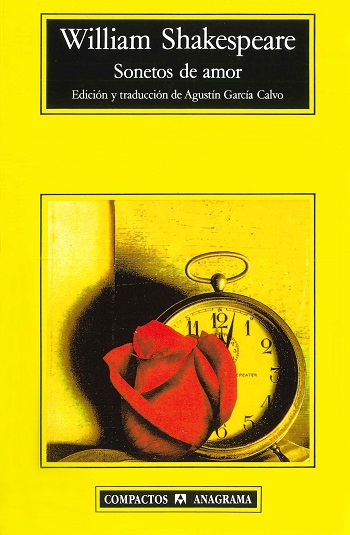
Cover of the edition of Agustín García Calvo's translation
of William Shakespeare's Sonnets (Ed. Anagrama, 1974)
García Calvo's translation (I met him when I requested permission to use texts from his book Hablando de lo que habla for the "Preface" of my cantata Musica ex lingua, for choir and orchestra, composed in 1989–1990. I later had a certain relationship with him when, in 1991, he included me -among many others- in his attempt to establish in Madrid a School of the Arts of Language, bringing together the disciplines of Linguistics, Logic, Mathematics and Music, a project that never came to fruition for lack of funding) was my "bedside book" when selecting the texts for my Four Sonnets of Shakespeare, and no less importantly, when returning to them time and again during the laborious process of composing the work.
The Four Sonnets by Shakespeare
In the autumn of 1996 my work La raya en el agua premiered, commissioned by the Círculo de Bellas Artes of Madrid for the solemn reopening of its Sala Fernando de Rojas, closed for many years for an extensive restructuring. In that premiere -carried out with minimal material means but enormous artistic resources, supplied by the intrinsic quality of all the performers- I had the good fortune of collaborating for the first time with the sopranist Flavio Oliver, whose musical and theatrical gifts repeatedly astonished me. Thinking of his voice and his stage abilities, only a few months later I wrote the role of Pasamonte in my opera D.Q. (Don Quijote en Barcelona), premiered in October 2000 at the Gran Teatre del Liceu in Barcelona, with a libretto by Justo Navarro and a dazzling production by La Fura dels Baus.
With this background, an idea that had been circling in my mind for some years began to take shape: composing a piece for voice and chamber ensemble based on a selection of the Sonnets by William Shakespeare. Their markedly ambiguous character struck me as ideal to be sung by an equally ambiguous voice, clearly that of a soprano yet produced by a man, bringing with it an unavoidable sense of unreality and equivocal sexuality, perfectly aligned with the earlier-mentioned custom of men performing female roles in the theatre of that era. And when, after the collaborations with Flavio Oliver already mentioned, the Orquesta Sinfónica de Madrid offered me the chance to write a symphonic work with or without soloists, I understood that all the circumstances were favourable for carrying out my project around Shakespeare's Sonnets, though shifting the initial chamber conception to a symphonic one. With this work, moreover, I complete a chapter of my catalogue in which I have long been immersed (that relating to vocal music, and thus to the always difficult and complex relationships between music and word), with this, my first and so far only cycle of lieder for voice and orchestra.
The selection of the sonnets was a difficult yet highly rewarding task, seeking among them different contrasts that would guarantee variety in their musical setting. Thus, Sonnet XL (Take all my loves, my love, yea take them all...) opens with an orchestral introduction in which, in very few measures, a rapid succession of sonic and stylistic atmospheres unfolds -a kind of general statement of the aesthetic principles that will inspire the entire work.

|
Take all my loves, my love, yea take them all: what hast thou then more than thou hadst before? No love, my love, that thou mayst true love call; all mine was thine before thou hadst this more. [...] |
The lyricism of this first sonnet gives way to the scherzando character of the second, Sonnet CXXX (My mistress' eyes are nothing like the sun...), with frequent comic and burlesque moments.

|
My mistress' eyes are nothing like the sun; coral is far more red than her lips red; if snow be white, why then her breasts are dun; if hairs be wires, black wires grow on her head. [...] |
If the first sonnet has a male addressee and the second clearly refers to a lady, the final movement seeks to unite both genders by interweaving the two remaining sonnets of the set, addressed respectively to a woman and to a man: CXXIX (Th' expense of spirit in a waste of shame...) and XXVI (Lord of my love, to whom in vassalage...), alternating their stanzas in an attempt at synthesizing lyrical and violent contrasts, the result of the impossible fusion of the two texts into one.


|
Th' expense of spirit in a waste of shame is lust in action; and, till action, lust is perjured, murd'rous, bloody, full of blame, savage, extreme, rude, cruel, not to trust; Lord of my love, to whom in vassalage thy merit hath my duty strongly knit, to thee I send this written ambassage, to witness duty, not to show my wit; [...] |
And since there is nothing more irksome to me than speaking about myself, I reproduce below some paragraphs from the notes Álvaro Marías wrote for the premiere program:
[... The truth is that, despite the extreme richness and complexity of the orchestral writing, the score betrays in some way its chamber origins, and not only because of the frequency of instrumental solos -the various solos for the concertmaster, and that of the first cello in dialogue with the voice in the third section, which constitutes a moment of great lyricism and beauty-, but also because of the pointillist delicacy of the writing, in which the filigree-like orchestration allows an exuberant orchestra of full strings and winds, harp, piano and celesta, five timpani and three percussionists playing more than twenty instruments, never to cover the voice.
A very clear example of this pointillist quality, as of orchestral embroidery, appears in the second sonnet, whose ironic and scherzando character gives rise to humorous writing that -with its syncopated notes, its incisive and witty mordents, its cascading scales, the lightness of its pizzicatos and trills, the arabesques in harp, piano or violin within a nuanced range of pianos, mezzo pianos and pianissimos- evokes, as we said, a long tradition of "scherzos," from the beginnings of Romanticism to our own time. Many years ago, in 1986, Turina declared: "I am discovering humour in music, in opposition to an excess of intellectualism, which has contributed to the audience's indifference toward contemporary music". The music for the sonnet "My mistress' eyes are nothing like the sun" is a perfect example of this attitude.
[...]
[...] Contrary to what its title suggests, the "Four Sonnets of William Shakespeare" premiered today constitute more a triptych of orchestral lieder, since the two final sonnets are treated within a single musical section; in this third section, the text moves from one sonnet to the other according to the sequence Quatrain 1 – Quatrain 1 – Quatrain 2 – Quatrain 2 – Quatrain 3 – Quatrain 3 – Couplet – Couplet. This superimposition or pairing of the two sonnets plays a dual structural role: maintaining the tripartite form of the whole and, at the same time, generating a contrasting structure for the third section, since Sonnets CXXIX and XXVI have very different characters (violent and impassioned in the sonnet on lust; lyrical and submissive in the one on vassalage). This tripartite form, with a more complex and kaleidoscopic third section, might evoke -mutatis mutandis, and much indeed must be changed- the structure of so many Classical-period concertos, whose third movement follows the intricate pattern of the rondo-sonata. In any case, the work presents its different sections linked together, without breaks and without pauses, as if forming a single great fresco rather than a juxtaposition of four independent orchestral songs.
(Álvaro Marías. Notes for the premiere program. Madrid, 24 April 2003)]

|

|
Program of the premiere of the Four Sonnets by Shakespeare (Madrid, 24 April 2003)
As might have been expected, the work was not programmed in 2016 -the 400th anniversary of Shakespeare's death- nor was it even mentioned as having been written in the numerous articles and studies that year devoted to his figure, his works, and the music composed in relation to them. And, of course, my opera D.Q. (Don Quijote en Barcelona) received identical treatment, bearing in mind that the same year also marked the 400th anniversary of Cervantes' death. For that reason I am especially grateful to this magazine for remembering me in this issue dedicated to the music inspired by Shakespeare.
Madrid, May 2025
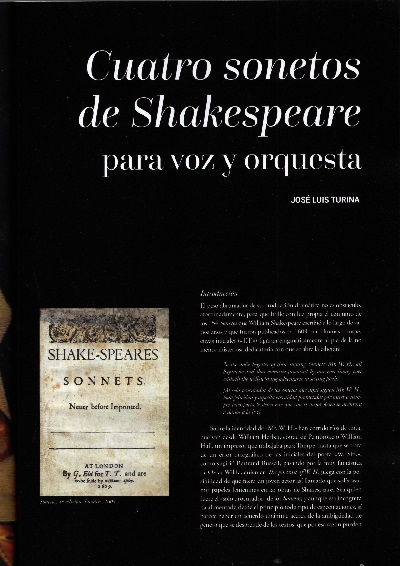
First page of the article published in Excelentia magazine