

With the Tokyo Quartet, during the rehearsal of Clémisos y Sustalos in the
Chamber Hall of the National Music Auditorium (Madrid, November 21, 2001)
Clémisos y Sustalos
(Fourth String Quartet)Commentary
Reviews
Download score
Commentary
Written during the winter of 2001, Clémisos y Sustalos is, so to speak, the "Spanish part" of a quadruple commission from the Tokyo Quartet, to which is dedicated, in co-production with the Madrid Liceo de Cámara de Madrid, the New York Chamber Cycle of the 82nd Street Hall, the Tokyo Opera City and the Città di Castello Festival in Italy, and the first of those performed by such a famous group that will be premiered in Madrid within the 2001-2002 season of the Liceo de Cámara.
It is a piece lasting about 18 minutes, approximately, which is structured in two strongly contrasted movements, which are performed without a solution of continuity, each of them integrated in turn by a succession of juxtaposed sections more or less extensive. The first is an energetic toccata, in which material is always highly atomized, made up of the reiteration of small designs that, when distributed among the four instruments in an absolutely equitable manner, progressively configure larger-scale organisms. The rapid succession of the different elements continuously provides violent contrasts that cover the entire range of timbre and dynamics of the quartet. All the tension accumulated during this movement is resolved with the arrival of the second one, which in turn represents a marked contrast with the previous one, both in character and in the treatment of the material: in the face of the continuous use of atomized elements of the former, the latter is characterized by the long phrases, with a wide melodic flight, of its different sections. These follow one another twelve in number, and each of them is based on twelve-tone serial material, very freely treated, which comes from various transformations of the main series of Alban Berg's Lyric Suite. In this sense, the twelve sections constitute a set of variations, each of which concludes with a long note, always different, whose final succession is that of the original series of Berg's quartet.

Julio Cortázar (1914-1984)
The titles of both the quartet and its two movements come directly from the famous chap. 68th of Rayuela ("Hopscotch"), the novel by Julio Cortázar whose reading accompanied me throughout the composition of this work. In this chapter, made up of a single paragraph barely twelve lines long, Cortázar uses a language called "glíglico", or purely musical language, consisting of interspersing absolutely invented words, devoid of meaning and valid only for their purely phonetic beauty, between conventional expressions and locutions that give them a different meaning for each reader, similar to how music works for the listener. Thus, behind the words “clémisos” and “sustalos” each one can place the concepts that the context in which Cortázar places them suggests: "As soon as he was amaled by the noema, she was crowded by the clémiso and they fell into hydromuria, in wild ambonians, in exasperating sustalos... ".

Rayuela's chapter 68th (1963)
For the two movements of the quartet I have chosen, respectively, the expressions "Trimalciato de ergomanina" and "Fílulas de cariaconcia", given that the interdependence between the two that occurs in the text, which makes the latter directly affect the former, relaxing his degree of tension (“... feeling how little by little the arillas were mirroring, they were becoming lumpy, redoubling, until he was stretched out like ergomanine trimalciate that has been dropped some filulae of cariaconcia...”), has an exact correspondence with the musical content of both movements, by neutralizing the lyrical variations that constitute the second the aggressive character of the initial energetic toccata. As in Rayuela, these titles mean nothing, therefore: they are just music, as is what they contain, which each listener must listen to, understand and assimilate as the music itself suggests.
Clémisos y Sustalos, fourth string quartet in my catalogue, was premiered by the Tokyo String Quartet, to which it is dedicated, in the Chamber Hall of the National Music Auditorium in Madrid, on November 21, 2001.

With the Tokyo String Quartet, after the premiere of Clémisos y Sustalos
(Madrid, Music National Auditorium, November 21, 2001)

First page of Clémisos y sustalos
Reviews
The Tokyo String Quartet at the 10th Liceo de Cámara
By Álvaro Guibert
(Article published in El Cultural, in relation to the premiere of Clémisos y sustalos. Madrid, November 21, 2001)
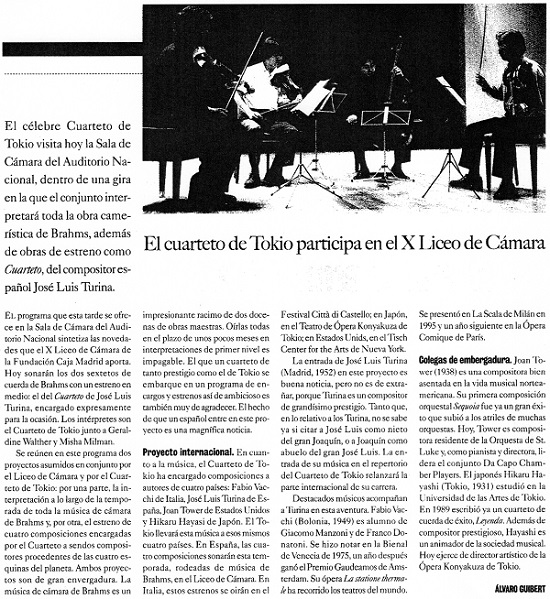
The celebrated Tokyo String Quartet visits the Chamber Hall of the National Auditorium today, as part of a tour in which the ensemble will perform the complete chamber works of Brahms, along with world premieres such as Cuarteto by Spanish composer José Luis Turina.
This evening's program at the Chamber Hall of the National Auditorium embodies the innovations brought by the 10th Liceo de Cámara of the Fundación Caja Madrid. The two Brahms string sextets will be performed, with a premiere in between: José Luis Turina's Cuarteto, commissioned expressly for the occasion. The performers are the Tokyo String Quartet together with Geraldine Walther and Misha Milman.
This program brings together two projects jointly undertaken by the Liceo de Cámara and the Tokyo String Quartet: on the one hand, the performance over the course of the season of Brahms's complete chamber music; on the other, the premiere of four works commissioned from composers from the four corners of the globe. Both projects are highly ambitious. Brahms's chamber music is an impressive cluster of some two dozen masterpieces. Hearing them all within a few months, and in top-level performances, is invaluable. That a quartet of such prestige as the Tokyo should embark on a commissioning and premiere program of this scale is also greatly to be appreciated. The inclusion of a Spanish composer in this project is excellent news.
An international project. As for the new works, the Tokyo String Quartet has commissioned compositions from four composers: Fabio Vacchi of Italy, José Luis Turina of Spain, Joan Tower of the United States, and Hikaru Hayashi of Japan. The Tokyo will take these works to those same four countries. In Spain, the four compositions will be heard this season, framed by Brahms's music, at the Liceo de Cámara. In Italy, the premieres will be presented at the Città di Castello Festival; in Japan, at Tokyo's Konyakuza Opera Theater; and in the United States, at the Tisch Center for the Arts in New York.
The participation of José Luis Turina (Madrid, 1952) in this project is welcome news, though not surprising, for Turina is a composer of the highest prestige. Indeed, when speaking of the Turina family, one no longer knows whether to refer to José Luis as the grandson of the great Joaquín, or to Joaquín as the grandfather of the great José Luis. The inclusion of his music in the Tokyo String Quartet's repertoire will help to expand the international dimension of his career.
Distinguished musicians accompany José Luis Turina in this project. Fabio Vacchi (Bologna, 1949) studied with Giacomo Manzoni and Franco Donatoni. He first drew attention at the Venice Biennale in 1975, and the following year won the Gaudeamus Prize in Amsterdam. His opera La statione thermale has been staged in theaters worldwide. It was presented at La Scala in Milan in 1995 and the following year at the Opera Comique in Paris.
Outstanding colleagues. Joan Tower (1938) is a well-established figure in American musical life. Her first orchestral work, Sequoia, was a major success, performed by many orchestras. Today, Tower is composer-in-residence with the Orchestra of St. Luke's, and, as pianist and conductor, leads the Da Capo Chamber Players. Japanese composer Hikaru Hayashi (Tokyo, 1931) studied at the Tokyo University of the Arts. In 1989 he wrote the successful string quartet Legend. In addition to his prestige as a composer, Hayashi is a driving force in Japan's musical life. He currently serves as artistic director of Tokyo's Konyakuza Opera.
"Rayuela", chapter 68th
By Juan Ángel Vela del Campo
(Review published in the newspaper El País. Madrid, November 23, 2001)

Surrounded by the two Brahms sextets in contemplative, impeccable and not at all captivating versions of the Tokyo Quartet, came the only world premiere of the excellent 10th Liceo de Cámara, the Spanish contribution to a project with other new creations from Italy, the United States and Japan, with repetitions of the quartets in more than twenty cities. An international dimension, then, for this transfigured night of Turina, in which he pays homage to the yearned Julio Cortázar and, specifically, to chapter 68th of Hopscotch. Hence the general title and that of the two movements, the initial energetic tocatta and the consequent lyrical variations, baptized for the occasion as Trimalciato de ergomanina and Fílulas de cariaconcia, respectively. In short, Cortázar: a love.
Solid, compact, committed and uncompromising work by the Madrid composer, with an overwhelming mastery of structure from abstraction and a subtle balance of tensions in development. There is no sustained dialogue with memory as in his opera Don Quixote in Barcelona, nor are there evocative winks from humor as in La raya en el agua. We are before a somber Turina, with a point of formal complicity in any case with Alban Berg's Lyrical Suite, a Turina of classical sobriety, vibrant in rhythms, master of sound resources (the pizzicati, the unisons are stupendous), with a poetic and exciting finale to conclude a climate of permanent restlessness.
The public received the work very warmly, as was perceived in the three rounds of applause, one of them with the composer on stage and another receiving applause from the room. The Tokyo Quartet is magnificent in a work that is not easy. The Liceo de Cámara scores an important goal. An additional note of attention: the book-hand program contains a documented and brilliant study of more than one hundred pages by Juan Manuel Viana on the chamber work of Brahms.
TOKYO STRING QUARTET: The Excellence of Four Voices
By Carlos Gómez Amat
(Review published in the newspaper El Mundo. Madrid, November 23, 2001)

The admirable Liceo de Cámara cycle, presented by the Caja Madrid Foundation, focuses this season on a great historical and contemporary treasure: the chamber music by Johannes Brahms. With some appropriate additions, this immortal music resonates in unsurpassable versions.
The Tokyo String Quartet takes center stage in the activities and has become the resident ensemble. In addition to their excellence, this quartet has now contributed to the enrichment of the repertoire with four commissions involving Japanese, American, Italian, and Spanish organizations. Welcome to the new music.
Representing Spain –enthusiastic applause for the presence of our art– the commission has been given to one of our composers with great personality and prestige, José Luis Turina. Always demonstrating his cultured nature, the composer titles his new quartet Clémisos and Sustalos and also uses the playful phoney language from Julio Cortázar's Hopscotch in the two movements.
José Luis Turina once again demonstrates his enormous technical mastery here. He utilizes the small but homogeneous sonic realm of the string quartet to convey his own musical thoughts. Although the initial toccata is very interesting in its rhythmic approach, I believe the most beautiful aspect is the lyricism of the variations, leading to a very fortunate ending in its sonority.
This is great music from the 20th century, but we are in the 21st. I trust that José Luis will find a path for the new century. The presence of the Viennese School in the second half of the last century has been somewhat overwhelming. We must place those masters –who are as much a part of history as Beethoven– in their niches and remember them like Saint Barbara, only when it thunders.
Magnificent rendition by the Tokyo Quartet. Kopelman, Ikeda, Isomura, and Greensmith, with the viola Walther and cello Milman, captured the two beautiful Brahms sextets in time and style. Historical and new music were applauded in the presence of the composer.
Tokyo String Quartet, a Luxury
By Álvaro Guibert
(Review published in the newspaper La Razón. Madrid, November 23, 2001)
The long-awaited premieres of the first two commissions by the Tokyo String Quartet have finally arrived, those of the Italian Fabio Vacchi and the Madrilenian José Luis Turina. This is a large-scale project that involves the Tokyo String Quartet premiering four compositions commissioned for the occasion and their subsequent performances in Madrid, Città di Castello, New York, and Tokyo. In addition to the aforementioned composers, those embarked on this adventure include the Japanese Hikaru Hayashi and the American Joan Tower. The fact that there is a Spanish voice in this project is great news, both in terms of recognition and international dissemination of our music. It is also a logical consequence of the high level achieved by our composition, which truly is very good.
Turina's quartet composed for the Tokyo bears the hallmark of the house: technical perfection and great expressive capacity. Writing for string quartet is a difficult and demanding task. The balance of sound among the instruments and the formal balance between the parts of the work are challenges that are particularly difficult to overcome in a string quartet. Turina does it brilliantly. This "Fourth Quartet" enters the ear naturally, with both the nervous and choppy sounds of the beginning and the sonorous landscapes of the end. And the structural tension grows, culminates, and diversifies with mysterious effectiveness. This is characteristic of masterpieces. This "Quartet" is inspired by the famous giglic chapter of Julio Cortázar's "Hopscotch". Turina has been thinking about music as language and language as music for years: he had to end up hitting on Cortázar.
Curiously, Vacchi's "Quartet No. 3" resembles Turina's. Both resort to very simple motifs: rapid notes or sustained notes; brief tremolo gestures that proliferate and accumulate, or flat and seductive chords. Vacchi employs diatonic scales where Turina resorts to chromatic series, but the result is very close. Turina's work seemed to me to be more rounded in form and more successful as a unit of expression.
Furthermore, the Tokyo Quartet presented the two novelties with impressive collective virtuosity. The premieres were surrounded by Brahms's music: the two sextets, the two quintets, and the first quartet. The Liceo de Cámara thus begins its concert cycle dedicated to Brahms's complete chamber music at full throttle. A true luxury.
The Chosen Ones Club
By Alberto González Lapuente
(Review published in the newspaper ABC. Madrid, November 30, 2001)

The tenth season of the Chamber Lyceum has begun its internal concert series dedicated to the complete chamber music works of Brahms. It has fallen to the Tokyo Quartet to perform the first two, in which, alongside the music of the Hamburg composer, new works commissioned to José Luis Turina, in their absolute premiere, and to Fabio Vacchi, in their first Spanish hearing, have been heard. These, along with those to come from Hikaru Hayasi and Joan Tower, are presented in co-production with the Città di Castello Festival, the 92nd Street Hall in New York, and the Opera City in Tokyo. The Chamber Lyceum connects with the outside world while closing its doors at home by announcing the sale of all its seats through subscription. A curious paradox that breaks stereotypes about the interest certain proposals may arouse in the public (so-called "minority" music of yesterday and today), and which, after ten years, has ended up turning this cycle into a club of the chosen ones.
Perhaps all this is the consequence of a quality principle of which the Tokyo Quartet can be a reliable representative. In these concerts, they have demonstrated this before the commissioned works, capable of allowing the performers to shrink to a refinement typical of music that stems from evanescence, the growth of the minimal, a purpose of superimposition, and even a lyrical flight not foreign to a certain Latin character. Perhaps Fabio Vacchi's third quartet was more pointillist than José Luis Turina's "Clémisos y sustalos", where any intention of contrast dissolves into a reality of enormous coherence in which posture and seduction prevail. And above all, a timbral refinement that links these two works and contrasts with the more luxuriant structure of Brahms's works. Reger explained it when talking about Brahms's "mist", through a term coined by William Tappert, implicitly addressing effusion, density, and the prodigality of the discourse. And it is in this last aspect where the Tokyo Quartet can showcase its best qualities: in a rhetoric that emphasizes internal development rather than explicit beauty. Because today, the Tokyo Quartet is a precision machine that requires a warm-up, especially its first violinist, Mikhail Kopelman. And when it achieves it, everything is possible: the two string quintets, the two string sextets, and the first quartet have only been the prologue.