
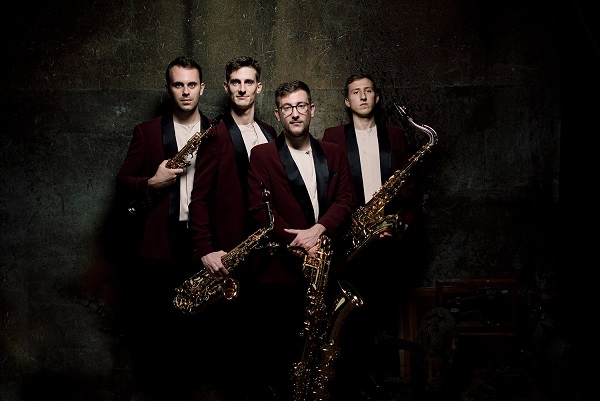
Kebyart Saxophone Quartet
Varius multiplex multiformis
For Saxophone QuartetCommentary
Download scores
Comentario
Varius multiplex multiformis was commissioned by the National Center for Musical Diffusion (CNDM) to write a new piece for the Kebyart quartet, serving as the culmination of my artistic residency for the 2023/2024 season.
The composition, extremely laborious, extends from October 2023 to February 2024, although the idea for the piece began to take shape over the previous summer. The title comes from Chapter 13 of the "Epitome of the Caesars", and it is the way its anonymous 4th-century author describes the character and actions of Emperor Hadrian.
|
... ... Varius multiplex multiformis; ad vitia atque
virtutes quasi arbiter genitus, impetum mentis
quodam artificio regens, ingenium invidum triste
lascivum et ad ostentationem sui insolens callide
tegebat; continentiam facilitatem clementiam
simulans contraque dissimulans ardorem gloriae,
quo flagrabat. (Epitome de Cæsaribus [4th century], Chapter 13) |
… … Various, manifold, and multifaceted; born almost as a judge of vices and virtues, managing the impulse of his mind with a certain craftiness, he cleverly concealed an envious, gloomy, lascivious nature that was insolent in its self-display; feigning self-restraint, amiability, and clemency, while disguising his burning passion for glory. (Epitome of the Caesars [4th century], Chapter 13) |
That pretext served to initiate a game in which two contrasting sections undergo a continuous process of varied, manifold, and multifaceted transformation, evolving alternately and divergently throughout the entire piece. In the first of these sections, a constant flow of rapid notes, starting as an imperceptible murmur gradually gaining substance, serves as a backdrop for a succession of twirls formed by longer notes that gradually acquire a thematic character and thus of figure that stand out from the previous murmur. This idea develops within the melodic range common to all four saxophones (the A-flat to A-flat octave centered on middle D, initially presented by each instrument as a sort of "statement of intent" regarding the equal treatment of all: there is no main voice in this piece, as the discourse is distributed as evenly as possible among the ensemble).
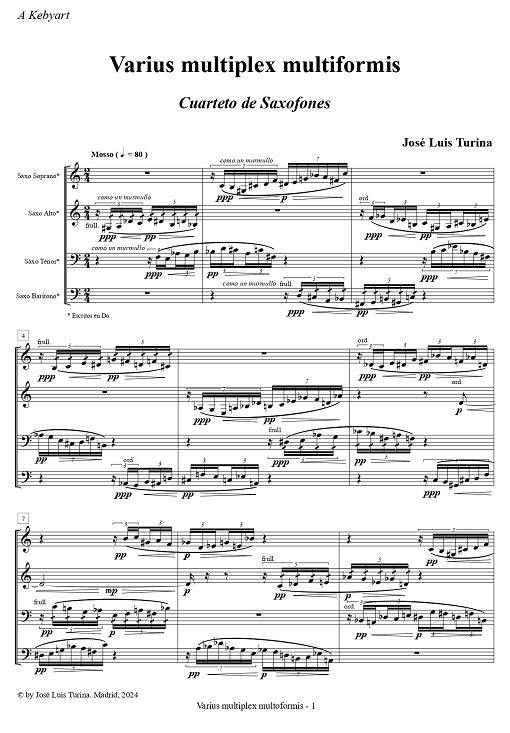
First page of Varius multiplex multiformis
This section is presented four times throughout the piece, corresponding to the odd parts of the seven that make up the composition. The first is the longest of all, and in the third, fifth, and seventh, the length gradually shortens until the final part culminates in a dizzying coda.
In contrast to the unthematic nature of this section, the second one is truly a block of elements, and its development in the second, fourth, and sixth parts of the piece follows a divergent trajectory in terms of duration. While the first section progressively shortens with each repetition, the elements of the second section undergo increasing elaboration, making the sixth section considerably longer compared to the fourth and especially the second, where these elements were merely presented in their most essential form. In the fourth section, these elements follow a reverse order from their presentation in the second and as they will be in the sixth. Thus, the fourth section acts as a divergent axis of symmetry for the entire piece, in a structural interplay difficult to follow by ear but evident in analysis.
The composition of Varius multiplex multiformis not only posed a great challenge due to the control of the elements involved and the meticulous writing it required, but it also represents an enormous challenge for the performers. It certainly would have been very different had I not known in advance that it would fall into the best possible hands, those of the four saxophonists of the Kebyart Ensemble (Pere Méndez, Víctor Serra, Robert Seara, and Daniel Miguel, soprano, alto, tenor, and baritone saxophones respectively), to whom it is naturally dedicated and who gave its brilliant premiere at Auditorium 400 of the Reina Sofía Museum in Madrid, on June 3, 2024, as part of the "Series 20/21" cycle of the National Center for Musical Diffusion, marking my farewell as composer-in-residence for the season.
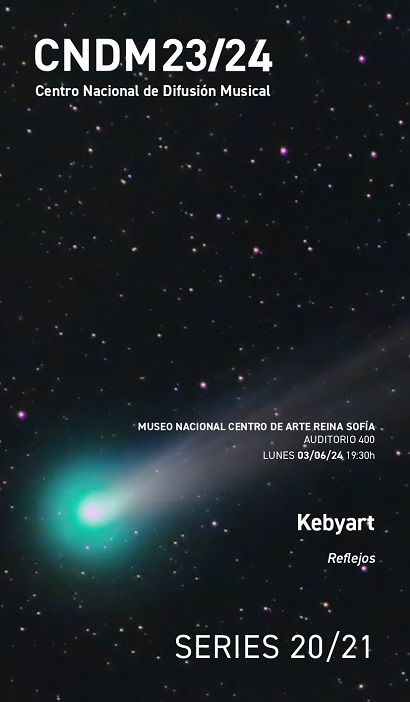
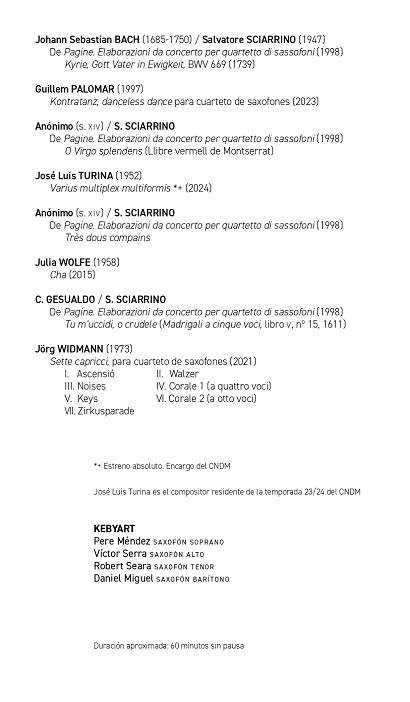
Program of the premiere of Varius multiplex multiformis
(June 3, 2024)
Download pdfs
(Scores & parts without watermarks available at www.asesores-musicales.com )Score in C
Transposed score