
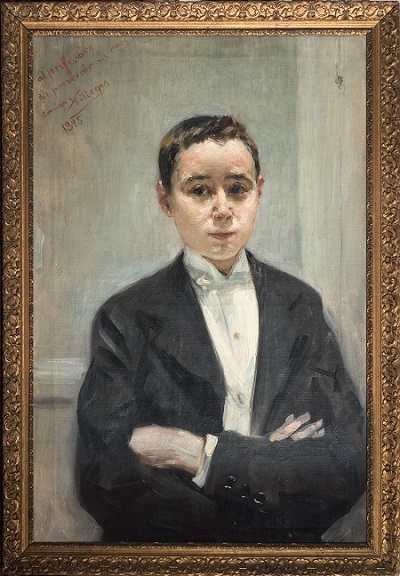
Joaquín Turina at the age of 12
Portrait of José Villegas Cordero (1895)
La música cinematográfica de Joaquín Turina / The cinematic music of Joaquín Turina
Introduction to the screening of the film "El Abanderado," within the Cycle Academic Composers of Spanish Cinema of the Royal Academy of Fine Arts of San Fernando and the National Film Archive -Cine Doré, January 11, 2024. Published in the book The Academicians Present... (coordinated by Fernando Lara), Royal Academy of Fine Arts of San Fernando (Madrid, 2025)In a brief article, published in the March 1942 issue of the Revista Nacional de Educación and entitled "On the Problem of Film Music", Joaquín Turina provides us with the keys to his relationship with cinema. The article begins by saying:
I was still a child when I saw my first film. This happened in Seville, in a hall on Sierpes Street; one of those halls frequented by La Fornarina and Pastora Imperio at the beginning of their careers, and which characterized the early years of the century. The film in question lasted five minutes and depicted the arrival of a train at the station. The public success was such that it was always repeated, once or several times.
It is evident that the first screening he attended must have taken place at the Gran Café Teatro Suizo, located at number 27 of Seville's Sierpes Street, very close to Turina's birthplace, and which would later become the Teatro Imperial. The Gran Café Teatro Suizo developed intense activity around flamenco (the reference to La Fornarina and Pastora Imperio is unquestionable), but it deserves to be remembered above all because it was the first venue in Seville to offer a cinematograph screening, which took place on September 17, 1896. It also seems clear that the film that so deeply impressed him was Arrival of a Train at La Ciotat Station, shot by the Lumière brothers in 1895 and first screened at the Indian Salon of the Grand Café in Paris in January of the following year. The film actually lasts 50 seconds, but in the memory of the 13-year-old boy who attended the screening, it grew by four additional minutes.
In 1942, the date of the article, Turina's experience with film music composition was certainly limited, as it was confined to the works he wrote in 1941 for two documentaries that, under the title Campamentos [Camps], were produced by the Frente de Juventudes. For these, Turina received the not insignificant sum of 6,000 pesetas. The first of them was dedicated to the camps of the Sección Femenina, and the score, written for orchestra, was composed in September 1941, with the orchestration carried out in collaboration with his pupil Carmen Fernández.
The music for the second documentary, devoted to the male camps, was composed the following month and orchestrated by Turina himself for string quartet. Both short films premiered at Madrid's Capitol Cinema on October 29 of that year, and they were awarded the Ulagui Films Internacionales 1941 Cup at the First CIRCE Documentary Competition. The award ceremony took place on July 29, 1942, at the Palacio de la Música, and it is more than likely that the granting of this prize was the reason for the article mentioned above.
Perhaps as a result of the success of these documentaries, Turina began from that moment a closer collaboration with the cinema -closer only in relative terms, of course, since he did not compose for many films, the total amounting, up until his death in 1949, to just four feature films and three documentaries. A key figure in this stage was the producer, director, and screenwriter Fernando Alonso Casares, better known as Fernán, with whom Turina would collaborate on several occasions, the first being the 1943 documentary Primavera sevillana, made for NO-DO, once again with Carmen Fernández orchestrating some sections. Beginning with Primavera sevillana, another of his students, Jesús García Leoz, also became involved -on this occasion as conductor of the National Orchestra for the soundtrack recording, later as orchestrator in future works, and, in the final film Turina undertook, as the one entrusted to complete it. The score was composed between May 27 and June 11, and the documentary premiered on June 22 of that year at Madrid's Capitol Cinema.
The first feature film in which Turina collaborated was El Abanderado, whose music was composed between July 24 and September 9, 1943, with the collaboration of Jesús García Leoz in orchestrating some fragments. Its premiere took place on October 15, and the screening was preceded by the documentary Primavera sevillana. Anticipation for the premiere was enormous, as recorded in that week's NO-DO newsreel, and the film was awarded the sixth prize of the Sindicato del Espectáculo in 1944.
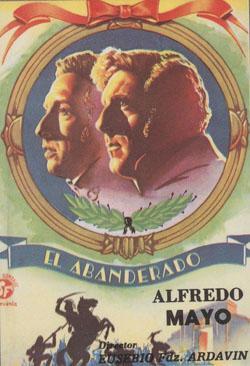
El Abanderado was directed by Eusebio Fernández Ardavín for Suevia Films, starring Alfredo Mayo in the role of Lieutenant Javier Torrealta, with Isabel de Pomés as Renata Larroche, and Raúl Cancio and José Nieto as Daoíz and Velarde, respectively. The script was by Fernández Ardavín himself, and the cinematography was handled by Hans Scheib and Ricardo Torres.
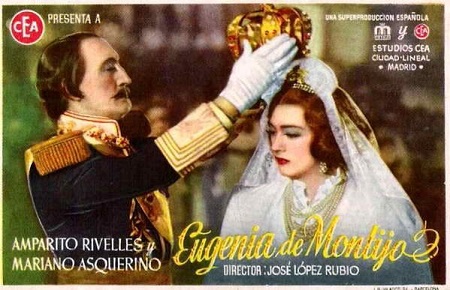
In 1944, Turina worked on the music for the film Eugenia de Montijo, directed by José López Rubio for CEA Films and premiered on October 16 of that year at the Avenida cinema in Madrid. Among its cast were Amparo Rivelles, Fernando Rey, Tony Leblanc, and Guillermo Marín.
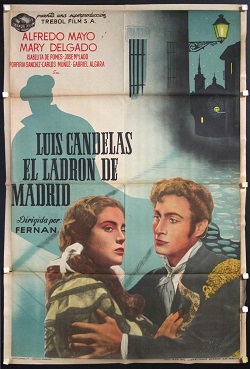
A few years later, in 1947, he composed the music for the film Luis Candelas, el ladrón de Madrid, directed by Fernán for Trébol Films. The premiere took place on January 19, 1948, at the Bilbao Cinema in Madrid. The cast included Alfredo Mayo, Mary Delgado, Isabel de Pomés, and José María Rodero, among others.
Like many films of the period, El Abanderado, Eugenia de Montijo and Luis Candelas fall within a type of film production typical of the 1940s, necessarily constrained to the prevailing aesthetic taste -a forced synthesis between grand ambitions and the modest reach imposed by political criteria, always vigilant through strict censorship ensuring that nothing deviated from the ideological principles established for a national-Catholic culture, which all authors were obliged to follow, regardless of whether they accepted, opposed, or were indifferent to them.
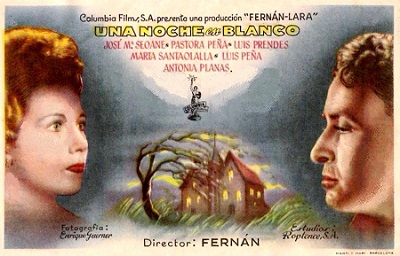
The last film in which Turina collaborated was Una noche en blanco (1948), also directed by Fernán for his own production company. Having begun the score on June 17, 1948, Turina wrote in his Diary entry for July 12: "One of the most acute and longest attacks of my illness begins. After a horrible week, a complication sets in [...] These are very bitter days... " And later: "… The film Una noche en blanco, violently suspended, was taken by Leoz, who finished it". After several months of long agony, Turina died on January 14, 1949, at the age of sixty-six.
...
Judging by the notes in his Diaries, in which from 1913 to 1948 Turina meticulously recorded the most significant events of each day, composing for cinema was hardly a pleasure for him. In the above-mentioned 1942 article, he already lists some of the less gratifying aspects of this task. The following example, full of wit and humor, is telling:
No matter how well thought out and detailed a film script may be, it is extremely difficult, almost impossible, to calculate the number of minutes and seconds of each section. If one could obtain the exact duration, the composer could then plan his work with full awareness, giving it the balance that every work of art should have... [...] ... But this usually does not happen in films, and when synchronization time arrives, with the artists, the orchestra, the engineers, and all the staff present in the studio, this truly terrifying cry is heard: «We are seven meters of music short! » The problem is not so much improvising those missing seven meters on the spot; the worst part is that by adding them, a new patch is formed that spoils the whole and destroys the balance. Another very serious case occurs when there are two or three extra pages of music; then the conductor exchanges the baton for scissors, cutting bars mercilessly before the horrified eyes of the composer.
And the final paragraph of the article is somewhat visionary. It reads:
We have reached the heart of the matter. For the moment, it seems very difficult to propose any particular solution; I do believe, however, that just as there already exist schools of film acting, it would be worthwhile to consider a branch of the subject of Music Composition that would study and address the multiple problems that the screen poses to musicians. For, if we look closely, what perspectives can be observed in the musical field today? Without mentioning names, I invite the reader to take a look at contemporary production, both national and international, and they will immediately realize that in most films, the screen and the music march like a badly matched marriage. Here is a subject from which the initial lines of a pedagogy of film music could be drawn.
At that time, Turina could hardly have imagined that more than fifty years would still pass before the curriculum for the advanced degree in Composition would include, among its modalities, Composition for Audiovisual Media, as part of the higher education in Music.
...
Finally, let me share an interesting fact that I discovered while preparing this text, one that no scholar had pointed out until now. Turina must have been aware that, despite the intense work devoted to composing the music for the films in which he collaborated, these works were destined for a very short life. For this reason, he did not hesitate to reuse the best fragments written for them in catalog works, seeking thereby to give them greater permanence. Thus, in 1945 he composed two piano works, catalogued as Opus 101 and 103, whose eloquent titles clearly reveal his dedication to film music during the preceding years. The first is entitled Magic Lantern, and in each of its three movements he employs material taken from some of the films. In the first, Prelude, he uses a fragment from El Abanderado; in the second, The mystery of the garden, he returns to Primavera sevillana; and in the third and last, Romantic Waltz, he reproduces a fragment of the ball scene from Eugenia de Montijo.
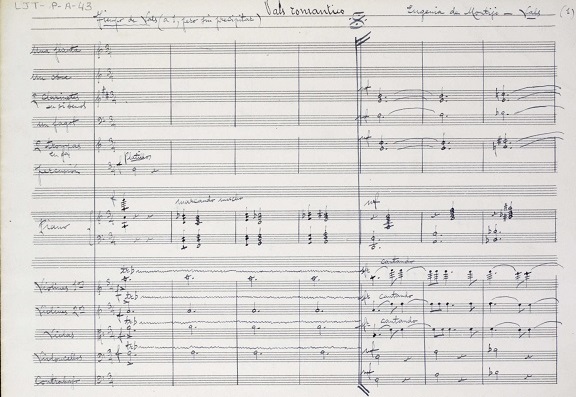
First page of the autograph orchestral score of the Waltz from Eugenia de Montijo
RTVE Symphony Orchestra. Cond.: Adrian Leaper
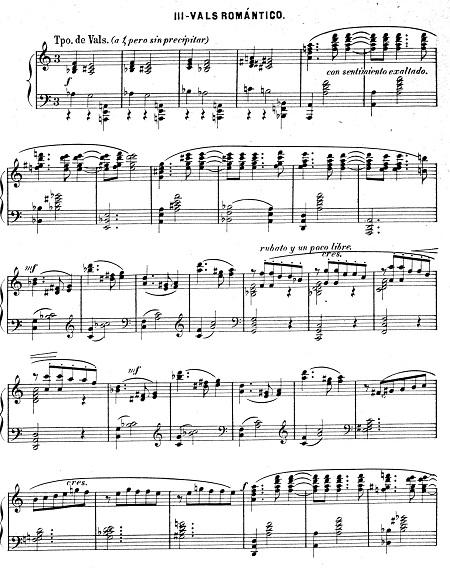
First page of the third movement ("Romantic Waltz")
of Magic Lantern, Op. 101, for piano
Jordi Masó, piano
The other work, even more eloquently entitled Film Fantasy, "narrates" the recording of a film soundtrack, as suggested by the annotations that name each of its five sections. The first is entitled In the film studios. Entry of the orchestra; the second describes The conductor, in a zortzico rhythm that seems to allude to some Basque conductor (perhaps Jesús Arámbarri, closely linked to cinema at the time); the titles of the three remaining sections are preceded by the word "Screen": in the first (Games in the gardens), Turina uses a fragment from Eugenia de Montijo; in the second (Gala reception in Madrid, 1808), he draws from El Abanderado; and in the third (Andalusian countryside), he returns once more to Primavera sevillana.
Although these two piano works are little known, as they are rarely performed, several recordings of them do exist, allowing both their listening and the appreciation of the quality of Turina's musical work for a medium in which -as we have seen in his Diaries, his article, and various interviews- he never felt fully comfortable. Yet, despite that, he nevertheless managed to leave an admirable testimony of his artistry and craft.