
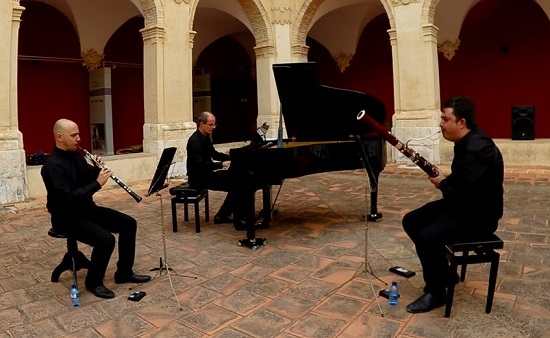
The Ausiàs March Trio
Tres Senyals / Three Signals
For Oboe, Bassoon and PianoCommentary
Download score
Commentary
This piece was composed at the request of the Ausiàs March Trio, whose members - oboist Daniel Ibáñez, bassoonist Esteve Casanova and pianist Claudio Carbó-approached me to write a work for a trio of double reeds and piano, an ensemble I had never written for before, and which perhaps for that reason attracted me from the very beginning. After accepting the proposal, I spent several days pondering the piece I had ahead of me, and, as on other occasions, I realized from the outset that it was more than appropriate to somehow connect it with the figure of the 15th-century Valencian poet from whom the trio takes its name.
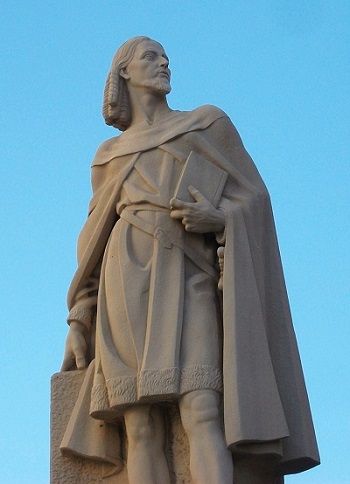
Sculpture of Ausiàs March in Gandía
(José Rausell Sanchis, 1969)
As I familiarized myself with the wonderful poetry of Ausiàs March (1400-1459), I was immediately struck by the constant use of certain poetic processes: the use of hendecasyllables with a caesura after the fourth syllable; the preference for stanzas based on octaves, and the use in certain cycles of poems (such as the Cantos de amor) of "tornadas", which are simply four-line stanzas that are interspersed -like a "refrain"- between each of the octaves that make up the composition, and that always begin with a poetic figure which makes a metaphorical reference to the beloved woman, whose name thus remains hidden, and which is known as senyal ("signal").
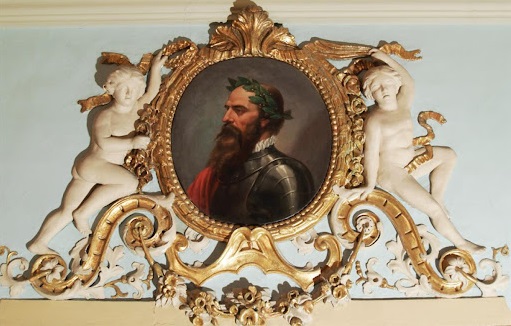
Ausiàs March, painted in 1866 by José Brel y Gital (1841-1894)
Among the various senyals used by Ausiàs March in these poems, I have chosen three, one for each of the movements of the piece. Thus, the first is titled Plena de seny ("Full of sense," or sometimes translated as "All prudence"), based on an imitative play ranging from canonic procedures between the oboe and bassoon over a continuous motion of sixteenth notes in the piano, to the alternating repetition of rhythmic groups among the three instruments in the central section.
For the second movement, the chosen senyal was Llir entre cards ("Lily among thistles"), based on the alternation of rhapsodic interventions by oboe and bassoon, with corresponding "comments" from the piano. The third and final movement is titled O foll amor ("Oh mad love"), and provides a sharp contrast with the previous one. Very lively and scherzo-like, it is structured as a rondo that ends in a vertiginous coda requiring great technical mastery from the performers, and whose thematic content revolves around a rhythmic-melodic cell that serves as the musicalization of the ten syllables of the first line of the "tornada": O foll amor, de vós no son content.
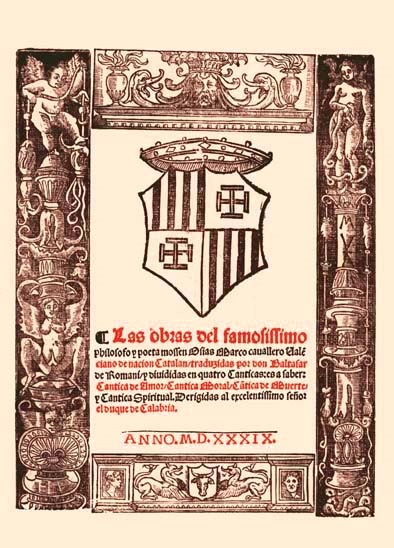
Cover of the Spanish translation of The works of the famous
philosopher and poet Osias Marco, a Valencian knight of Catalan
nation, translated by Baltasar de Romaní (1539)
Three Signals was composed between Madrid and Sant Celoni (Barcelona) between December 2021 and March 2022, and is naturally dedicated to the Ausiàs March Trio.
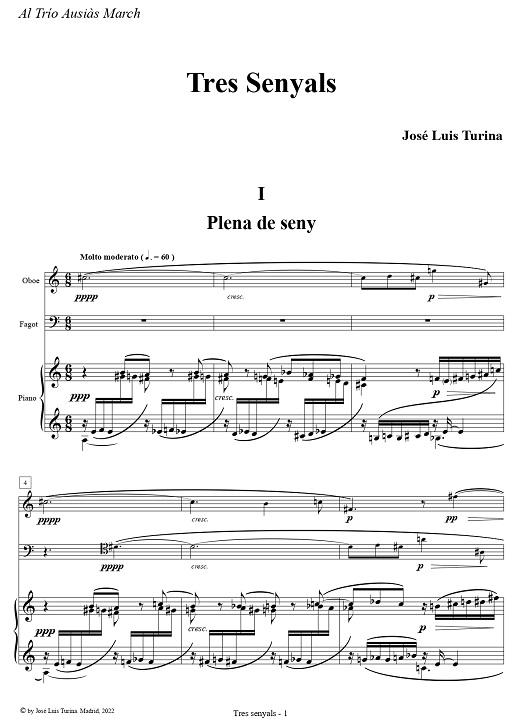
First page of the Tres Senyals