
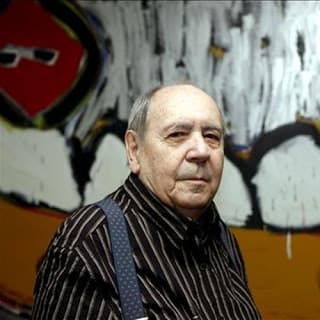
Gustavo Torner (Cuenca, 1925)
Los complementarios / The complementary ones
Program note for the concert A gift for a centennial in homage to Gustavo Torner, featuring works by the academic composers of the Music Section of the Royal Academy of Fine Arts of San Fernando (Madrid, June 24, 2025)Commentary
Video
Reviews
Download score
Commentary
Torner's world is an ambiguous, Borgesian world. In it, realities and appearances blur. Opposites touch; nothing is truly what it seems, and each thing contains something of everything else. We are in the realm of equivalencies, of visual metaphors where the glint on the edge of broken glass turns into a sea horizon, and where six meters of stainless steel stand for the immensity of the sky. (FERNANDO ZÓBEL)
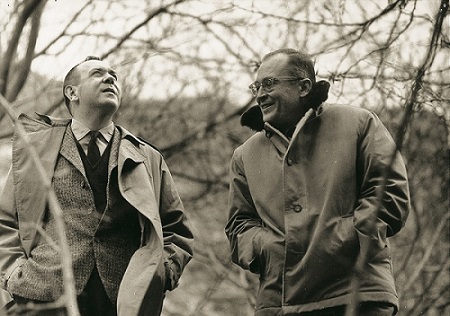
Gustavo Torner and Fernando Zóbel (ca. 1965)
Photo: Fernando Nuño
I met Gustavo Torner towards the end of the spring of 1982. At the time, I was a teacher and Secretary at the Professional Conservatory of Music in Cuenca, and the director of the center, Pablo López de Osaba, was also the director of the Museum of Spanish Abstract Art. The museum had been founded by Fernando Zóbel in 1966 in close collaboration with Torner, and both had co-chaired it during its early years until its donation to the Juan March Foundation in 1980.
Late on a sunny morning in June 1982, after finishing my morning shift at the Conservatory -housed in the old Audiencia building- and in need of catching my breath after climbing the steep slope of Alfonso VII Street, I paused halfway on my way home, halfway down San Pedro Street, stopping at the Mangana Restaurant in the Plaza Mayor. There, leaning on the bar with glasses of wine in front of them, was López de Osaba giving a stern scolding to a middle-aged man who was staring back at him with a look of bewilderment. "But how can you tell me you don't know who Sebastián Durón is?" he was rebuking him. "It's like me saying I don't know who Berruguete is!" The comparison struck me as completely disproportionate, but the reprimand didn't go any further because, upon seeing me arrive, López de Osaba interrupted his speech to introduce me to his companion -none other than Gustavo Torner. The reference to Durón was relevant because, a few weeks later, a chamber opera cycle was scheduled to take place in Cuenca, featuring his opera La guerra de los gigantes (The War of the Giants). This series was also directed by López de Osaba in collaboration with the Youth Institute and also included my own chamber opera Ligazón, based on a text by Valle-Inclán.
Unlike Fernando Zóbel -whom I knew fairly well during my years in Cuenca and to whose memory I dedicated my work Exequias in 1985, a commission from the Cuenca Religious Music Week- I didn't get to know Torner as closely. In those early years of the 1980s, he only visited Cuenca sporadically. Nevertheless, it was enough to share a few conversations with him, which inevitably drifted towards the figure and music of Stravinsky.
In any case, it was in Cuenca where I first began to appreciate Gustavo Torner's work, struck by his intelligent and sensitive use of pure geometric forms -squares, circles, triangles, cubes- in combinations full of ingenuity, expressiveness, and structural force. I was deeply impressed by a visit to the monument commemorating the VI World Forestry Congress, better known as the Monument to Wood, erected in 1966 at the "Tejadillos site", next to the Escabas River, in the Sierra de los Barrancos of the Cuenca Highlands. The concept of a solid cube suspended -or inscribed- within the ethereal cube suggested by the wooden structure in which it is set left a lasting impression on me.
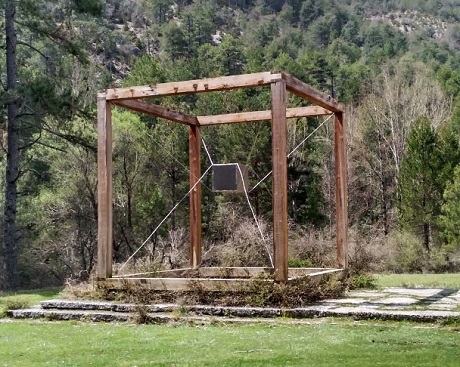
© Spanish Association of Landscapers
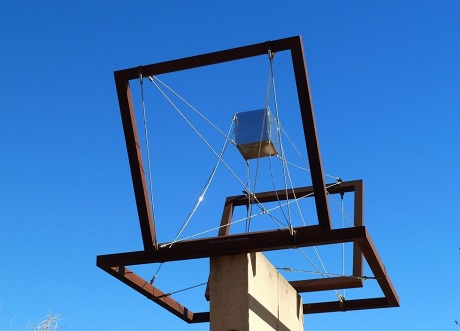
Equally moving is the variation on that same idea which, since 1986 -twenty years later- and under the name Monument to the Constitution, crowns the Plaza Mangana in the city of Cuenca. In this work, the same solid, suspended cube now seems to want to break free from its container, which takes the shape of transparent gates or book pages opening to facilitate its flight.
Being equally interested in Torner's dual role as both painter and sculptor, I must admit that I believe it is in the latter field where he has created his most accomplished works -those that have achieved the greatest communicative power. This is no doubt because his artistic vision fits perfectly with the urban spaces where many of his sculptures have been installed, and which have thus become highly familiar -not only to the contemporary art connoisseur but also to the ordinary passerby who lives with them day after day. One of his most iconic works in this sense is Reflexiones (1972), better known as The Cubes, to the point that the real name of the square where it stands -Plaza de Emilio Jiménez Millas- has been all but forgotten, replaced in popular usage by Plaza de los Cubos (Cubes Square). This urban sculpture is a true statement of intent: once again, a pure geometric figure reproduces itself in a quasi-fractal manner, with a purpose that, surely in Torner's mind, is to continue ad infinitum, with only the available space setting the physical limits of its execution.
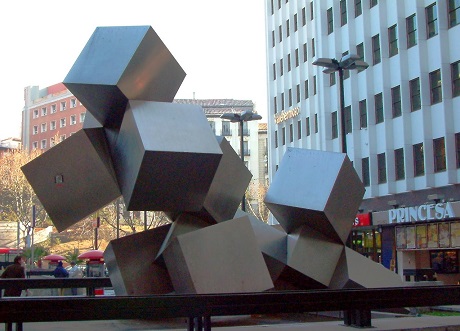
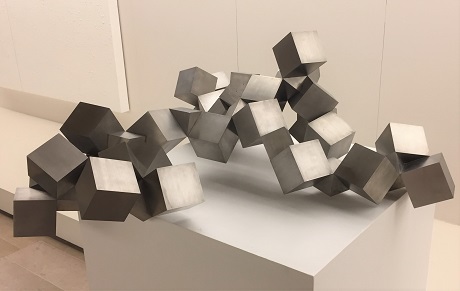
Reflexiones III (1974). (Espacio Torner, Cuenca)
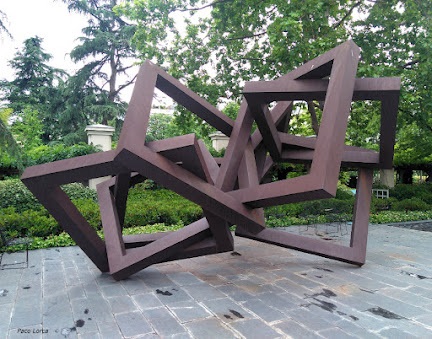
La rectitud de las cosas V (1983). (Juan March Foundation10:16 30/06/2025, Madrid)
Something similar happens with a series of sculptures that, under the generic title Los complementarios (The complementary ones), occupied Torner's work during the final years of the last century and the early years of the current one -a series that has attracted me especially for several reasons:
- These sculptures, once again, start from a "pure" geometric figure, which in this case is the quadrilateral. However, the quadrilaterals Torner employs are never complete; what emerges -what rises from the pedestal into which the various elements are inserted- is, in fact, only a part of these figures. The rest must be imagined inside the pedestal, and it is our minds that, through perceptual play, are tasked with "understanding" them as complete forms, helping us to infer what figure they represent. By applying various principles of Gestalt theory -closure, continuation, Prägnanz- we can mentally reconstruct the hidden parts of the sculpture that remain "underground", though we can never be certain that what we believe we perceive is actually so.
- But in a masterful twist of expectation, Torner creates all the sculptures in this series using a polished metal base, which acts as a mirror reflecting the interior side of the geometric elements -shattering our assumptions and dismissing our expectations even before we've had time to formulate them. As Fernando Zóbel wisely noted in the paragraph that opens these notes, "in Torner's world… nothing is truly what it seems, and each thing contains something of everything else".
- A non-artistic reason -though no less important- for my choice lies in the fact that the work Gustavo Torner donated to the Academy upon his admission in 1992 was precisely one from this series: Los complementarios VI, which can be seen in the center of Hall 50 on the third floor of the Museum.
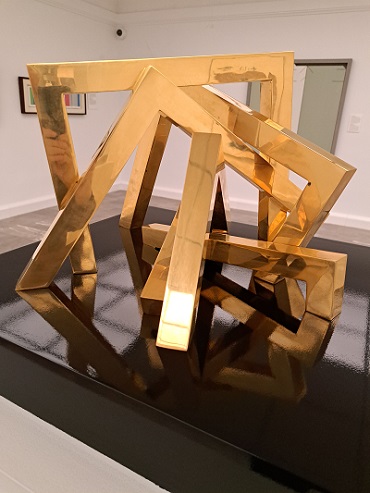
Made of gold on steel over a lacquered steel base, the accompanying photograph shows how the play of reflection "completes" the figure, giving it a constantly changing new life as we view it from different angles.
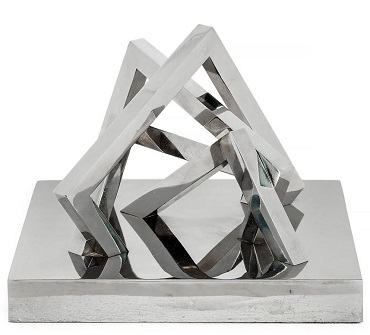
Los complementarios IV (1992)
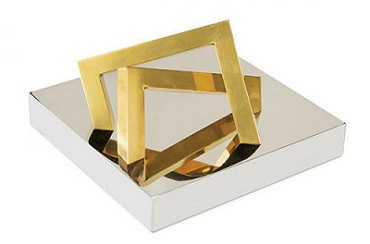
Complementarios torcidos (2000)
In short, it is a subtle interplay between the tangible reality of the material and the immaterial reality created by its reflection -plus the imagined reality (if such an oxymoron is allowed) of the part of the figure we presume lies beneath the surface.
As has already been said in these program notes, it would be as impossible as it would be pretentious to try to reproduce a plastic work in musical form. But one can indeed draw from its contemplation -and from reflection on its various structural aspects- a set of ideas and conclusions that allow for a musical treatment intimately related to them. This has been my aim in Los complementarios, written for this concert, where I use only the string trio (violin, viola, and cello) from the full ensemble.
The piece, about seven minutes in length, is structured in two sections that, like the mirror play of the sculptures, develop divergently. An initial slow section alternates three times with a very fast one, with each iteration introducing variations on the original material. With each repetition, the first section loses elements, while the second grows proportionally. As can be seen, it is a mirror-like game, but one in which the reflection does not reproduce the projected image, but its structure. Much like the sculpture The Cubes, the work could continue ad infinitum, but both logic and common sense set a reasonable limit to its realization.
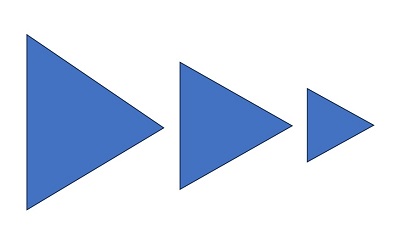
Outline of the 1st section
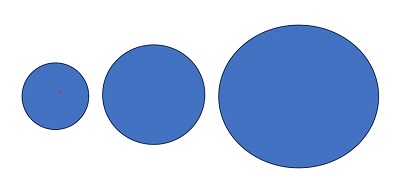
Outline of the 2nd section
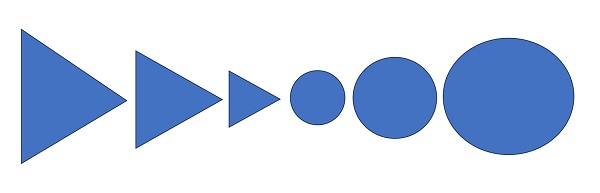
Structural reflection of the two sections
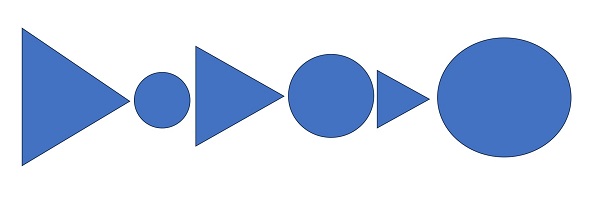
Ouline of the final form, with the two sections alternating
The beginning of the piece is, in a way, a statement of intent, seeking to metaphorically recreate the use of pure forms found in Torner's sculptures. What in those works is a cube, a triangle, or a quadrilateral, here is the open-string sound of one of the three instruments, always distorted by a dissonant note from one of the other two. And, as happens with the laws of perception, the open-string perfect fifth -lacking the expressiveness of vibrato- creates expectations of continuation in which a modal/tonal context becomes inevitable.
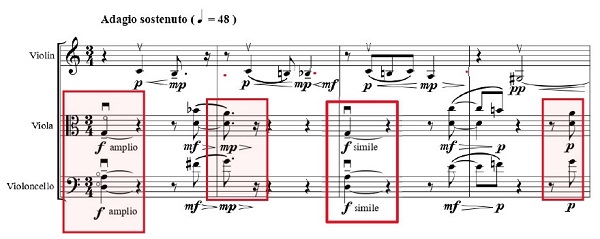
Throughout this section -though also in the fast one that alternates with it- there are frequent "mirror" situations in which the apparently highest-pitched instrument, the violin, drops to occupy the lowest register, while the upper voice shifts at times to the viola and at others to the cello, generating significant melodic tension through register manipulation.
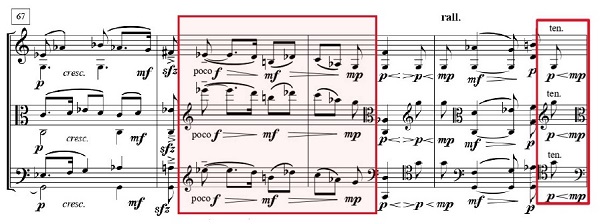
Listeners should not expect to hear a literal parallel between the music and the sculptures that inspired it. If a connection exists, it is purely metaphorical. In any case, it should suffice to say that without the contemplation of those works and reflection on them, this piece would have been very different -or perhaps it simply would not exist at all.
Madrid, May 31, 2025
Los complementarios was premiered on June 24, 2025, in the Main Hall of the Royal Academy of Fine Arts of San Fernando, as part of the concert-tribute to Gustavo Torner on the occasion of his centenary. The performers were the members of the "Andrés Segovia" Trio: Víctor Ambroa, violin; Rocío Gómez, viola; and Carlos Sánchez, cello.
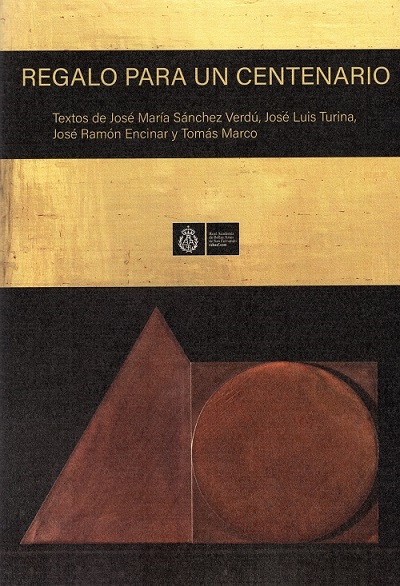
The above text, along with commentaries on his works by Tomás Marco, José Ramón Encinar and José María Sánchez-Verdú, was included in the booklet Gift for a Centenary, published by the Royal Academy of Fine Arts of San Fernando in June 2025, on the occasion of the Tribute Concert to Gustavo Torner.
Video
| "Andrés Segovia" Trio (Víctor Ambroa, violin; Rocío Gómez, viola; and Carlos Sánchez, cello) Tribute Concert to Gustavo Torner on the occasion of his centenary Hall of the Royal Academy of Fine Arts of San Fernando. Madrid, June 24, 2025 |
Reviews
Contemporary Spanish music pays tribute to Gustavo Torner on his centennial
By Arturo Reverter
(Review published in the online magazine Scherzo, Madrid, June 25, 2025)
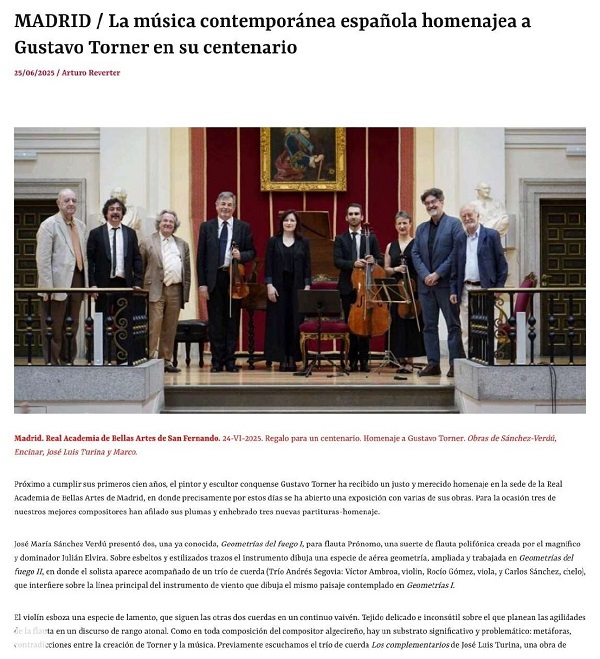
As he approaches his hundredth birthday, painter and sculptor Gustavo Torner, a native of Cuenca, has received a fitting and well-deserved tribute at the headquarters of the Royal Academy of Fine Arts in Madrid, where an exhibition featuring several of his works has just opened. For the occasion, three of our finest composers have sharpened their pens and composed three new homage scores.
[...] We first heard Los complementarios, a string trio by José Luis Turina -an elegiac piece animated by lively pizzicatos that gradually fades away. It's a subtle interplay between reality and imagination, remarkable for its rare elegance and structured in two distinct sections.
[...] The performance of these varied and evocative scores was superb throughout -not only from the string trio and the flutist, but also from the highly accomplished harpsichordist Silvia Márquez: agility, precision, focus, and intensity. The overall presentation and commentary on each piece were delivered by the always calm, deliberate, and precise academic José Luis García del Busto.
Music for Gustavo Torner on his centennial
By Álvaro Guibert
(Review published in the online magazine El Cultural, Madrid, June 26, 2025)
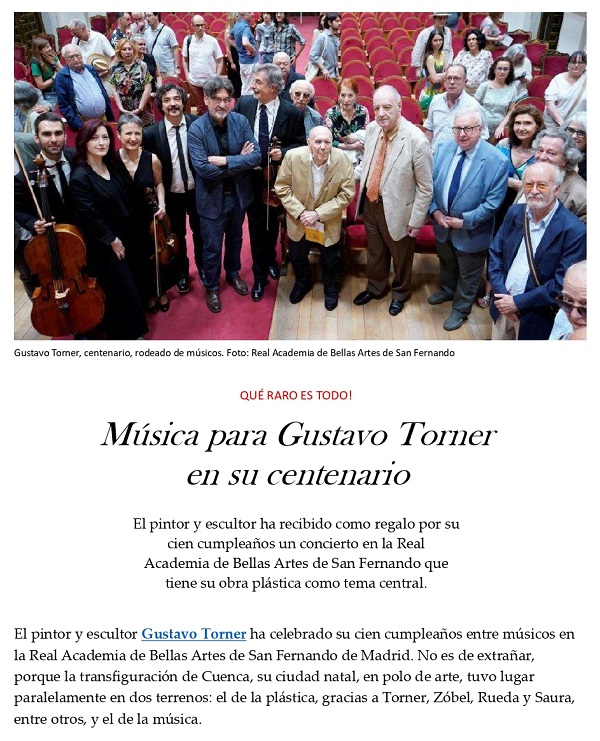
The painter and sculptor received a birthday gift for his hundredth birthday in the form of a concert at the Royal Academy of Fine Arts of San Fernando, with his visual art as its central theme.
Painter and sculptor Gustavo Torner celebrated his hundredth birthday among musicians. It's hardly surprising, since the transformation of Cuenca -his hometown- into a cultural hub happened on two fronts simultaneously: the visual arts, thanks to Torner, Zóbel, Rueda, and Saura, among others; and music. For decades, nearly every Spanish composer with something to say premiered works in Cuenca during the Religious Music Week. Some even settled there for a time to teach and create at the Electroacoustic Music Laboratory. Before becoming today's Torner Space -a sanctuary for the artist's work- the old Church of San Pablo had hosted the premieres of numerous compositions. One could say that Torner's spaces have always been surrounded or traversed by time and music. Few visual forms have such a natural musical equivalent as Torner's often extreme textures: pristine or grainy. The scores we heard -and, in a way, saw- in this concert were all composed in tribute to Torner. Three of them, by José María Sánchez-Verdú, José Luis Turina, and José Ramón Encinar, were written specifically for the occasion and premiered at this event. Tomás Marco's work had premiered in Paris half a century ago.
All the works seemed to stem from Tornerian principles: the aforementioned smooth-rough contrast, or on a more abstract level, the creative exploration of duality -since many of Torner's paintings unfold, in one way or another, in pairs.
[...] For his piece "Los complementarios", written for string trio, José Luis Turina draws inspiration from the reflections, shadows, and projections that abound in Gustavo Torner's sculptures -specifically, in the series bearing that name. These are volumes that distribute themselves equally between the corporeal and the incorporeal, the perceived and the imagined. Turina's work is a hall of mirrors, in which the figures flee in opposite directions -not across space, but in time; specifically, across six sections: three slow, three fast, which by their formal traits seem to drift apart. One senses that, given its carefully planned structure, Turina could meticulously justify -note by note, marking by marking- the necessity of every detail in this score. At the same time, the listener -or at least this one- feels drawn by the work's expressiveness to disregard the architecture that sustains it. Perhaps that's as it should be. The theme of the slow sections in "Los complementarios", especially in its first appearance, is rendered with deeply moving intensity.
[...]
The success of this birthday concert for Gustavo Torner -who was present in the hall- was due in large part to the excellent performances by the aforementioned Julián Elvira, harpsichordist Silvia Márquez, and the Andrés Segovia Trio, made up of Víctor Ambroa, Rocío Gómez, and Carlos Sánchez.