

Tomás Marco and Mª Rosa Cepero
Rosa engalanada / Adorned rose
For Flute and GuitarCommentary
Recordings
Video
Reviews
Download score
Commentary
Rosa engalanada was composed in May 1992, intended for a concert in homage to Tomás Marco, on the occasion of his fiftieth anniversary. This concert was made up of twelve very short compositions -around five minutes long- by as many authors, in which the different ages and aesthetics were unified by the common denominator of friendship and affection for the Madrid composer.
My modest contribution to the event had only one conditioning factor: the instrumental combination of flute and guitar. Reviewing the catalog of Tomás Marco, recently published by the General Society of Authors of Spain, I found that one of his most recent works had been written just a year before, in 1991, for the same performers who would premiere my work composed for the occasion: the Versus Duo, made up of flutist Ian Fawcett and guitarist Daniel Sanz. Both the instrumental combination and its title, Luciérnaga furiosa, served as a starting point for my Rosa engalanada.

Carlos Gardel (1890-1935)
The Luciérnaga furiosa ("Furious Firefly") is an ingenious distortion of the image of the “luciérnaga curiosa” ("curious firefly") that appears in a song, El día que me quieras ("The day you love me") immortalized by Carlos Gardel (in fact, as furious, and not curious, it is like many people -myself included- understood it). Rehearing the song, I stopped at a point where the lyrics recreate a new image (…“la rosa que engalana…" -... the rose that adorns...") that I immediately grasped, due to the undoubted affective importance that the word "rose" has for Tomás Marco. For the title, I looked for, in addition, an expression that recalled a usual mode of title of Tomás: noun + adjective (Campana rajada -"Cracked Bell"-, Espejo velado -"Veiled Mirror"-, Espacio sagrado -"Sacred Space"- or the same Luciérnaga furiosa -"Furious Firefly"- can serve as an eloquent sample), and I organized the music into two differentiated sections "Canción" and "Tango", rushing to add that "Canción" has nothing of a song, and "Tango" little of a tango, beyond a simple burst. They are simple connotations, aimed at creating false expectations in the listener, whose frustration gives off a certain expressiveness.
Fragment of the movie El día que me quieras (1935) |


In 1994 it was included on the CD Jeune musique de chambre espagnole, of the label L'empreinte digitale, performed by Isabelle Duval (flute) and Caroline Delume (guitar).

Cover of the CD with the recording of Rosa engalanada (1994)
Recordings
1) Premiere recording: Dúo Versus (Ian Fawcet -flute- and Daniel Sanz -guitar-). Madrid, Monumental Theater, December 6, 1992
2) Recording: Isabelle Duval (flute) and Caroline Delume (guitar)
Vídeo
Ziriab Duo (Lisa Meignin, flute / Gaspard Schlich, guitar)

First page of Rosa engalanada
Reviews
Tribute to Tomás Marco on his 50th anniversary
By Antonio Fernández-Cid
(Review published in the ABC newspaper. Madrid, December 7, 1992)
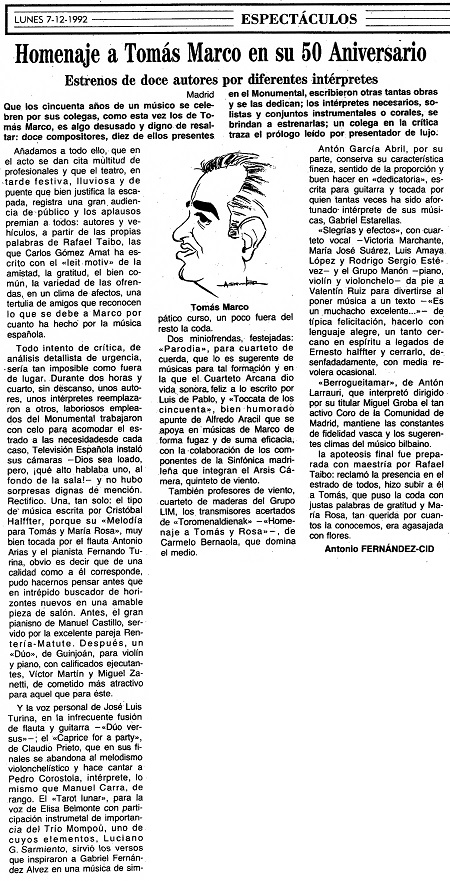
Premieres by twelve composers, played by various performers
For a musician's fiftieth anniversary to be celebrated by his peers, as was the case this time with Tomás Marco, is unusual and noteworthy: twelve composers -ten of whom were present at the Monumental Theatre- each wrote a piece dedicated to him; the necessary performers, including soloists, instrumental ensembles, and choirs, eagerly premiered them; a fellow critic penned the prologue, which was read by a distinguished presenter.
Added to all this, a multitude of professionals gathered for the event, and the theater, on a festive, rainy holiday weekend that provided a perfect excuse for an outing, saw a large audience whose applause rewarded everyone -composers and performers alike. From Rafael Taibo's opening words to Carlos Gómez Amat's text, imbued with the «leitmotif» of friendship, gratitude, shared purpose, and the diversity of offerings, the atmosphere was one of deep affection -an intimate gathering of friends acknowledging Marco's invaluable contributions to Spanish music.
Any attempt at critique or detailed, immediate analysis would have been both impossible and out of place. For two hours and fifteen minutes, without intermission, one composer and performer succeeded another, while the diligent staff of the Monumental worked tirelessly to adjust the stage for each new setup. Spanish Television set up its cameras -thankfully, though one technician at the back of the hall was speaking rather loudly!- and there were no surprises worth noting.
[...]
And the distinct voice of José Luis Turina was present in the rare fusion of flute and guitar -«Dúo Versus» [...].
[...]
The grand finale was masterfully orchestrated by Rafael Taibo: he called everyone onto the stage, invited Tomás to join them, and Marco delivered a closing statement with well-earned words of gratitude. Meanwhile, María Rosa, so dear to all who know her, was honored with flowers.
Twelve premieres
By Carlos Gómez Amat
(Critique published in El Mundo newspaper, Madrid, December 8, 1992)

Well then, this is going to be like the telephone directory, which, according to the famous madman, is full of characters. A beautiful tribute was paid to Tomás Marco by his colleagues and peers -not only a composer but also a critic, organizer, revitalizer of musical life, author of books, and so on. He does it all, and he does it well. In short, he is the «indispensable man». This is widely recognized, and that is why he has been honored with this musical crown -something usually reserved, when it happens at all, for when the honoree is already a gloomy and withered corpse, as Don José Zorrilla once put it. Fortunately, at fifty, Tomás is as fresh as a rose.
Twelve new works dedicated to a friend and magnificently performed. This is not the time to go into detail. Rafael Taibo presented with his usual mastery and read a few lines from this humble servant of yours, which, together with those of José Luis García del Busto in the program notes, helped set the right tone for this friendly gathering.
We then enjoyed [...] the assured wisdom of José Luis Turina -Dúo Versus, flute and guitar [...].
As you can see, a small musical army. If everyone who belonged -both friends and musicians- had been present, it would have been overwhelming. There was a large audience that applauded enthusiastically.
Tomás gave his thanks, we all went up on stage, and mutual applause was exchanged. Naturally, the event was also dedicated to María Rosa, the fair lady of the castle in Spanish music, with a thousand knight-errants at her service. Truly, everything turned out beautifully. Perhaps no musician has ever received such a valuable, sincere, and heartfelt tribute.
In Honor of Tomás Marco
By Leopoldo Hontañón
(Review published in the January 1993 issue of the magazine Scherzo)
