home > bibliography > José Luis Turina: The professions of the musician
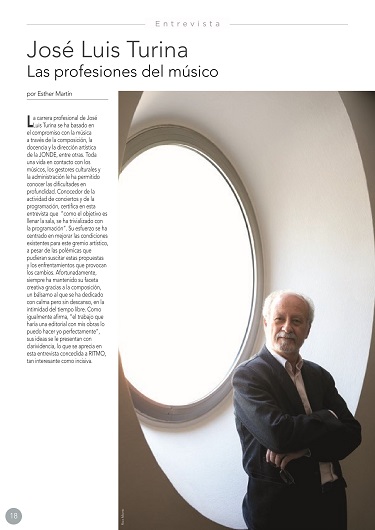
José Luis Turina. Las profesiones del músico / José Luis Turina: The professions of the musician
By Esther MarínInterview published in the January 2018 issue of RITMO magazine
The professional career of José Luis Turina has been based on a commitment to music through composition, teaching, and his role as the artistic director of the Spanish National Youth Orchestra (JONDE), among other pursuits. A lifetime in contact with musicians, cultural managers and the administration has allowed him to gain deep insight into the difficulties faced by the field. As someone well-versed in concert activity and programming, he states in this interview that "since the goal is to fill the hall, programming has been trivialized". His efforts have focused on improving the existing conditions for this artistic guild, despite the controversies that these proposals might generate and the conflicts that changes provoke. Fortunately, he has always maintained his creative side through composition, a balm to which he has dedicated himself calmly but relentlessly, in the privacy of his free time. As he also states, "what a publishing house would do with my works, I can do perfectly well myself"; his ideas come to him with clarity, as seen in this interview with RITMO, which is as interesting as it is incisive.
Question.- Let's start with the beginning, which is very important in your case because you started late in music…
Answer.- I began my musical studies at the age of 17, a late start, so that when I came into contact with composition, my peers had already assimilated integral serialism and its consequences. I felt out of place in a generation that I belonged to by age, but not creatively, and naturally, I also couldn't identify with the next one. This situation was key to the independence of my musical career; it pushed me to follow a path that would fully satisfy me.
Q.- What does composing mean to you?
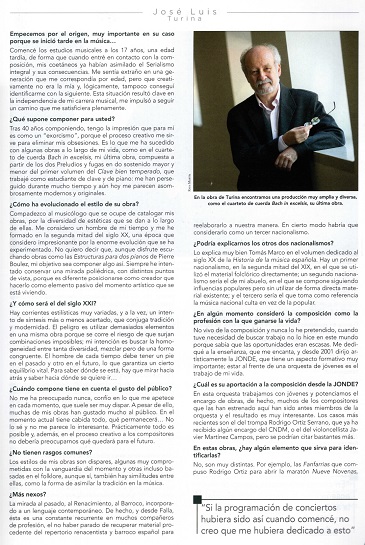
A.- After 40 years of composing, I have the impression that for me it is like an "exorcism", because the creative process helps me to eliminate my obsessions. This is what has happened with some of my works throughout my life, like the string quartet Bach in Excelsis, my latest work, composed from the two preludes and fugues in C# major and minor from the first volume of The Well-Tempered Clavier, which I studied as a harpsichord and piano student, and which have haunted me for a long time and still seem astonishingly modern and original to me.
Q.- How has the style of your work evolved?
A.- I pity the musicologist who has to catalog my works because of the diversity of aesthetics that appear throughout them. I consider myself a man of my time, and I was trained in the second half of the 20th century, an era I find impressive due to the enormous evolution experienced. I do not mean that, even though I enjoy listening to works like Structures for two pianos by Pierre Boulez, my goal is to compose something like that. I have always tried to maintain a multifaceted perspective, with different points of view, because it is different to position oneself as a creator than as a passive element of the artistic moment being experienced.
Q.- And how will it be in the 21st century?
A.- There are very varied stylistic currents and, at the same time, a more or less successful attempt at synthesis that combines tradition and modernity. The danger is using too many elements in a single work because there is a risk that impossible combinations may arise, bordering on pastiche; my intention is to seek homogeneity amid such diversity, to mix but in a coherent way. The person of each time must have one foot in the past and another in the future, which guarantees a certain vital balance. To know where one is, one must look back and know where one wants to go.
Q.- When you compose, do you think about the audience's taste?
A.- I have never been concerned about that; I trust what I feel like doing at any given moment, which is usually very different. Nevertheless, many of my works have been very well received by the audience. At present, everything has a place; what will endure... I don't know, and I don't find it interesting. Practically everything is possible, and, moreover, in the creative process, composers should not worry about what will last for the future.
Q.- Do they have no common traits?
A.- The styles of my works are diverse, some are very committed to the avant-garde of the moment, and others are even based on folklore. However, there are similarities among them, such as the way of assimilating tradition in music.
Q.- More connections?
A.- A glance at the past, at the Renaissance, the Baroque, incorporated into a contemporary language. In fact, since Falla, this has been a recurring theme among many colleagues in the profession: the continuous recovery of material from the Spanish Renaissance and Baroque repertoire to rework it in our own way. In a sense, this could be considered a third nationalism.
Q.- Could you explain the other two nationalisms?
A.- Tomás Marco explains it very well in the volume dedicated to the 20th century of The History of Spanish Music. There is a first nationalism, in the second half of the 19th century, which directly used folk material; a second nationalism would be that of my grandfather, which involved composing with popular influences but without directly using existing material; and the third would be the one that takes cultivated national music as a reference instead of popular music.
Q.- Did you ever consider composition as a profession to make a living from?
A.- I don't make a living from composition, nor have I ever intended to. When I needed to find a job, I didn't do it in this field because I knew the opportunities were scarce. I dedicated myself to teaching, which I love, and since 2001 I have been the artistic director of the JONDE, which has a very important educational aspect; leading a youth orchestra has been the work of my life.
Q.- What is your contribution to composition from JONDE?
A.- In this orchestra, we work with young people and promote the commissioning of works; in fact, many of the composers who have premiered works here were previously members of the orchestra, and the result is very interesting. The most recent cases are horn player Rodrigo Ortiz Serrano, who has already received some commissions from the National Center for Musical Diffusion (CNDM), or cellist Javier Martínez Campos, but there are many others who could be mentioned.
Q.- Are there any elements in these works that help identify them?
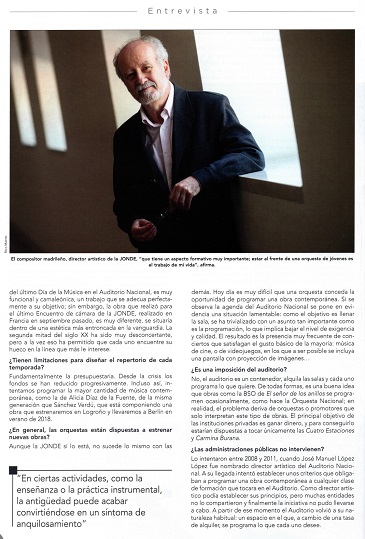
A.- No, they are very different. For example, the Fanfares composed by Rodrigo Ortiz to open the "Nine Ninths" marathon on the last Music Day at the National Auditorium are very functional and chameleon-like, a piece that fits perfectly with its purpose; however, the work he did for the last JONDE Chamber Music Meeting, held in France last September, is very different and would be placed within a more avant-garde aesthetic. The second half of the 20th century was very disconcerting, but at the same time, it allowed everyone to find their place in the line they were most interested in.
Q.- Are there any limitations to designing the repertoire for each season?
A.- Mainly budgetary. Since the financial crisis, funds have been gradually reduced. Even so, we try to program as much contemporary music as possible, such as that of Alicia Díaz de la Fuente, from the same generation as Sánchez Verdú, who is composing a piece that we will premiere in Logroño and take to Berlin in the summer of 2018.
Q.- Are orchestras, in general, willing to premiere new works?
A.- Although JONDE is, this is not the case with other orchestras. Nowadays, it is very difficult for an orchestra to provide the opportunity to program a contemporary work. If you look at the agenda of the National Auditorium, it becomes evident that the situation is lamentable: since the goal is to fill the hall, an issue as important as programming has been trivialized, which implies lowering the level of demand and quality. The result is the frequent presence of concerts that satisfy the basic tastes of the majority: film music or video game music, preferably including a screen with image projection...
Q.- Is this imposed by the auditorium?
A.- No, the auditorium is just a venue; it rents out its halls, and each one programs what they want. In any case, it is a good idea to occasionally program works like The Lord of the Rings soundtrack, as the National Orchestra does; the real problem comes from orchestras or promoters who only perform this type of work. The main goal of private institutions is to make money, and to achieve this, they would be willing to play only The Four Seasons and Carmina Burana.
Q.- Don't public administrations intervene?
A.- They tried between 2008 and 2011, when José Manuel López López was appointed artistic director of the National Auditorium. Upon his arrival, he tried to establish criteria that required any kind of ensemble playing in the Auditorium to program a contemporary work. As artistic director, he could set his principles, but many entities did not share them, and eventually, the initiative could not be carried out. From that moment on, the Auditorium returned to its usual nature: a space where, in exchange for a rental fee, each person programs whatever they want.
Q.- Will the new generations change this way of understanding programming?
A.- They haven't had the opportunity yet, but it's likely, although it could be worse; we haven't hit rock bottom. If concert programming had been like this when I started, I don't think I would have dedicated myself to it. Fortunately, I have this job, from which I try to guide the new generations of performers, who are the most impressive this country has ever produced.
Q.- In what sense?
A.- Currently, the musicians who finish their higher studies at conservatories make up the best generation that has existed in decades, but their situation is complicated: faced with the difficulty of finding work, they continue their studies once they have completed their higher degree. This achieves a very high level, both qualitatively and quantitatively, but obviously, that is not the way forward nor the solution.
Q.- You have always been very involved with music education. In fact, you collaborated in the development of the regulations for LOGSE.
A.- Yes, in the 1990s, I was very actively involved as an advisor in the development of this law, which marked a before and after in artistic education in this country.
Q.- Did this legislative change promote the development of musical studies?
A.- Yes, for decades we had suffered from a very confusing and disorganized structure in music education. When I started, we had students of different ages in the same class because all levels were taught in the same institution (in my case, the Royal Conservatory of Music in Madrid), and teachers were hired based on fluctuating student enrollments.
Q.- Some structures did not change then and remain the same, such as those related to the teaching staff…
A.- Conservatory professors have the status of secondary school teachers, and no government has taken the step to elevate these studies and their teachers to the university level. Before the Popular Party (PP) came to power in 1996, a draft law for Higher Art Education Centers was being developed, which was an intermediate solution between what existed at the time and a university framework, but it was never even discussed.
Q.- What would have happened if this law had been enacted?
A.- Higher art education centers would have been assimilated into universities, but within their own legal framework, independent of them.
Q.- How are the chairs filled?
A.- I have not been in touch with these matters for many years, but I suppose that most are filled by professional-grade teachers who are temporarily assigned to higher education centers, as was done before. The problem is that, in reality, they are not full professors, although after working in this role for a certain time and through a selective process, they can obtain that rank. In any case, in certain activities, such as teaching or instrumental practice, seniority can end up becoming a symptom of stagnation, and one must be very vigilant to prevent that from happening.
Q.- After your retirement, what plans do you have?
A.- Although I could have retired already, I have requested an extension. I remain focused on JONDE until the time comes to be less involved and start thinking about other things. I have always greatly enjoyed composing, and my work pace is calm; I've spent a year and a month working on the quartet I mentioned earlier, which I hope to finish these days and which I have had to interrupt several times to work on pieces that were requested with more urgency. I haven't charged for a commission for many years, but fortunately, I live off my job, and this way, I have the freedom to accept what I want at any given time. On many occasions, I have reversed the usual process of composition, and until the work is finished, I don't think about its purpose. As you can see, my case as a composer has been very particular since its beginnings, and it still is.
Q.- To the point of being your own publisher...
A.- The work a publisher would do with my pieces I can do perfectly myself. I admit that I haven't paid much attention to my music; it could have been performed more often if I had been more vigilant about it. That's one of the things I'll focus on when I retire: promoting my works. Personally, I regret many of the pieces I've published.
Q.- Could you explain why?
A.- Thanks to technology and the Internet, the process is simpler. We all use software to edit sheet music, and in the digital age, paper is no longer as necessary as it once was. Thus, the only role a publisher has today is to promote its authors' music at festivals and concerts. In my case, no publisher has done that, although most of my colleagues who have a publisher supposedly concerned with this haven't fared much better.
Q.- In 2017, Spanish composers made the news when INAEM gave them a space in the Auditorium that began with a first photo.
A.- It was conceived as a starting point, and from that perspective, it's a good idea because at the National Auditorium there were many photos of performers or conductors but none of composers, even though many works have premiered there. My colleagues and I appreciate the initiative because, deep down, the history of music is the history of musical composition.
Q.- Do you feel part of that generation?
A.- No, we are not the same age, and some of them were even my teachers. Antón García Abril was my professor at the conservatory, and his teaching was crucial in my training, along with that of Carmelo Bernaola during some summer courses.
Q.- Do you miss any colleagues?
A.- This is supposed to be just the beginning, and this space will eventually be surrounded by more photos, although to this day no more have been hung. It is the National Auditorium itself that is in charge of this, and I have no doubt they will continue to expand it. As for names, Agustín González Acilu, Ángel Oliver, Joan Guinjoan, Manuel Castillo, Carmelo Bernaola, José Ramón Encinar, José Manuel López López, and many others should be there... The list would be endless.
Thank you for your time.