

Cover of issue no. 13 of Platea Magazine
(Madrid, October–December 2019)
On the 70th Anniversary of the Death of Joaquín Turina
Article published in issue no. 13 of Platea Magazine. Madrid, October–December 2019Aware of the importance of his legacy, and with the intention of doing everything possible to protect and promote it, from the very beginning of my career as a composer I have devoted a large part of it to working on the music of my grandfather, the composer Joaquín Turina, the 70th anniversary of whose death was commemorated this past January 14. Returning to his music time and again has been a constant in my professional activity. As proof of this, I can cite the reconstruction, in the early 1980s, of the score of the opera Jardín de Oriente, whose whereabouts were -and still are-unknown, and which I had to rewrite in its entirety from the orchestral material preserved at the Sociedad General de Autores de España. What today would be extremely simple using any music notation software required, at the time, many months of painstaking work, as it had to be done by hand and bar by bar. However, it proved worthwhile, as it made possible the revival of the opera at the Teatro de la Zarzuela in Madrid in February 1982, at the initiative of the Dirección General de Música y Teatro, in commemoration of the centenary of the composer's birth.
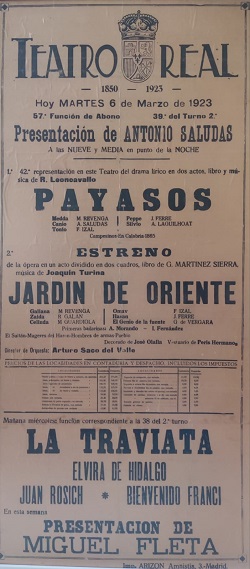
Poster for the premiere of Jardín de Oriente
(Madrid, March 6, 1923)
Shortly after completing the reconstruction of that score, the Orquesta Bética de Sevilla asked me to finish the orchestration of the last two numbers of El Poema de una Sanluqueña, of which my grandfather had completed the first two. The complete orchestral version was premiered by the orchestra in Seville in September 1982, again coinciding with the centenary of his birth, with Luis Izquierdo conducting and Pedro León as the soloist in the beautiful violin part. And, already as a composer, my piano piece ¡Ya "uté" ve…! (based on a three-note figure with which Turina portrays María, a waitress at the Café "Nueva España" in Recuerdos de mi rincón, and shortly thereafter in "La morena coqueta," from the first series of Mujeres españolas) was included in the tribute volume to Joaquín Turina published by the Ministry of Culture that same year.
This was followed by successive arrangements (of the Serenata, Escena andaluza and La oración del torero -for string octet, and for violin, clarinet, and piano), along with many articles, lectures, program notes, and CD booklets, as well as the critical edition of the Sonata española of 1907–08, which had been withdrawn from circulation by the composer and was brought back into print by Schott in 1991. However, none of this compares to the work involved, between October 2014 and January 2016, in transcribing for wind quintet four of my grandfather's works that stand at key points in his output.
The initiative arose after a concert at the Chamber Hall of the Auditorio Nacional de Música in Madrid in early October 2014, in which various groups formed within the Joven Orquesta Nacional de España -whose members all belonged to it and later developed professional careers as chamber ensembles (such as Hércules Brass, Trío Rodin, Academia de las Luces, and Trío Vasnier, among others)- were invited to commemorate the 30th anniversary of the JONDE.
The second half of the last of the two concerts was performed entirely by the wind quintet Azahar Ensemble (1), whose official presentation I had the privilege of attending as the sole guest during the orchestra's working period in Santiago de Compostela in July 2010. At the end of the concert, its members expressed their regret that, in the many concerts they performed abroad, they could never satisfy organizers' requests to include a Spanish wind quintet by a composer of the "Generation of the Masters", for the simple reason that none of them (neither Albéniz, nor Granados, nor Falla, nor Turina) had written anything for that ensemble.
Although the wind quintet became established as a genre in the early 19th century (Danzi and Reicha are undoubtedly the most representative composers of that period), with its repertoire steadily expanding thanks to a significant number of European and American composers, our great composers of the late 19th and early 20th centuries adhered instead to the aristocratic tradition of chamber music -written especially for ensembles including piano, violin, and/or cello- clearly rooted in the 19th century, as opposed to the more plebeian tradition of wind-based ensembles. Without leaving Joaquín Turina's catalogue, it includes no fewer than 16 chamber works: three string quartets (since La oración del torero must be considered as such in its transcription by the composer from the original for lute quartet), three piano trios, one piano quartet, one piano quintet, and five duos for violin and piano. The remaining three works that complete these 16 are particularly striking for their unconventional instrumentation: a sextet for principal viola, piano, and string quartet entitled Escena andaluza; a suite of nine movements, each written for a different combination based on voice, piano, and string quartet, called Las Musas de Andalucía; and a Tema y Variaciones for harp and piano. As can be seen, wind instruments are conspicuously absent from all of them.
In various articles I wrote around the 50th anniversary of Joaquín Turina's death, as well as in several lectures, I highlighted this group of works as the most cohesive and interesting part of the composer's catalogue, one that allows him to shine with particular brilliance within the chamber music panorama of the "Generation of the Masters". Neither Falla nor Albéniz composed works for the classical ensembles (piano duos and trios, string quartet, piano quartet and quintet), and only Granados approached the genre with a piano trio, a piano quintet, and several pieces for duo with piano, among which a violin sonata survives only in its first movement.
Surely my own appreciation of my grandfather's chamber music, together with the conversation with the members of Azahar Ensemble after the aforementioned concert, led me to embark without hesitation on the transcription for wind quintet of some of his most representative works. As a trial, I began with Sacro-Monte from Cinco danzas gitanas. The ensemble's enthusiasm upon receiving it, and the successful outcome in performance, encouraged me to complete the transcription of the rest of the suite. A few weeks later came La oración del torero, which was equally well received, both by the musicians themselves and by audiences at its first performances. At that point, the idea of recording a CD arose, which required expanding the material with arrangements of the suite Sevilla and the five movements of the second series of Mujeres españolas. Finally, the CD was completed with the arrangement of my own Variaciones sobre temas de Turina, originally composed for piano four hands for a family tribute to my father, the painter José Luis Turina Garzón, on the occasion of his 90th birthday in 2009.

Cover of the CD Turina x Turina by Azahar Ensemble
Although I am aware that this is not entirely the case, I like to think that, with the wind quintet orchestrations of those four works by Joaquín Turina, I have contributed to expanding a chamber music catalogue of unquestionable importance, but one that lacked a section devoted to an ensemble supported both by history and by its timbral characteristics. Orchestrating those pieces meant giving free rein, in equal measure, to the musical genes inherited from my grandfather and the pictorial ones from my father: the palette -metaphorically speaking- provided by the color of the quintet adapts wonderfully to the melodic and harmonic color of the music itself, highlighting the brilliance, contrasts, passion, and enchantment that abound in those scores. In short, it was an intense and very laborious task, but one whose result has brought me great satisfaction. The presentation of the CD at the Manuel de Falla Hall of the SGAE this past February was also an excellent way to commemorate the 70th anniversary of the composer's death.
(1) Azahar Ensemble, made up of Frederic Sánchez (flute), María Alba Carmona (oboe), Miquel Ramos (clarinet), Antonio Lagares (horn), and María José García Zamora (bassoon), won second prize (the first was not awarded) and the Audience Prize at the highly prestigious ARD Competition in Munich in September 2014.
Madrid, August 2019