
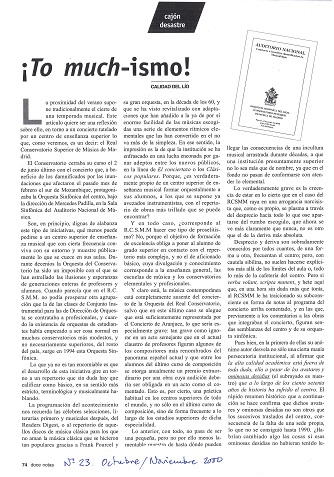
¡No pasarán! / They shall not pass!
This article was written for no. 23 (October-November 2000) of
The approach of summer traditionally marks the conclusion of one musical season and the public preview of the next. This article aims to reflect on both, focusing on a concert and a series sponsored by two institutions dedicated to higher education -which, as we shall see, is a saying: the Royal Conservatory of Music of Madrid and the Complutense University.
The former closed its academic year on June 2nd with a concert benefiting those affected by the floods that struck southern Mozambique this past February. The concert featured the Symphony Orchestra of the conservatory, conducted by Mercedes Padilla, and took place in the Symphony Hall of the National Music Auditorium. The latter announced its 2000-2001 season, presenting a preview to the audience at the Auditorium.
At first glance, both initiatives are praiseworthy. The University's effort deserves commendation because cultural enjoyment -and music, let us not forget, is a part of culture- and fostering the cultural breadth expected of students entering higher education are by no means incompatible with its primary mission of research. The Conservatory's effort is also commendable because, aside from the charitable nature of the event, what less can be expected of an advanced musical institution than to occasionally engage with its surroundings and publicly showcase what is being cultivated within its walls? For decades, the Conservatory's orchestra has been a pipe dream that has dashed the hopes of generations of teachers and students alike.
When it seemed that no ensemble could thrive in the Royal Conservatory of Music of Madrid beyond those formed in the Instrumental Ensemble classes -and when orchestral conducting classes required hiring professionals- student orchestras had already become the norm in many smaller conservatories across the country, even those that were not considered "higher" institutions. In 1994, however, this Symphony Orchestra emerged, initially directed by Luis Izquierdo, later by Jesús Amigo, and since 1999 by Mercedes Padilla, a professor of Counterpoint and Fugue at the "Arturo Soria" Professional Conservatory of Music and currently at the Royal Conservatory of Music of Madrid on secondment.
What is less commendable, however, is that the development of these initiatives -outreach and training, respectively- revolves around a repertoire that must undoubtedly be classified as "basic" in the strictest sense of the term, both terminologically and musically.
The programming of these two events -the concert and the series- brings to mind the famed literary and musical selections of Reader's Digest, or the repertoire of those "classical music for people who don't love classical music" records made popular by Franck Pourcel and his grand orchestra in the 1960s. This trend has been revitalized with adaptations that, beyond the inherent simplicity of the chosen music, add rudimentary rhythmic elements, making them the pinnacle of simplicity. In this sense, it seems as though both institutions have become embroiled in a fierce competition to win over "new audiences", much like El Conciertazo or Clásicos populares. But is it truly fitting for a higher education musical institution to train its students -presumably already skilled instrumentalists- in orchestral performance with the most overplayed repertoire available? And is it acceptable for a university-level institution to organize a series musically designed, at best, for middle school music classes? (1)
In any case, should either institution engage in this kind of proselytism? The Conservatory should not, as the aim of excellence in training requires exposing higher-level students to the most complex repertoire, not that of basic enthusiasts -a task suited to general education, music schools, and elementary and professional conservatories. Nor should the University, as this has no relation to its stated objective of research, which, as we mentioned earlier, is not only a priority but intrinsic to its mission.
And of course, contemporary music is practically absent throughout the Complutense University cycle, and completely so from the concert by the Orchestra of the Royal Conservatory, unless one argues that it is sufficiently represented by the Concierto de Aranjuez, which would be particularly grievous. It would be as serious as ignoring, in such an event, the fact that some of the most renowned composers in the current Spanish music scene are members of the faculty (not to mention all those who have passed through its halls since its founding -among whom, notably, maestro Rodrigo was not included). Furthermore, each year an extraordinary award is granted to a student in the final year of Composition for a piece that ought to be required listening in such an event -whether it be a year-end, opening, or charitable concert. This is a common practice in advanced institutions worldwide, not only for the final-year Composition students but regularly throughout the higher studies of this discipline.
The foregoing, however, is but a small -though no less lamentable- example of how far the consequences of a deeply ingrained musical ignorance, perpetuated over decades, can go. The result is that two institutions allegedly of higher education are such only in name, for in practice, they are content with addressing the most elementary levels.
What is truly troubling is the shared conviction of both institutions that they are in the right -a conviction that, in the case of the Royal Conservatory of Music of Madrid, borders on narcissistic arrogance. This arrogance, as is typical, manifests itself through disdain for anything that dares deviate from the path the institution has chosen -a path now clearer than ever: absolute drift.
This disdain and drift are well known to anyone who, in one way or another, frequents the Conservatory. However, with cunning discretion, they rarely become explicit beyond the confines of the classroom or, at most, the campus cafeteria. But if verba volant, scripta manent (words fly, writings remain), here we are: at a particularly thoughtless moment, the subconscious of the Royal Conservatory of Music of Madrid has betrayed itself in the form of program notes for the above-mentioned concert. These notes, preceding the commentary on the concert's repertoire (authored by Emilio Rey, Professor of Rhythmics and Paleography), include descriptions of the Conservatory and its Symphony Orchestra.
In the first of these, the anonymous author reveals not only a certain institutional persecution complex by stating that "the high academic quality is beyond doubt, despite the trials and ominous neglects (emphasis ours) that the institution has suffered throughout its 170-year history". The brief historical summary that follows confirms that these trials and neglects refer to the institution's successive relocations due to the lack of a dedicated building -a situation that was not resolved until 1991. Would anything have changed had these ominous neglects not occurred? Categorically, no, as the commentary itself makes clear shortly afterward: "Despite all these trials, the Conservatory has also overcome successive and debatable changes in regulations, academic policies, neglect, and misunderstandings of all kinds".
Of course! That explains the administrators' fondness for solmization, old clefs, and strict counterpoint, as well as their proverbial aversion to contemporary music and anything closer to the 21st century than to Maria Christina, under whose reign the Conservatory was founded in 1830. And if this is true for content, what will it mean for the new curriculum and all the innovations that will stem from the upcoming implementation of higher education degrees? They shall not pass!
Still, all of this is simply anecdotal. Among the unfortunate claims slipped into the Symphony Orchestra's concert program, perhaps the most regrettable is the one that informs the reader that its current director, Mercedes Padilla, "gained media attention several years ago for being the first woman in Spain to undertake such complex musical tasks". While intended as a compliment, the author's words end up being an insult, suggesting that such a difficult job is not meant for a woman. This reflects an unacceptable, underlying machismo that, in any case, "tolerates" Mercedes Padilla's intrusion into the world of orchestral conducting only because, beneath her beautiful feminine appearance, there lies a man's intellect. Would it not have been clearer, and infinitely more elegant, to highlight that Mercedes Padilla's leadership in a field traditionally dominated by men is clear evidence of the capacity of both genders to perform equally?
But not all is lost. A quick visit to the website of the Royal Conservatory of Music of Madrid (www.real-conserv-madrid.es) reveals a glimmer of hope for those who, starting this academic year, knock on its doors to begin their higher education studies. In the "Information" window, under the "1966 Curriculum" submenu, one reads: "The Madrid Conservatory currently operates under the 1966 curriculum. This outdated curriculum (emphasis ours) is being replaced by the 1992 curriculum, known as the LOGSE (!)". (Emphasis and exclamation points ours.)
Shall not they pass?
(1) The program for the concert of the Royal Conservatory of Music of Madrid included the overture to The Barber of Seville, the Concierto de Aranjuez, and The New World Symphony. The Complutense University's series features numerous works by composers ranging from the Baroque to the "light" 20th century (such as Britten or Shostakovich), with the bulk of the program devoted to the Classical and Romantic repertoire. Popular pieces, such as Mahler's Symphony No. 5 or Pictures at an Exhibition, are also included. Particularly noteworthy for its musicological significance is the Officium et Missa pro defunctis by Mariano Rodríguez de Ledesma. However, the cycle's most enigmatic work remains: Spanish work to be determined. Could it, perchance, be contemporary? Or is that asking too much?

Cover of the preview of the 2000-2001 concert season of the Complutense University of Madrid

Inner pages of the preview of the 2000-2001 concert season of the Complutense University of Madrid
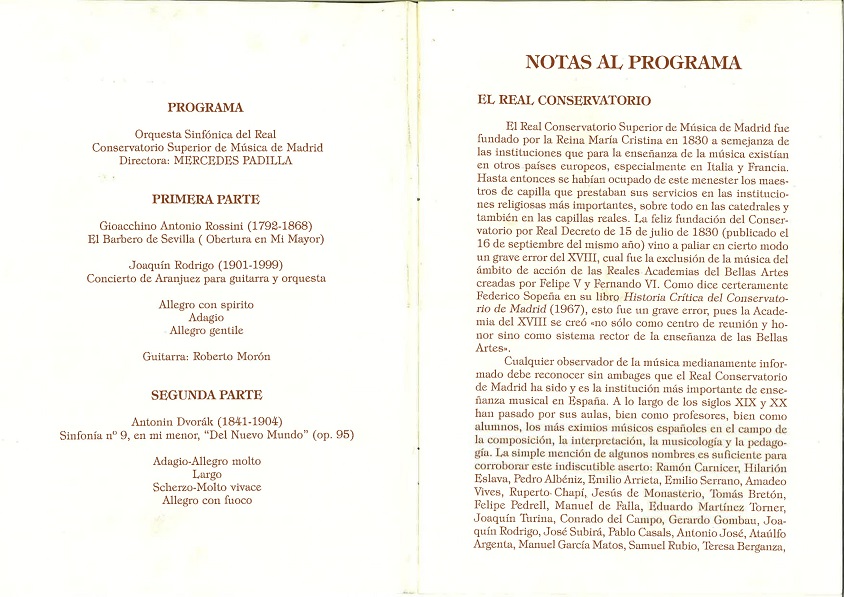

Program notes for the concert at the Royal Conservatory of Music in Madrid