
home > list of works > orchestral music > orchestra > Fantasía sobre una fantasía de Alonso Mudarra / Fantasy on a Fantasy by Alonso Mudarra

Cover of the Three music books in cipher for vihuela by Alonso Mudarra (1546)
Fantasía sobre una fantasía de Alonso Mudarra / Fantasy on a Fantasy by Alonso Mudarra
For OrquestaCommentary
Recording
Videos
Reviews
Download score
Commentary
This work was composed in the spring of 1988 under commission of the Tenerife Symphony Orchestra, which, newly formed in its second epoch, wanted to perform in Madrid including in its program the premiere of work commissioned to a Spanish composer. The managers of the orchestra asked me for a brilliant and outstanding work for the orchestra in general, and, above all, for its brass section, of extraordinary quality, in particular. In addition, they wanted the work to somehow recreate the music of the Spanish Renaissance, in the line of a series of works that were composed at that time (Villanesca and Abestiak, by Bernaola -on Francisco Guerrero and Juan de Anchieta, respectively-, Music for an inauguration, by Bertomeu -on Pablo Bruna-, and especially, Tiento de primer tono y Batalla imperial, by Cristóbal Halffter -on Francisco Correa de Arauxo y Juan Bautista Cabanilles-.
I chose the music of a 16th century composer: Alonso de Mudarra. Specifically, I chose what is surely his best-known work: the Fantasía n. 10, for vihuela, which bears the curious subtitle "that counterfeits the harp in the manner of Ludovico". This fantasy contains a series of dissonant notes, called false at the time, which must have sounded extremely strange to its contemporaries, and that is why they make it so suggestive for today's ears, for whom dissonance is something habitual.

First page of the Fantasía n. 10 by Alonso Mudarra
Recording: Hopkinson Smith (lute)
In my Fantasía on that Fantasy, Mudarra's music blends with mine, alternating back and forth in separate sections and, at the same time, imbuing one with the flavor of the other. Thus, in the quotes from Mudarra's Fantasía, the orchestration highlights even more the harshness of the original dissonances, while the language of the sections that frame them is softened by allowing itself to be penetrated by Renaissance sonorities, solidly consonant, with an unmistakable modal flavor.
In this way, the central section is entirely occupied by a modal melody that, widely sung in unison by the entire string section, progresses from the darkest mode, the Phrygian, to the brightest, the Lydian, through a complex contrapuntal network that, starting from the unison, expands in the form of canons until reaching a scope of five octaves.

Main phrase of the middle section of the Fantasía sobre una Fantasía de Alonso Mudarra
(Phrygian mode; in the last measure of the example the repetition is started in Dorian mode)

Final of the middle section of the Fantasía sobre una Fantasía de Alonso Mudarra.
Overlapping in canon on Violins I of the phrase in Mixolydian and Lydian modes
The score, dedicated to my son Guillermo, was premiered in the fall of 1988 by the Tenerife Symphony Orchestra under the direction of Víctor Pablo Pérez. Given its brilliance and its rapid communication with the listener from the first hearing, it is not surprising that it is my most performed orchestral work, having been recorded on CD three times, the last one in 2007 by the Malaga Philharmonic Orchestra conducted by Aldo Ceccato.

|

|

|


Cover of the CD "Spanish contemporary music" (1991)

Cover of the monographic CD of the Málaga Philharmonic Orchestra (2006)

Cover of the CD Recreation of the Málaga Philharmonic Orchestra (2007)

First page of the Fantasía sobre una Fantasía de Alonso Mudarra
Recording
Recording: The National Youth Orchestra of Spain (Cond.: Cristóbal Soler)Videos
Simón Bolívar Venezuelan Youth Symphony Orchestra. Cond.: Alfredo Rugeles
Caracas (Venezuela), Teresa Carreño Theater, April 2008. First Hispanic-Venezuelan FestivalVideo RTVE: Spanish Radio Television Symphony Orchestra. Cond.: Cristóbal Soler
Madrid, Teatro Monumental, January 13, 2017Reviews
The fashionable orchestra
By Juan Ángel Vela del Campo
(Review published in the newspaper El País. Madrid, October 23, 1989)

[...]
Bright, gimmicky and brilliant was the Fantasía sobre una fantasía de Alonso Mudarra, by José Luis Turina, a recreation with current sonorities of one of the works from the Spanish Renaissance viehuelistic repertoire. Composed in April and May 1989, it was the first time it was heard in Madrid.
[...]
Making good music doesn’t cost that much
By Antonio Moral
(Review published in El Independiente newspaper, Madrid, October 23, 1989)
That an orchestra like Tenerife’s, virtually nonexistent just over five years ago, has achieved such a high artistic level as the one we enjoyed in the first of its three Madrid concerts -within the ONE cycle, while on tour in Galicia to inaugurate a new auditorium in Santiago de Compostela- is nothing short of miraculous in a country like ours. If, in addition, we consider that this «provincial» orchestra’s budget is five times smaller than that of any of its Madrid counterparts, which are fully funded by public money, the situation becomes truly alarming. It calls into question the government's policy on the matter -if such a policy has ever existed at all.
[...]
The program was completed with the Madrid premiere of «Fantasía sobre una fantasía de Alonso Mudarra» by Madrid-born composer José Luis Turina, a work that demonstrated serious craftsmanship and solid execution. The piece, with no other aim than orchestral display and enjoyment, is skillfully constructed and exhibits an excellent sense of color. The audience, not typically receptive to premieres, confirmed its appreciation with a long ovation for the composer.
The talent of José Luis Turina
By Fernando Ruiz Coca
(Review published in Ya newspaper, Madrid, October 24, 1989)

[...]
The Tenerife orchestra presented an interesting program, featuring the world premiere of «Fantasía sobre una fantasía de Alonso Mudarra» (the one that «imitates Ludovico's harp»), composed by José Luis Turina -grandson of the great Sevillian musician (Madrid, 1952). The piece was commissioned by the Tenerife orchestra, which requested a work that would be «brilliant, effective, and showcase the orchestra as a whole, particularly its splendid brass section». The young Turina has fulfilled the commission to perfection, transforming Mudarra's delicate vihuela piece into the grandeur of the orchestra, giving special prominence to the excellent brass section. [...]
Canarians are still in the lead
By Víctor Burell
(Review published in the newspaper Cinco Días. Madrid, October 25, 1989)

[...]
We could only enjoy the Fantasía sobre una fantasía de Alonso Mudarra, by José Luis Turina, a work that, leaving the field of orchestrations on pieces from antiquity, to which we are accustomed, glosses -creating- the Fantasy n. 10 by the 16th century vihuelist. The languages of the past and modernity come together, empowering each other naturally, until we perceive everything that is current in Mudarra's message. But through a brilliant new form, recognizable qualitatively and quantitatively as the creation of the maker of the gloss. The preparation of the piece by the OST, second to none, led directly to that unusual success for music today.
[...]
Turina and Mintz, with the Tenerife Symphony Orchestra
By Leopoldo Hontañón
(Review published in the newspaper ABC. Madrid, January 11, 1990)
The Tenerife Symphony Orchestra, probably the one that has experienced the fastest and most solid relative progress among all regional and autonomous orchestras, has designed an ambitious program for the 1989-90 season. This program includes a reasonable presence of both performers and composers from our country, while also featuring names from the latest generations, such as José Luis Turina and Jorge Fernández-Guerra, both with world premieres. As part of this season, the Tenerife ensemble will perform a couple of concerts that are also included in the 6th Canary Islands International Music Festival, which has just begun. I want to highlight these concerts here for two reasons. Their program includes «Variations on a Theme by Haydn» by Brahms, «Violin Concerto in E minor» by Mendelssohn, «The Firebird» by Stravinsky, and -here lies the first reason- «Fantasy on a Fantasy by Alonso de Mudarra» by José Luis Turina. These concerts will take place in Tenerife and Las Palmas, respectively, next Saturday and Sunday.
Among those of us who write about this subject, there is unanimous agreement that the most serious limitation affecting Spanish music -aside from education- is not a lack of premieres (although there are too few of those as well) but rather a lack of re-performances. The Juan March Foundation does organize periodic revival concerts, but beyond that, there is little else. That is why I want to highlight the approach taken by the Canary Islands ensemble and its principal conductor, Víctor Pablo Pérez. The «Fantasy on...» was commissioned by the Tenerife Symphony Orchestra itself from the Madrid-born composer and was premiered as an absolute world premiere during the three-day concert series in which the ensemble participated in the 1989-90 season (on October 8, 9, and 10) at the Madrid Auditorium as part of the subscription series of the National Orchestra of Spain (ONE). Not only was the new work performed again for four consecutive days -on October 11, 12, 13, and 14, making it, in a sense, a «continuous world premiere» without any ironic intent- but now, as I mentioned before, it will be performed twice more this coming weekend. Nine performances in the span of three months seems to me a sufficient number to highlight the exceptional nature of this case. (And this is true even if the piece follows a creative formula that may be starting to be overused. Antonio Fernández-Cid, in his favorable review of the Madrid premiere, noted something along these lines, referring not only to this newly premiered work but also to «Tiento y Batalla Imperial» by Cristóbal Halffter and «Fandango de Soler» by Claudio Prieto. One could now add, staying within these same composers, «Variations and Disagreements on Themes by Luigi Boccherini» by Turina himself, as well as Cristóbal Halffter's ongoing project for a new interpretation of Soler's fandango, specifically for cellos. But in any case, I insist, every re-performance of a new work is welcome.)
[...]
The Tenerife Symphony Orchestra and violinist Shlomo Mintz
By Agustín Quevedo
(Review published in Diario de Las Palmas. Las Palmas de Gran Canaria, January 15, 1990)
[...]
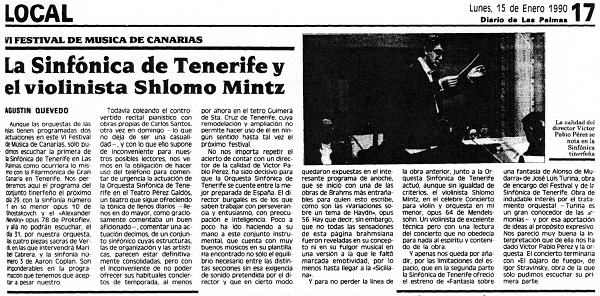
And we can hardly add more, due to space constraints, except to mention that in the second half the Tenerife Symphony Orchestra presented the premiere of «Fantasy on a Fantasy by Alonso Mudarra» by José Luis Turina, a work commissioned by both the Festival and the Tenerife Symphony. A piece of undeniable interest for its orchestral treatment -Turina is a great connoisseur of harmonies- and for its contribution of ideas to expressive intent. We found the performance by Víctor Pablo Pérez and the orchestra to be very fine. [...]
Another good recital from our symphony
By Alfonso de Terán
(Review published in the Diario de Avisos. Santa Cruz de Tenerife, January 16, 1990)

[...]
This would begin with the "Fantasía" by José Luis Turina on a fantasy by Alonso de Mudarra, which, as the author himself says: "its composition was due to a joint commission from the Tenerife Symphony Orchestra and the Canary Islands Music Festival". I hope that the author has been satisfied with the version that the orchestra to which it was dedicated makes of it, since it sounded admirably, with sonorous richness, with timbre dissection in the passages of more advanced musical language, with expressiveness and communicability in a work that due to its contemporaneity requires a special treatment.
The fantasy of José Luis Turina, which was already premiered in the first of the concerts of our symphony this season, begins somewhat informally in crescendo to form the first of the themes that the metals take, from then on they appear a series of fragments of the fantasy of the Spanish Renaissance vihuelist, either in the different sections or in the tutti, juxtaposed with current elements. After about nine minutes of duration, the work ends with a brilliant epilogue in which brass and percussion prevail over the orchestral tutti. The work is frankly interesting and is followed perfectly despite its novelty and this in good art due to the good work of our orchestra and the good judgment of Víctor Pablo Pérez in dealing with it. Being a new work, it is somewhat risky to judge the version, but I dare to predict that it was magnificent, with good sound, attractive and if not, the author corrects me.
[...]
Shlomo Mintz and the Tenerife Symphony Orchestra, conducted by Víctor Pablo Pérez
By Martín Codax
(Criticism published in the newspaper La Provincia. Las Palmas de Gran Canaria, January 16, 1990)

[...]
The session went from night to day with José Luis Turina's «Fantasía», commissioned by the Orchestra and the Festival that had its premiere in Madrid and was now presented in the Canary Islands by the same performers. A true alchemist of symphonic magic, Turina builds a frontal clash between Alonso Mudarra's Fantasy n 10 and his own ideas. Starting from the explosion of the great orchestral «cluster», the inspiring theme appears elaborated in the brass «fanfares» or in the massive strings, in the pointillism of woodwinds and percussion or in the «tutti» as a motley visionary translation of a confrontation between the Renaissance ideal and the paroxysmal stridency of our time. Mudarra's notes are not at any time the guiding axis of the piece, but the pretext of a mechanism of collision or compromise in which the intention that could be called «ideological» gives way to the foreground to the exuberance of the palette and the directly acoustic pleasure of a «total ear» applied to chiseling huge reliefs, moving masses, hypersaturated explosions. In just nine minutes, the complete panel of the compulsive contemporary orchestra materializes.
Sure of gesture, absolute master of the flow and volumes, masterfully ordering the movement, Víctor Pablo Pérez enjoyed the display with his musicians and made us enjoy it.
[...]
Luxury Spanish Music
By José Luis Pérez de Arteaga
(Review of the CD by the Poznan Philharmonic Orchestra conducted by José Luis Temes, published in El Independiente, Madrid, October 26, 1990)

On September 29, during the penultimate day of the Alicante International Festival of Contemporary Music, this CD, sponsored by the Ministry of Culture, was presented. Recorded in August 1989 in Poland, at the Concert Hall of Poznan University, with the highly competent Philharmonic Orchestra of that city, this album includes four works by three contemporary Spanish composers -orchestral pieces that are, moreover, highly significant within their respective catalogs. The excellence of the recording quality and the outstanding conducting work of José Luis Temes -focused not only on achieving absolute precision and cohesion but above all on making music- grant this production enormous significance in our market, which is otherwise quite lacking in orchestral recordings of our national music.
The two pieces included by Madrid-born José Luis Turina (1952) reflect his extraordinary ability to create with originality from preexisting external materials. Luciano Berio himself, regarding his own transcriptions and reinterpretations of other composers, remarked that "often, when speaking of others, we say the most about ourselves". In his Pentimento (1983), Turina "reveals" a passage, hidden behind the orchestra, from Wagner’s Parsifal (and it is fascinating to recall that, in this same year, 1990, another Spanish composer, José García Román, has used Parsifal as the "pretext" for his remarkable Overture for Strings). In his Fantasía (1989), on the other hand, a Fantasía for vihuela by Mudarra serves as the basis for paraphrase, sometimes even openly quoting the original piece. In both cases, the orchestral treatment is brilliantly rich.
[...]
A great talent in orchestral conducting
By Ramón María Serrera
(Review published in the newspaper ABC. Seville, February 9, 1991)
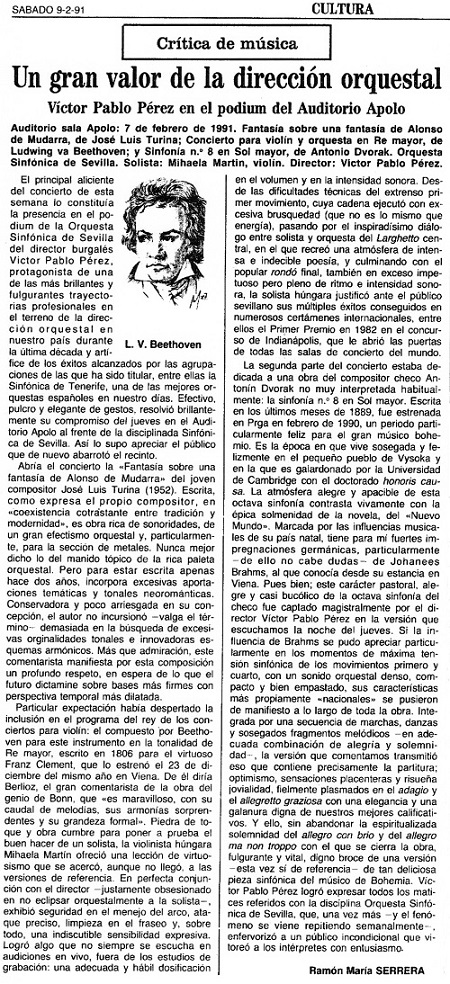
Víctor Pablo Pérez on the podium of the Apolo Auditorium
The main attraction of this week's concert was the presence on the podium of the Seville Symphony Orchestra of the Burgos-born conductor Víctor Pablo Pérez, the protagonist of one of the most brilliant and dazzling professional careers in orchestral conducting over the past decade. He is the driving force behind the successes achieved by the ensembles he has led, among them the Tenerife Symphony Orchestra, one of the best orchestras in Spain today. Efficient, meticulous, and elegant in gesture, he fulfilled his commitment on Thursday at the Apolo Auditorium with great success, conducting the disciplined Seville Symphony. The audience, once again filling the venue to capacity, clearly appreciated it.
The concert opened with «Fantasy on a fantasy by Alonso de Mudarra» by the young composer José Luis Turina (b. 1952). Written, as the composer himself states, in a contrasting coexistence between tradition and modernity, it is a work rich in sonorities, full of orchestral effects, especially for the brass section. The oft-used phrase "a rich orchestral palette" could not be more apt here. However, for a work composed barely two years ago, it incorporates an excessive number of neo-Romantic thematic and tonal elements. Conservative and not particularly daring in its conception, the composer did not venture -if the term may be allowed- too far into the search for bold tonal innovations or new harmonic schemes. Rather than admiration, this reviewer expresses deep respect for this composition, awaiting what the future will determine on firmer grounds and with a broader temporal perspective.
[...]
Flaubert, Soler, Ruders and a chinese sea of witches
By José Luis Pérez de Arteaga
(Review published in the newspaper El Independiente. Madrid, September 27, 1991)
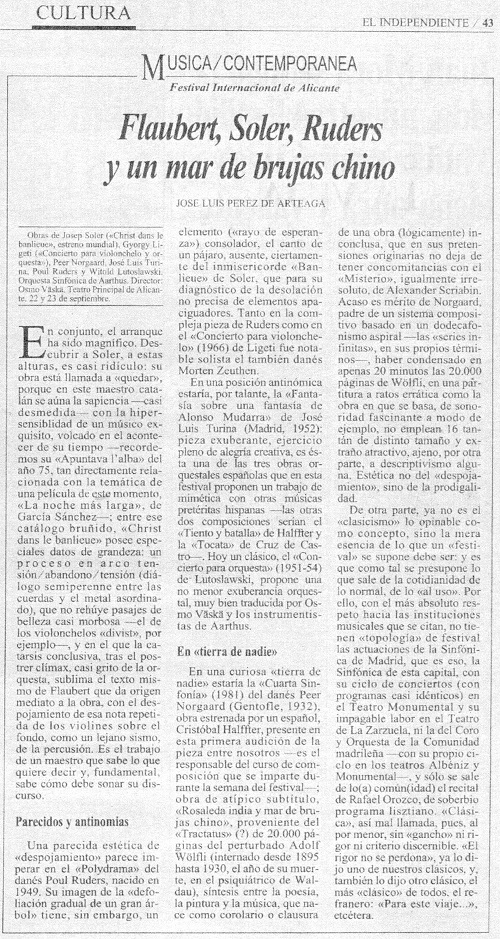
[...]
In an antinomic position, by temperament, would be «Fantasy on a Fantasy by Alonso Mudarra» by José Luis Turina (Madrid, 1952): an exuberant piece, a full exercise in creative joy. This is one of three Spanish orchestral works in this festival that propose a mimetic engagement with earlier Hispanic music -the other two being Halffter's «Tiento y batalla» and Cruz de Castro's «Tocata»-.
[...]
Turina, Ruders and Lutoslawski, performed by the Aarhus Symphony
By Pedro Beltrán
(Review published in the newspaper Información. Alicante, September 28, 1991)
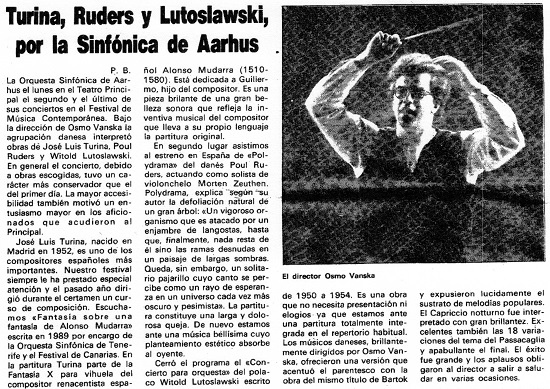
The Aarhus Symphony Orchestra performed the second and final of its concerts at the Contemporary Music Festival on Monday at the Teatro Principal. Under the direction of Osmo Vanska, the Danish ensemble presented works by José Luis Turina, Poul Ruders and Witold Lutosławski. Overall, the concert had a more conservative character than that of the first day, due to the works selected. This greater accessibility also led to a more enthusiastic reception from the music lovers who attended at the Principal.
José Luis Turina, born in Madrid in 1952, is one of the most important Spanish composers. Our festival has always paid him special attention, and last year he led a composition course during the event. We heard «Fantasia on a Fantasy by Alonso Mudarra», written in 1989 on commission from the Tenerife Symphony Orchestra and the Canary Islands Festival. In this score, Turina draws from the Fantasía X for vihuela by the Spanish Renaissance composer Alonso Mudarra (1510–1580). The piece is dedicated to Guillermo, the composer's son. It is a brilliant work of great sonic beauty, reflecting the musical inventiveness of the composer, who transforms the original piece into his own language.
[...]
The National Orchestra, on home ground
By Manuel I. Ferrand
(Review published in the newspaper ABC. Seville, June 30, 1992)
In its two successive appearances at Seville's Teatro de la Maestranza, the Spanish National Orchestra presented itself with the accomplished artistry of an ensemble that seems to have regained both its pulse and its direction. On the occasion of its recently celebrated fiftieth anniversary -held last March 31- our leading orchestra has shown that it can confidently stand alongside top-tier international ensembles. It retains a historical identity -one that enables it, for example, to approach Spanish music with exceptional quality- and has renewed its interest in programming that blends the unusual with the appealing. Milanese conductor Aldo Ceccato, its principal conductor since October 1 of last year, is undoubtedly the key figure behind this new takeoff of the ONE (Orquesta Nacional de España).
[...]
There is no doubt that the National Orchestra continues to be a privileged interpreter of Spanish music: it is part of its very fabric, and it expresses its sense of balance with utmost naturalness. The work of José Luis Turina (1952) is closely linked to the best musical tradition of this country. Far from concealing it, the Madrid-born composer has, on several occasions, chosen music from our past as a starting point for his own compositions. Such is the case with the piece that opened the second of the ONE's concerts in Seville: Fantasía sobre una Fantasía de Alonso Mudarra. This work has been remarkably successful within our recent musical landscape -in its short existence, it has become an essential reference for the new directions Spanish music is taking. Within its orchestral fabric, one can hear the evocative melody that the Renaissance Sevillian composer Mudarra wrote under the title Fantasía que contrahace la harpa en la manera de Ludovico.
[...]
Splendid concert by the Seville Symphony Orchestra
By José Antonio Lacárcel
(Review published in the newspaper El Ideal. Granada, July 3, 1992)
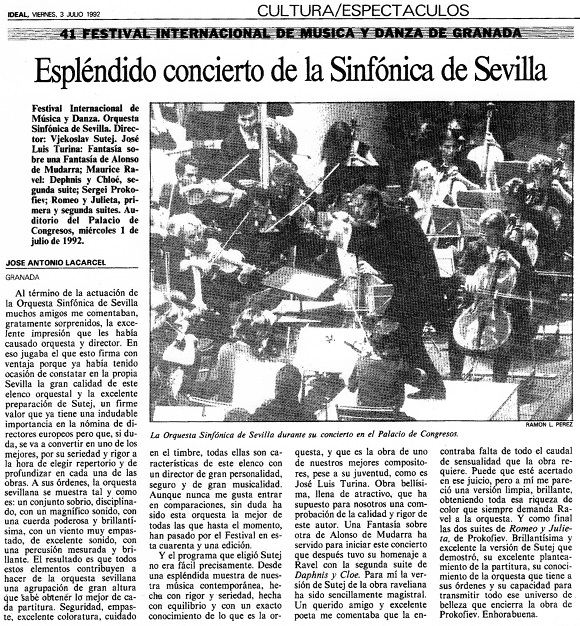
At the end of the performance by the Seville Symphony Orchestra, many friends commented to me -pleasantly surprised- on the excellent impression made on them by both the orchestra and its conductor. In this regard, the undersigned had something of an advantage, having already had the opportunity to witness first-hand, in Seville itself, the great quality of this orchestral ensemble and the superb preparation of Sutej -a solid talent who already holds undeniable stature among European conductors, and who, without a doubt, is destined to become one of the finest, thanks to his seriousness and rigor in selecting repertoire and delving into each work in depth. Under his direction, the Seville orchestra reveals its true character: a sober, disciplined ensemble with magnificent sound, a powerful and brilliant string section, a wind section with rich blend and excellent tone, and a percussion section that is both measured and brilliant. The result is that all these elements come together to make the Seville orchestra a truly outstanding group, capable of bringing out the best in every score. Security, blend, excellent coloration, and careful attention to timbre -these are all hallmarks of this ensemble under a conductor of great personality, confidence, and deep musicality. Although I am never fond of making comparisons, there is no doubt that this orchestra has been the finest among all those that have appeared so far in this forty-first edition of the Festival.
And the program chosen by Sutej was by no means easy. It began with a splendid example of our contemporary music -crafted with rigor and seriousness, with balance, and with a precise understanding of what an orchestra is. The piece is by one of our finest composers, despite his youth: José Luis Turina. A beautiful and captivating work, it provided us with clear evidence of this composer's quality and discipline. A Fantasía based on one by Alonso de Mudarra served to open this concert, which later paid tribute to Ravel with the second suite from Daphnis et Chloé.
[...]
José Luis Turina, between Schönberg and Beethoven
By Enrique Franco
(Review published in the newspaper El País. Madrid, March 28, 1993)
Schönberg and Beethoven once again joined hands in the cycle by the Spanish National Orchestra (ONE) that Ceccato dedicates to the two Viennese Schools. [...]
[...]
José Luis Turina enjoys working within the genre of variations (explicit in this case). So far, he has given us a set on Scarlatti (1985) for instrumental ensemble, another on Prokofiev (1986) for bassoon and piano, a concerto in the form of Variations and variances on themes by Boccherini for harpsichord and orchestra (1988), and in 1989, the so-called Fantasy on a fantasy by Mudarra. It is an intelligent and inspired work, for knowledge gains true significance when it responds to the indefinable impulse of personal inventiveness.
Works by José Luis Turina, Schoenberg, and Beethoven Performed by the OCNE
By Antonio Iglesias
(Review published in the newspaper ABC. Madrid, March 29, 1993)
José Luis Turina's track record already attests to a magnificent artistic trajectory; but it is his works -with their solid consistency, both contemporary and at the same time rooted in tradition and its natural evolution- that continually reaffirm this. On this occasion, serving as the «opener» in the weekly programs of the Spanish National Orchestra and Choir's concert series at the Auditorio, his «Fantasy on a Fantasy by Alonso Mudarra» was included -Mudarra being our renowned 16th-century vihuelist, whose score is clearly interwoven or subtly alluded to in this piece through the notes of one of the best-known works in the guitar repertoire.
Turina's original material is structured upon this foundation, with both compositional elements alternating or intertwining within an admirably organized sonic tapestry, featuring a reduced string section and including three percussionists and a piano, among other timbres. It was performed very well by the musicians of the Spanish National Orchestra and conducted equally well by their principal conductor, Aldo Ceccato. The composer himself, present in the audience, shared in the warm applause.
[...]
Beneficial for the Audience
By Rafael Benedito
(Review published in the newspaper Ya. Madrid, March 30, 1993)
[...]
The first part of this concert opened with a work by a Spanish composer, Fantasy on a fantasy by Alonso Mudarra, by José Luis Turina, which shows that he is one of the most genuine and communicative creators in our country.
His great merit lies in the fact that, while remaining true to himself as a creator, he seeks out the audience and always offers suggestive works, with the added value of never falling into the mediocre and demagogic spectacularity so often used by those who follow fashionable aesthetics that they neither feel nor understand.
A beautiful score that connects tradition with the present through artistic richness and effectiveness.
The Valencia Orchestra applauded in the Complutense Series at the Auditorium
By Antonio Iglesias
(Review published in the newspaper ABC. Madrid, February 23, 1998)
Very fittingly, the Second Complutense Concert Series included in its program a performance by the Valencia Orchestra -an excellent ensemble, fully deserving of the honor of being featured, both for the undeniable caliber of its musicians and for their enthusiasm and artistic commitment. As proof of its merit, we may cite the outstanding performance of its trumpet player throughout the «Pictures» from Russia, showcasing beautiful tone quality and technical precision -not merely free of mistakes, but without the slightest flaw. To highlight this is to acknowledge the soloist, but in this case it is intended to reflect on the entire Valencian ensemble.
José Luis Turina, with his «Fantasy on a Fantasy by Alonso Mudarra», opened the Saturday afternoon program -played to an almost full Symphony Hall despite the clash with an important football match-. The work, which calls for a large orchestra including piano, three percussionists, and timpani, begins with a well-defined instrumental clamor and, at various moments, incorporates essential motifs from the famous piece by the celebrated 16th-century Spanish vihuelist. The structure, the original way the theme is «stained&aquo;, and the clever use of timbre, all within a concise duration of just over ten minutes, mark the success of this «Fantasy», which adds significantly to José Luis Turina's catalog.
[...]
[Alexander] Anisimov (who replaced the originally scheduled Yuri Temirkanov due to a sudden illness) concluded the program with «Pictures at an Exhibition» by Mussorgsky -the beautiful piano work that Maurice Ravel masterfully orchestrated. His expressive conducting, already noted during Turina's «Fantasy», was again evident. [...] He was warmly applauded and offered an encore. A fine memory of the performance by the Valencia Orchestra.
A flawless performance
By Marc Llorente
(Review published in the newspaper Información. Alicante, September 27, 2002)
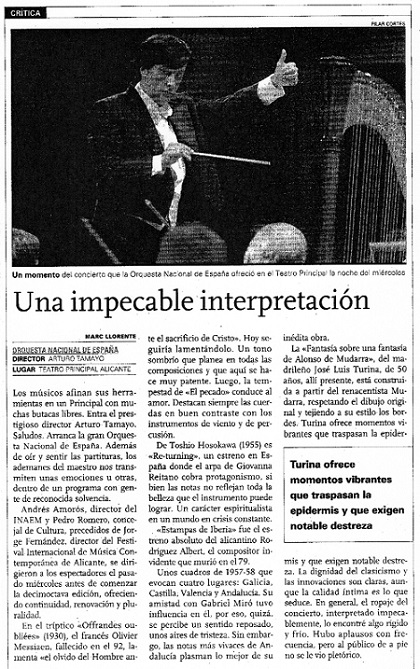
The musicians tune their instruments in a Teatro Principal with many empty seats. The prestigious conductor Arturo Tamayo enters. Applause. The great Spanish National Orchestra begins. In addition to hearing and feeling the scores, the maestro's gestures convey various emotions, within a program featuring figures of proven artistry.
Andrés Amorés, director of INAEM, and Pedro Romero, city councilor for culture, preceded by Jorge Fernández, director of the Alicante International Festival of Contemporary Music, addressed the audience last Wednesday before the start of the festival's eighteenth edition, offering continuity, renewal, and diversity.
[...]
«Fantasy on a fantasy by Alonso de Mudarra», by the 50-year-old Madrid-born composer José Luis Turina -who was present- is built upon the work of the Renaissance composer Mudarra, respecting the original motif and weaving around its edges in his own style.
Turina offers stirring moments that go beneath the surface and demand notable skill
The dignity of classicism and the spirit of innovation are evident, though it's the intimate quality that truly captivates. Overall, the concert's structure -flawlessly executed- struck me as somewhat rigid and cold. There was frequent applause, but the general audience didn't seem particularly elated.
A fascinating beginning full of memory
By Justo Romero
(Review published in the newspaper El Mundo, Madrid, September 28, 2002)
World premieres and 20th-century classics came together during the two-part opening of the 18th Alicante Contemporary Music Festival, led by a National Orchestra in top form under the baton of that steadfast champion of contemporary music, Arturo Tamayo.
This new edition's program offers a carefully curated selection that includes nine world premieres, three operas, and a series of performances that also commemorate anniversaries of several composers -such as the centenary of Alicante-born Rafael Rodríguez Albert's birth, the 60th birthday of Tomás Marco, and the 50th of José Luis Turina and Santiago Lanchares.
Fittingly, two of these composers were featured in the opening concert. The absolute premiere of Estampas de Iberia by Rafael Rodríguez Albert (1902–1979) was presented [...]
Far more substantial is the brilliant Fantasy on a fantasy by Mudarra, composed by José Luis Turina in 1989. The now fifty-year-old composer from Madrid personally received the well-deserved applause that followed the National Orchestra and Tamayo's precise and vibrant performance.
[...]
The Málaga Orchestra fills the Euskalduna with Turina, Mozart, and Brahms
By Aitzol San Sebastián
(Review published in the newspaper El Mundo. Madrid, November 6, 2003)
The Andalusian Philharmonic, conducted by Maestro Aldo Ceccato, performs today and tomorrow in Bilbao
As part of the exchange program that, in the final weeks of next year, will bring the Bilbao Symphony Orchestra (BOS) to the shores of the Mediterranean, the Philharmonic Orchestra of the Malagan capital will take center stage in the two concerts (today and tomorrow) that make up the fifth event in the twenty-concert series comprising the 2003/2004 season.
The performances will take place at the Euskalduna Palace in Bilbao, beginning at 8:00 p.m. There, the Málaga Philharmonic Orchestra, under the baton of Italian maestro Aldo Ceccato, will present a program featuring Fantasy on a fantasy by Alonso de Mudarra by José Luis Turina (b. 1952); Symphony No. 40 in G minor, K. 550 by Wolfgang Amadeus Mozart (1756–1791); and Symphony No. 2 in D major, Op. 73 by Johannes Brahms (1833–1897).
The Málaga City Orchestra -renamed Málaga Philharmonic Orchestra in 2001- was founded in 1991. Its programming combines the aesthetic trends of the past with the most innovative and modern contemporary ones. On this occasion, the Málaga ensemble arrives in the Basque capital under the direction of Milan-born Aldo Ceccato, who has been musical and artistic director since 1999 of «I Pomeriggi Musicali», one of Italy’s oldest and most prestigious orchestras.
The concert will open with a composition by J. L. Turina based on a work by Alonso de Mudarra (1508–1586), one of the most prominent figures of Spanish humanism. In this piece, a play of allusions is developed around the word «fantasy», used here in the sense of «a work free from formal constraints», making paradox the central aesthetic element. Commissioned with the request that it be «brilliant, striking, and a showcase for the orchestra«, Turina also uses the piece to explore one of the great obsessions in his oeuvre: the coexistence of music from the past and present, and their mutual interaction.
[...]
Excellent performance
By Otxandio
(Review published in the newspaper Gara. Bilbao, November 10, 2003)

The orchestra exchange has given us the opportunity to gauge the interpretative quality achieved by the Málaga Philharmonic Orchestra. And judging by the audience's applause, it was a satisfying one.
It is true that the repertoire pieces offered, somewhere between the Classical and Romantic styles, are well-worn for any ensemble worth its name, but the inter-family balance, the well-prepared execution and refined acoustic sound, the agile transitions from cadenced to effervescent moods, and the precise rapport with the seasoned baton of the distinguished conductor Aldo Ceccato, all revealed a solid orchestral ensemble -one that many groups would envy. To what extent is their principal conductor, Alexander Rahbari, involved in their development? That is a question worth asking.
With the expansive score of José Luis Turina's "Fantasy on a fantasy by Alonso Mudarra", Ceccato recreated Turina's personal style and its elevated sonic transformations, stamping the orchestral whole with a mark of power that, in Mozart's "Symphony No. 40 in G minor, KV 550" and Brahms's "Symphony No. 2 in D major, Op. 73", confirmed both its interpretive capability and finesse.
[...]
Music to celebrate the Constitution
By Ramón María Serrera
(Review published in the newspaper ABC. Seville, December 15, 2003)
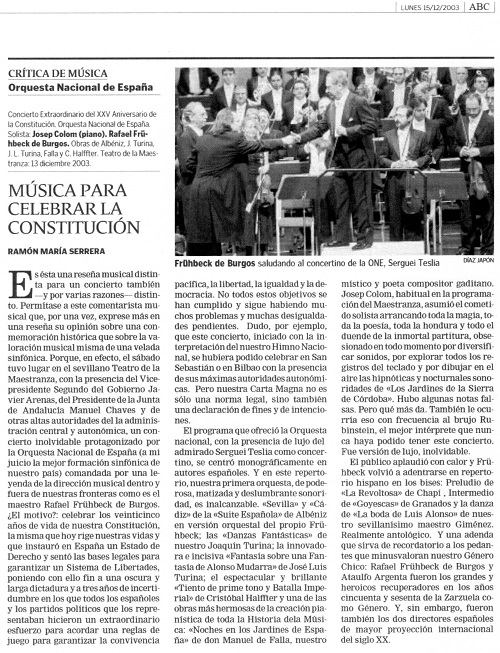
This is a different kind of musical review for a concert that was also, for several reasons, different. Allow this music critic, just this once, to express more in a review his opinion on a historic commemoration than a purely musical assessment of a symphonic evening. Indeed, last Saturday, an unforgettable concert took place at Seville's Teatro de la Maestranza, attended by Deputy Prime Minister Javier Arenas, President of the Regional Government of Andalusia Manuel Chaves, and other high-ranking authorities from both the central and regional administrations. The event featured the National Orchestra of Spain (in my opinion, the finest symphonic ensemble in the country), led by the legendary maestro Rafael Frühbeck de Burgos, a conductor of international renown. The occasion? To celebrate the twenty-fifth anniversary of our Constitution -the one that today governs our lives, established a state governed by the rule of law, and laid the legal foundation for a system of freedoms. That Constitution brought an end to a long, dark dictatorship and to three years of uncertainty during which Spaniards and the political parties that represented them made an extraordinary effort to agree on the rules of the game that would ensure peaceful coexistence, liberty, equality, and democracy. Not all of these goals have been fully achieved, and many problems and inequalities remain. I doubt, for instance, that this concert -opened with the performance of our National Anthem- could have taken place in San Sebastián or Bilbao with the presence of their highest regional authorities. But our Constitution is not merely a legal text; it is also a declaration of purposes and intention.
The program offered by the National Orchestra, with the distinguished presence of the esteemed Serguei Teslia as concertmaster, focused exclusively on Spanish composers. And in this repertoire, our foremost orchestra -powerful, nuanced, and dazzling in its sound- is simply unmatched. «Sevilla» and «Cádiz» from Albéniz's «Suite Española», orchestrated by Frühbeck himself; the «Danzas Fantásticas» by our own Joaquín Turina; the innovative and incisive «Fantasía sobre una Fantasía de Alonso Mudarra» by José Luis Turina; the spectacular and brilliant «Tiento de primer tono y Batalla Imperial» by Cristóbal Halffter; and one of the most beautiful works in the entire history of piano music: «Nights in the Gardens of Spain» by Don Manuel de Falla, our mystical and poetic composer from Cádiz. Josep Colom, a regular performer at the Maestranza, took on the soloist role, drawing out all the magic, all the poetry, all the depth, and all the duende of the immortal score -obsessed at every moment with diversifying the sound, exploring the full range of the keyboard, and painting in the air the hypnotic, nocturnal sonorities of «The Gardens of the Sierra de Córdoba». There were a few wrong notes -but what does it matter? That used to happen frequently to the great Rubinstein too, the finest performer this piece has ever known. It was a luxurious, unforgettable rendition.
The audience responded with warm applause, and Frühbeck returned to delve into Spanish repertoire for the encores: the «Prelude» from «La Revoltosa» by Chapí, the «Intermezzo» from «Goyescas» by Granados, and the dance from «La boda de Luis Alonso» by our deeply Sevillian maestro Giménez. Truly anthological. And a final note to remind those pedants who look down on our Género Chico: Rafael Frühbeck de Burgos and Ataúlfo Argenta were the great and heroic revivalists of Zarzuela as a genre in the 1950s and 60s. And yet, they were also the two Spanish conductors with the greatest international acclaim in the 20th century.
Color, epidermis, and virtuosity
By Pablo J. Vayón
(Crítica publicada en el Diario de Cádiz. Cádiz, 26 de noviembre de 2006)
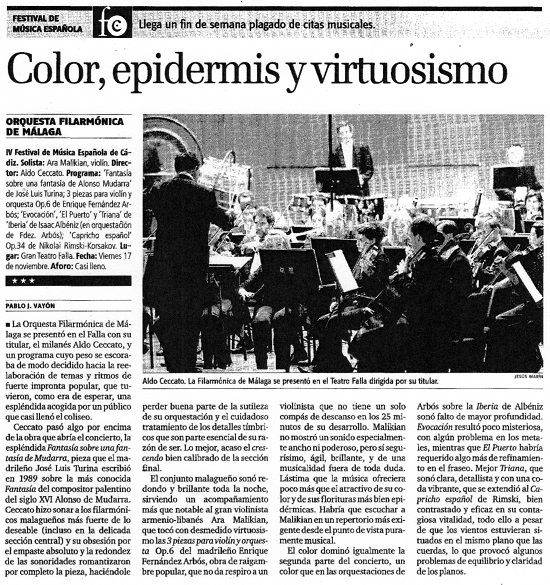
The Málaga Philharmonic Orchestra appeared at the Falla with its principal conductor, the Milanese Aldo Ceccato, and a program whose weight leaned decisively toward the reworking of themes and rhythms with a strong popular imprint -works that, as expected, were splendidly received by an audience that nearly filled the theater.
Ceccato somewhat skimmed over the piece that opened the concert, the splendid Fantasía sobre una fantasía de Mudarra, a work the Madrid-born José Luis Turina wrote in 1989 on the basis of the best-known Fantasía by 16th-century composer Alonso de Mudarra from Palencia. Ceccato made the Málaga Philharmonic sound louder than desirable (even in the delicate central section), and his obsession with absolute blend and rounded sonorities romanticized the piece entirely, stripping away much of the subtlety of its orchestration and the careful handling of timbral details that are an essential part of its very raison d'être. The best element, perhaps, was the well-calibrated crescendo of the final section.
[...]
Concert or simple rehearsal?
By Aguiló de Cáceres
(Review published in Diario de Mallorca, Palma de Mallorca, February 23, 2008)
The title does not seek to revive Hamlet's "to be or not to be" dilemma, yet it certainly has much to do with the double prism of perception through which, as the performance unfolded, unusual paths of interpretation kept emerging on stage -paths all the more curious and amusing. Was it a concert, or was it really a rehearsal that the Symphony was offering in its tenth outing of the season? The program coincided with the presence on the podium of the Russian-French Jean Jacques Kantorow -an absolute spark of shared energy with the various sections of the symphonic strings, which he held firmly in the palm of his hand with complete mastery. It is a gesture for which we must thank and admire him, given what it meant for our orchestra, faced with a multicolored cast capable even of tackling music from the sixteenth century, altered with brief and noisy fantasies springing from the ingenuity of its composer, the Spanishman with a widely resonant surname, José Luis Turina. He could not have chosen a better title for his Fantasy on a Fantasy by Alonso Mudarra, where the fantasy takes on a thunderous flight over the staves of the famous Sevillian vihuelist -a courtier all his life, despite being grounded in a solid and learned Renaissance tradition in the country. Its ten minutes of imaginative journey were enough, however, to serve as a gateway to a main symptom of pure "rehearsalism", with the subsequent performance by the French pianist Alain Planés, whose name I recall -if I am not mistaken- from his successful appearance at the Frédéric Chopin Festival of Valldemossa in 1998.
[...]
Málaga color by way of substitution
By Manuel del Campo
(Review published in the newspaper Sur, Málaga, December 2, 2017)
The fifth program of the Málaga Philharmonic Orchestra's 28th subscription season at the Teatro Cervantes turned out to be the concert of the unforeseen -of substitutions. The absence of principal and artistic director Manuel Hernández-Silva, due to a sudden illness, brought in Málaga-born Alejandro de Palma to take his place. Likewise, guitar soloist Vicente Coves, reportedly in rehabilitation following an accident, was replaced by fellow Malagueño Marco Socías. Strong local accents to begin with, though regrettably before a sparse audience.
Trained at the Madrid Conservatory and later in Italy under Franco Donatoni, José Luis Turina de Santos (1952), grandson of Seville-born Joaquín Turina, stands as a representative of a new generation of composers. José Luis Temes speaks of this present-day Turina's "penchant" for reinterpreting the music of the past through an underlying aesthetic and cultural lens. Indeed, the 'Fantasy on a Fantasy by Alonso de Mudarra', which opened the concert both the night before last and last night, revisits Mudarra's (1510–1580) 'Tenth Fantasy' from his collection of fantasies for vihuela -itself a reimagining of other music of its time. The flavor of the piece, at moments perhaps unusual, along with its intelligent orchestration, stood out in the performance by the local Málaga Philharmonic. Conducted with the clear baton of Alejandro de Palma, it drew the first applause of the evening -also directed toward the composer himself, who was present at the Cervantes.
[...]
The fresh breeze of the JONDE
By Teobaldos
(Review published in Diario de Noticias. Pamplona, January 13, 2018)
We continue to follow JONDE with genuine affection and support. I still remember the magnificent performance of Der Rosenkavalier in August 2014, also at Baluarte. They are highly trained young musicians, in that formative stage in which everything involves entrance exams for everything, when they feel scrutinized in every way, and during which they must remain in a state of constant tension in search of opportunities. Perhaps the concert at the end of their gatherings is one of the happiest and most rewarding moments of so much effort -for them and for the audience. There is nothing like the sound of a great orchestra you are part of.
This ensemble often hosts a resident composer who confronts the young musicians with premieres, often full of harsh dissonances. But this time, the score by José Luis Turina (1952), while delving into the dissonances of Alonso Mudarra, is a wonderfully comprehensible work: its modernity and originality absorb, without nullifying, the themes of the Spanish Renaissance composer, returning them to solo instruments and to an orchestration that melds everything together. It is a beautiful work, with string textures -such as that fugal passage- that seamlessly link tradition and the new.
[...]
And, as a cheerful finale, a pasodoble. It is always refreshing to hear a well-played pasodoble.
Passion
By Xabier Armendáriz
(Review published in Diario de Navarra, Pamplona, January 14, 2018)
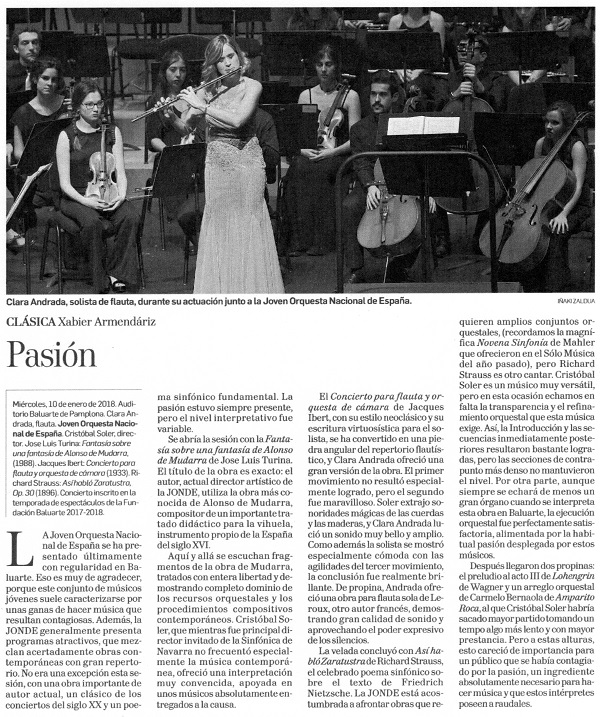
The Spanish National Youth Orchestra has been performing at Baluarte with some regularity in recent times. This is something to be truly grateful for, as this ensemble of young musicians is usually marked by a contagious eagerness to make music. Moreover, JONDE generally presents appealing programs that skillfully blend contemporary works with major repertoire pieces. This concert was no exception, offering a significant work by a living composer, a classic 20th-century concerto, and a fundamental symphonic poem. Passion was ever-present, but the interpretative level varied.
The concert opened with Fantasía sobre una fantasía de Alonso de Mudarra by José Luis Turina. The title of the work is precise: the composer, who is currently the artistic director of JONDE, draws on the most well-known piece by Alonso de Mudarra, author of an important didactic treatise for the vihuela, an instrument characteristic of 16th-century Spain. Here and there, fragments of Mudarra's work can be heard, treated with complete freedom and revealing full mastery of orchestral resources and contemporary compositional techniques. Cristóbal Soler -who, during his tenure as principal guest conductor of the Navarre Symphony Orchestra, did not particularly engage with contemporary music- offered a deeply committed interpretation, supported by musicians who were wholly devoted to the cause.
[...]
MADRID/OCNE: two Russians and a Spanish fantasy
By Tomás Marco
(Review published in the online magazine Scherzo. Madrid, January 30, 2022)

The use by composers of materials already used by others is a constant in musical history. But modernity has introduced a special conceptual way of doing this, which is what American treatise writers have called borrowing and here it is usually known as 'music about music'. Almost all current composers have practiced it at some point and a milestone in this process is the Tiento and Battle by Cristóbal Halffter. José Luis Turina is an illustrious composer who has played the theme on several occasions and his most notorious attempt is the Fantasy on a Fantasy by Alonso de Mudarra composed in 1989 for the Tenerife Symphony Orchestra. Already Mudarra's original imitates (“countermakes”, as he writes) the theme of the mysterious harpist Ludovico. Turina uses both materials within a structurally very interesting and very own context, and with a sovereign orchestral treatment that is far from being a simple orchestration. Brilliant and sovereignly made work, it is in many aspects worthy of being considered a masterpiece.
[...]
Solidity in the OCNE with Shostakovich and Afkham
By Gonzalo Alonso
(Review published in the newspaper La Razón. Madrid, February 2, 2022)

The event opened with "Fantasía sobre una fantasí de Alonso Mudarra", a work by José Luis Turina of about ten minutes.
I heard someone describe this week's OCNE concert as a "programón". It really was. It opened with Fantasy on a fantasy by Alonso Mudarra, a work by José Luis Turina of about ten minutes in which he demonstrates inventiveness in recreating and his ability to orchestrate. It was premiered in 1989 as a commission from the Tenerife Symphony Orchestra and the Canary Islands Music Festival in times of the still-missed Rafael Nebot, who wanted a brilliant and outstanding score for the orchestra. Turina fulfilled the task, especially in the brass section with a very large template. Current language with evocations that the public listened to with great pleasure and that Afkhan provided with order and command.
[...]
Concert at five in the afternoon of the poet
By Emilio Sanmiguel
(Review published in El Nuevo Siglo newspaper, Bogotá, September 2, 2024)
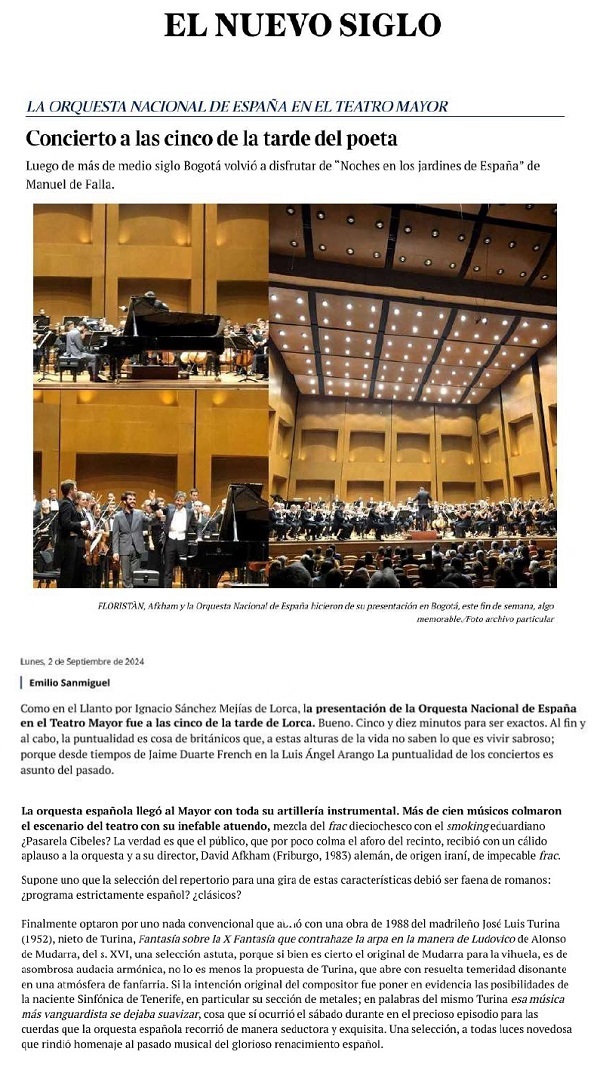
They ultimately opted for a rather unconventional [program], which began with a 1988 piece by José Luis Turina (b. 1952), a Madrid native and grandson of Turina. The work, Fantasy on the 10th fantasy that counterfeits the harp in the style of Ludovico by Alonso de Mudarra from the 16th century, was an astute selection. While it is true that Mudarra's original vihuela piece is of striking harmonic boldness, Turina's interpretation is no less daring, opening with a resolute and dissonant audacity in a fanfare-like atmosphere. If the composer’s original intention was to showcase the potential of the then-new Tenerife Symphony Orchestra -particularly its brass section-, in Turina's own words, that more avant-garde music allowed itself to soften. This certainly happened on Saturday in the exquisite string section episode, which the Spanish orchestra delivered with seductive and refined artistry. A selection that was, without a doubt, innovative, paying tribute to the musical past of Spain’s glorious Renaissance.
[...]