

Introducción a la edición crítica de Margarita la Tornera" de Ruperto Chapí / Introduction to the critical edition of "Margarita la Tornera" by Ruperto Chapí
Study published in the score edition of the opera under the same title by the Instituto Complutense de Ciencias Musicales (ICCMU). Madrid, November 2000The composer
The work
Editing criteria
The libretto and its author
The composer
Ruperto Chapí y Lorente was born in Villena on February 27, 1851, and died in Madrid on March 25, 1909, a few days after the premiere of his longest and most ambitious work, Margarita la Tornera, at the Teatro Real on February 23 of that year. The fifth child of a musically inclined family, Chapí quickly displayed exceptional musical talent, which, in 1866, led to his relocation to Madrid to pursue professional music studies at the Real Conservatorio María Cristina, where he studied composition under none other than Emilio Arrieta.
Between 1874 and 1878, he held a scholarship that allowed him to continue his studies in Rome and Paris. During these years, he composed his first major symphonic and vocal works, including a Symphony in D Minor (1877) and the oratorio Los ángeles, with text by Antonio Arnao. Nonetheless, during his scholarship years, Chapí developed a strong inclination toward composing music for the stage. This passion clashed with the prevailing trends in Spain at the time, which were regrettably dominated by Italian opera -centered at Madrid's Teatro Real- and zarzuela, primarily performed at the Zarzuela and Apolo theaters. However, this did not prevent Chapí, before turning 30, from seeing his first three operas (Las naves de Cortés, La hija de Jefté, and Roger de Flor) performed at the Teatro Real. Despite limited public success, these early operas led him to focus on composing zarzuelas, a genre in which he achieved continuous and resounding success from 1882 (with the premiere of La tempestad) until 1902, when he returned to opera with Circe. From this extensive period come the works that have cemented Chapí's name in the zarzuela repertoire: La tempestad, La Revoltosa, El rey que rabió, La Bruja, Curro Vargas, El tambor de granaderos, among others.
In addition to this remarkable output, Chapí also produced an equally significant -though nearly forgotten- body of symphonic and chamber works. These urgently deserve to be rescued from the oblivion imposed by our society's intellectual and institutional neglect. Among these works, four string quartets stand out prominently.
In 1902, as mentioned earlier, Chapí returned to opera composition with Circe, marking the beginning of a new creative phase and the culmination of a lengthy effort to revitalize Spanish lyric theater. This movement had been initiated in 1881 by the impresario Arderius, with a project aimed at creating new works to which Arrieta, Barbieri, Caballero, Marqués, and Chapí, among others, contributed. This effort culminated in 1902 with the creation of a new theater, the Teatro Lírico, led by impresario Luciano Berriatúa, with the aim of becoming the home of Spanish opera. During its early seasons, the theater premiered not only Circe but also new operas by Bretón and Ricardo Villa. However, the initiative was a resounding failure, effectively marking the beginning of a bleak century for Spanish opera -a period perhaps symbolically and physically ended by the recent revival of Margarita la Tornera at the Teatro Real, 90 years after its premiere.
The Work
The earliest records of the composition project for this opera date back to June 1895, when the newspaper La Época reported that Chapí had obtained a libretto based on Zorrilla's legend. Initially planned for a premiere at the Teatro de la Zarzuela, the project was delayed to prioritize more urgent works and underwent a series of transformations in subsequent years. The most significant of these was the shift from a zarzuela to an opera. This change required Carlos Fernández Shaw -the librettist and a collaborator with Chapí since 1896 on major zarzuelas like La Revoltosa and Los hijos del batallón- to make successive and substantial modifications to the original text. The libretto reached its definitive form, ready for mise en musique, in 1904.
The composition and orchestration of the score occupied Chapí during 1905 and 1906. While this timeline aligns with Chapí's usual creative process, it is remarkably brief, especially considering the opera's total length of over two hours and the substantial size of the orchestra, as will be discussed later.
The premiere of Margarita la Tornera at the Teatro Real in February 1909 generated considerable anticipation. This was fueled by the ongoing and, at times, heated debates over Spanish opera, which Chapí and many other composers of the time engaged in through the capital's press, often clashing with the management of Madrid's main theater. That this opera later fell into obscurity is even harder to understand, given the enormous success of its premiere. It was reprogrammed for the following season and even premiered at the Teatro Colón in Buenos Aires. Only the severe and often inexplicable harshness of Spanish audiences toward some of their most distinguished artists can account for such an injustice.
Margarita la Tornera is structured in three acts, the first two of which are further divided into three scenes each, while the third is divided into two. What stands out is the meticulous planning with which Chapí organizes the musical material, resulting in great variety both on the surface (i.e., in purely melodic aspects) and in the deep psychological strategy that informs more profound elements (such as the overall treatment of harmony or the aesthetic irony that underscores certain situations, as will be discussed later).
Broadly speaking, Margarita la Tornera is, deliberately, an opera. This statement, while seemingly obvious at first glance, is far from trivial considering that Chapí not only brought his genius and skill to this work, but also aimed to prove -to himself and his contemporaries- that the battle for Spanish opera was a winnable one, if fought properly. After nearly thirty years of silence in opera, Chapí had to contend, first and foremost, with the inertia of his success as a zarzuela composer. It is well known how audiences can react when evaluating something about which they already hold -or believe they hold- a firm opinion. In this sense, Margarita la Tornera is worlds apart from Chapí's zarzuelas for several reasons, the most notable being its objective scope and its subjective restraint.
Regarding the former, "scope" should not be understood in its most prosaic, quantitative sense -that of sheer length. As mentioned earlier, the opera runs for approximately two hours, a duration found in some grand zarzuelas as well, which are nonetheless still considered zarzuelas. Instead, the scope here is qualitative: it contrasts the zarzuela's proverbial and inconsequential lightness with a profound and serious gravity. While this gravity partly stems from the essence of the dramatic narrative itself, it is primarily a result of the musical material and its treatment. Just as even the most humorous zarzuelas contain lyrical, if not openly dramatic, moments, every respectable opera must occasionally relax dramatic tension to sustain it through to the end. The key difference lies in the focal point, which alters the entire perspective of the work.
Thus, the other noteworthy elements of the opera are simply extensions of this overarching concept. From the demanding treatment of the vocal parts to the intricate orchestration -requiring a substantial symphonic ensemble- and the richly nuanced harmonic-tonal framework, every aspect of this opera highlights the author's initial aesthetic vision. As for the aforementioned restraint, it reflects Chapí's deliberate effort to distance himself from his own previous style, not as a critique of his earlier work, but as a move away from his identity as a zarzuela composer. This is particularly evident in his refusal to indulge in anything easy, catchy, or melodically predictable. For example, when a beautiful melody emerges, which under normal circumstances might have developed into a splendid aria (such as the third-act fragment Mi vida entera se renueva...), it is quickly cut short in favor of a cohesive musical narrative. In this narrative, it is not the voices but the orchestra that carries the primary expressive burden. Indeed, Margarita la Tornera is fundamentally a symphonic opera, where the dramatic-musical continuity is dictated from the orchestra pit rather than the stage. This approach aligns with the prevailing Wagnerian influence and places this work, from that perspective, light-years away from Chapí's zarzuelas such as La Revoltosa or El rey que rabió, works whose melodies are well-known and easy to hum for any enthusiast. In contrast, it is relatively easy to recall orchestral fragments from Margarita la Tornera, but exceedingly difficult to remember vocal lines, as nothing in them encourages such recollection.
In summary, Margarita la Tornera is a work that aligns more with European musical frameworks than with Spanish ones, despite being sung in Spanish and having a Spanish narrative. Chapí was well aware that his opera could be genuinely national without rejecting the most significant European cultural influences of the time. Moreover, Chapí consistently navigated a dual artistic identity: one national and the other European. The latter is reflected in a substantial collection of concert works that today remain largely and unjustly overlooked, as previously noted, and which clearly exhibit Italian, French, and German influences of the era. In this context, Margarita la Tornera belongs more to this second category of Chapí's catalog. It is unmistakably a Europeanist opera, with evident echoes of works like Die Meistersinger von Nürnberg, a title especially revered and admired by Spanish musicians around 1900. A considerable portion of the scenic and musical treatment in the works of Spain's leading opera composers (including melodic, harmonic, and orchestral aspects) owes much to this Wagnerian masterpiece. Thus, except for the second act -which is the most "Spanish", musically speaking, of the three (a necessity dictated by the dramatic setting, unfolding in picturesque locations like the Corral de la Pacheca and the Casón de los Duendes, where the absence of Spanish rhythms and idioms would be unthinkable)-, the music of the other two acts is decidedly European. The brief sequence in the third scene of Act I, which incorporates Andalusian harmonic and melodic techniques, feels more like a syntactic anomaly than a seamless continuation of the musical texture.
Given all this, it is no surprise that Chapí employed an orchestra of unusual proportions for the zarzuela composers of his time, who were typically constrained to smaller ensembles for practical reasons. His instrumentation includes quadruple woodwinds (including piccolo, English horn, E-flat clarinet, bass clarinet, and a sarrusophone -now obsolete and replaced in this critical edition by the modern contrabassoon as its contemporary equivalent), four horns, three trumpets, three trombones, one tuba, two harps, an extensive percussion section, and a broad string section (frequently divided, especially in Act III, where these divisions and harmonic combinations create mystical and celestial sounds that would be difficult to achieve otherwise). Additionally, in Act II, a small rondalla ensemble and an internal band are included.
Chapí, like most accomplished composers of his time, was not merely a musician of great melodic inventiveness. In Margarita la Tornera, his mastery of harmony and counterpoint is evident, with one of the finest examples in Spanish music from this period appearing in the third scene of Act I. Here, a tightly imitative dialogue between the soprano and the orchestra is skillfully bound together by a fascinating modulatory process, giving the passage immense expressive power. This aligns perfectly with the protagonist's anxiety and hesitation as she contemplates leaving the convent to succumb to Don Juan's seduction.
Furthermore, Chapí demonstrates his exceptional skill as an orchestrator in this opera, both through the superb and spectacular sonorities that underscore certain scenic moments and through the masterful restraint of the orchestral ensemble when its role is to accompany and support the singing without overwhelming it.
Speaking of singing, although Chapí's musical discourse in Margarita la Tornera aligns with the principles of Wagnerian lyrical drama, the selection of solo voices leans more towards the classical operatic tradition. This is exemplified in the character of Gavilán, who is reminiscent of Leporello in Mozart's Don Giovanni. Thus, the opera requires two female soloists -a dramatic soprano and a light soprano (Margarita and Sirena, respectively)- and three male soloists -a tenor, a baritone and a bass- for the roles of Don Juan de Alarcón, Don Lope de Aguilera, and Gavilán. A second soprano with vocal characteristics similar to Margarita's is also needed for the final dialogue between her and the Virgin-Tornera, who has taken her place in the convent during her absence. This ensemble is complemented by a large choir, which has its most significant quantitative and qualitative role in the second act.
What undeniably sets Margarita la Tornera apart from other works by Chapí is the treatment of the solo voices -not only in the melodic aspects mentioned earlier, but also in the extraordinary challenges posed to the principal roles of Margarita and Don Juan, as well as the highly demanding and risky part of Sirena in the second act. The frequent use of the upper vocal register and the systematic employment of ascending harmonic-melodic progressions place the voices under great tension, requiring solid vocal technique to preserve the intelligibility of the text. This text, at times overly abundant, often overflows the melodic framework meant to contain it, risking clarity in delivery.
The adoption of the European, German-influenced aesthetic of the time provides insight into the harmonic-tonal vocabulary employed, which falls within openly post-Romantic boundaries. However, the great modulatory richness derived from the expansive use of tonality does not hinder Chapí's demonstration of immense dramatic talent. He employs a "dramatic treatment of tonality", adapting it with precision to the diverse psychological situations in the libretto. In this regard, Margarita la Tornera serves as a masterful compendium of the infinite possibilities of tonality. While it verges on more open fields -foreshadowed by Wagner in Tristan und Isolde and confirmed by Debussy in Pelléas et Mélisande just a few years before the opera's premiere- tonality remains a valid language here. It offers abundant possibilities for writing masterpieces, from forced modulatory progressions, whose mechanical nature underscores the protagonists' anxiety (as in the third scene of Act I, where Margarita is plagued by internal contradictions as she decides whether to stay in the convent or succumb to Don Juan's embrace), to the most static tonal states (such as the prolonged tonic harmony of C major in the second scene of Act III, symbolizing the spiritual peace accompanying Margarita's return to the convent and her encounter with the Virgin). The opera also includes the deliberate use of conventional harmonic progressions (particularly in Act II, symbolizing the baseness and superficiality of the worldly society to which Don Juan and Don Lope belong).
Finally, a brief examination of the general character of the acts sheds light on the skilled organization of the work's overarching structure. While the first act transitions from the narrative (introducing Don Juan and his intentions) to the dramatic (the escape from the convent during the storm), the third act progresses from the dramatic (the protagonists' reunion and Margarita's rejection of Don Juan) to the mystical (her return to the convent and meeting with the Virgin). In both acts, the music serves as a seamless narrative thread of extraordinary refinement. However, the enigmatic second act stands apart because its music seems to defy expectations continuously, creating violent contrasts both psychological and aesthetic. Yet, beneath this apparent conceptual looseness lies profound dramatic wisdom, which here reveals itself through irony rather than explicitness. Scenarios that appear cultured, where one might expect a classical treatment of technical procedures, are deliberately vulgarized to reflect, as noted earlier, the superficiality of the world into which Don Juan has drawn Margarita before abandoning her. This is evident in scenes like the dialogues between Don Juan, Don Lope, and Gavilán in the first scene, or the final scene of the third. Conversely, the most intrinsically popular number in the opera, Sirena's challenging zarabanda, is given a harmonic and orchestral treatment of the highest caliber. By vulgarizing the cultured and ennobling the popular, Chapí reveals his personal and insightful critique of society. Between these scenes lies a surprising and significant aria for Margarita (which, along with the one in the final scene of Act I, ranks among the most important operatic pieces for dramatic soprano in 20th-century Spanish opera). Here, through the verismo vigor of the music and the highly dramatic stage situation -Margarita realizing she has been abandoned but refusing to accept it- the opera returns to authenticity. This aria is followed by a stunning ensemble (Margarita, Sirena, Don Juan, and Don Lope). The act closes with a grand ensemble scene, including a sword duel, where Chapí once again demonstrates his exceptional theatrical talent.
Editing Criteria
This edition has faithfully adhered to the original manuscript in its entirety, with the exception of a handful of irrelevant errors and evident omissions made by Chapí (almost always occurring at a page turn) that were promptly detected and appropriately corrected. These corrections, along with decisions regarding a few passages of minor harmonic uncertainty, have been the only points requiring critical intervention. For, without a doubt, Ruperto Chapí was a great master, and a great master neither needs nor should tolerate anyone attempting to revise his work.
Margarita la Tornera includes a splendid reduction for voice and piano by Vicente Zurrón, whose facsimile has been skillfully published by ICCMU as a logical complement to the critical edition of the score (3).
Lastly, the magnificent orchestration work by Chapí has minimized the need for critical revision, allowing the focus to remain on dynamics and articulations (nuances, accents, crescendos, etc.). These aspects, often inexplicably neglected by composers of all periods until well into the 20th century, are absolutely fundamental today, both from a composer's and a performer's perspective. In orchestral works, such notations require meticulous attention and planning, which are conspicuously absent in the original score but have been diligently addressed in this edition.
The libretto and its author
Carlos Fernández Shaw was born in Cádiz on September 23, 1865. Between 1880 and 1885, he studied law, graduating in the latter year and joining the Madrid Literary and Legal Academy. A regular collaborator with the Ateneo de Madrid, he served as its secretary. As a recognized journalist, he demonstrated his talent through numerous articles in newspapers such as La Época, La Ilustración, El Correo, El Liberal, La Ilustración Española y Americana, and Blanco y Negro, among others.
At the La Época literary circle, he befriended Antonio Peña y Goñi, who introduced him to Ruperto Chapí and, consequently, to the world of lyric theater. Fernández Shaw contributed to this genre with several essential works, including Las bravías (based on Shakespeare's The Taming of the Shrew, 1896), La Revoltosa (1897), La chavala (1898), Los buenos mozos (1899), El gatito negro and El alma del pueblo (1905), La parranda (1903), and La venta de Don Quijote (1904), all set to music by Chapí.
His interest in lyric theater led him to participate in efforts to create a Spanish opera. Together with Chapí, he embarked on the ambitious project of Margarita la Tornera, an opera based on a Spanish legend featuring Spanish characters, settings, and themes.
Carlos Fernández Shaw also contributed to other operatic endeavors, including La maja de rumbo (1910), with music by Emilio Serrano, and wrote librettos for Conrado del Campo's El final de don Álvaro, which was warmly received at Teatro Real, and La tragedia del beso (1915). Another significant work in his career was La vida breve, with music by Manuel de Falla, premiered in 1913. Fernández Shaw passed away in Madrid on June 7, 1911, before the work's debut at the Opéra-Comique in Paris.
For the libretto in this edition, we have faithfully followed the version housed in the Biblioteca Nacional de Madrid, catalogued under [T/17244]: Margarita la Tornera. Leyenda en tres actos y ocho cuadros basada en obras de Avellaneda y Zorrilla. Letra de Carlos Fernández Shaw y música de Ruperto Chapí. Madrid, 1908 (4).
The minor discrepancies observed between some verses in the libretto and their use in the score and the reduction do not affect the dramatic context. For instance, in Act I, No. 77, the libretto reads: "Los vestidos ya la esperan que en el mundo llevará", while the reduction changes it to "Los vestidos ya la esperan que en el mundo vestirá". Similarly, in Act II, No. 134, the libretto states: "Como cuerda que vibra, mi cuerpo de repente se pone a vibrar", modified in the reduction to "Como cuerda que vibra, mi cuerpo de repente comienza a vibrar". These and other slight variations have prompted us to adopt the text from the reduction for the score to unify these two sources as much as possible, facilitating future productions of the work. One amusing discrepancy lies in Act I, No. 39, regarding Margarita's eyes:
"Sus claros ojos, grandes y transparentes" (libretto)
"Sus grandes ojos, claros y transparentes" (reduction)
"Sus claros ojos, negros y transparentes" (score)
As in previous cases, the reduction has been chosen to settle the size and quality of Margarita's eyes as perceived by Don Juan in this scene.
Madrid, February 2000
(1) Of the 218 works composed by Chapí, 163 are zarzuelas. For further details on his biography and catalog, it is essential to refer to the comprehensive study by Luis G. Iberni (Ruperto Chapí, Instituto Complutense de Ciencias Musicales, 1995).
(2) Written between 1903 and 1907, during Chapí's full creative maturity.
(3) The introduction to the critical edition of Margarita la Tornera published by ICCMU includes examples of discrepancies between the manuscript of the score and the piano reduction, as well as a comprehensive list of errors found in the latter, which are not reproduced here.
(4) The introduction to the critical edition concludes with a synopsis of the plot by Oliva G. Balboa, which is not reproduced here.
Escrito relacionado:
About the critical edition of Margarita la Tornera by Ruperto Chapí
Article published in the program book for the opera's premiere at Teatro Real, Madrid, December 1999

Press release published in the newspaper ABC (Madrid, December 2, 1999)
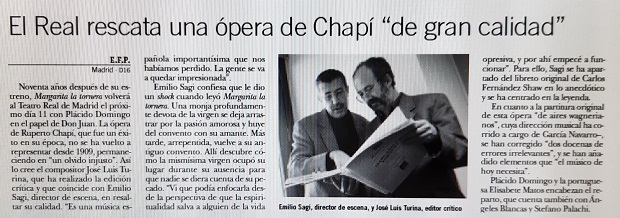
Press release published in Diario 16 (Madrid, December 2, 1999)
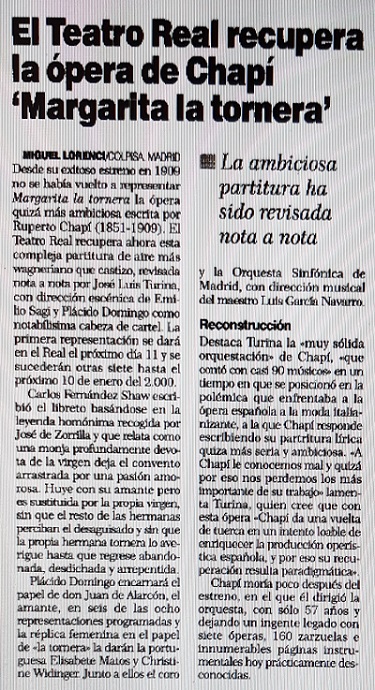
Press release published in El Diario Vasco (San Sebastian, December 2, 1999)
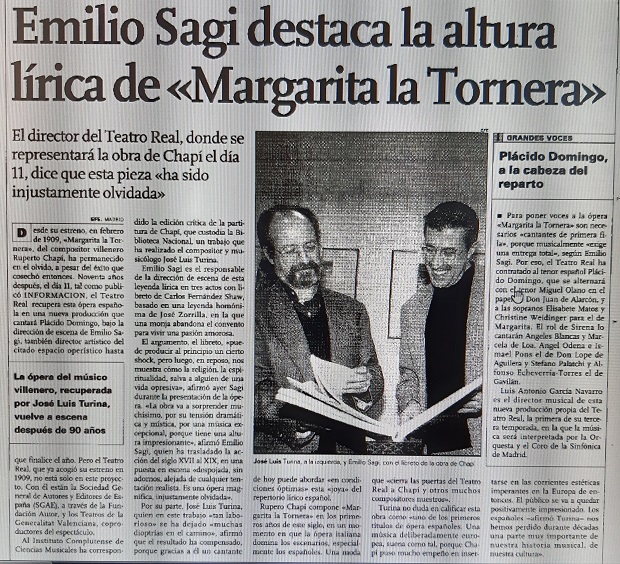
Press release published in the newspaper Información (Alicante, December 2, 1999)

Press release published in the newspaper El País (Madrid, December 10, 1999)

Press release published in the newspaper El País (Madrid, December 11, 1999)
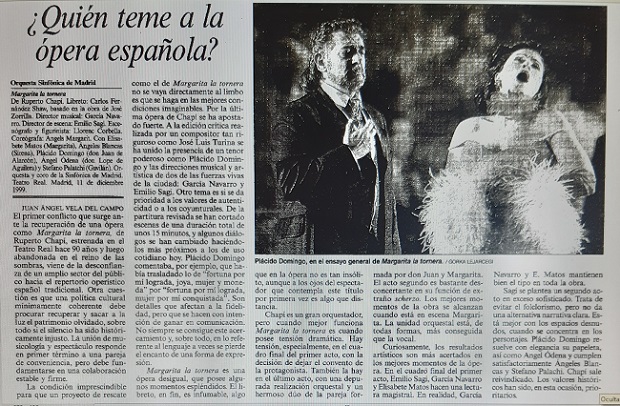
Article by Juan Ángel Vela del Campo published in the newspaper El País (Madrid, December 12, 1999)

Distribution of the CD from the Teatro Real label