
home > bibliography > Music Inspired by Zóbel: A First Example by José Luis Turina
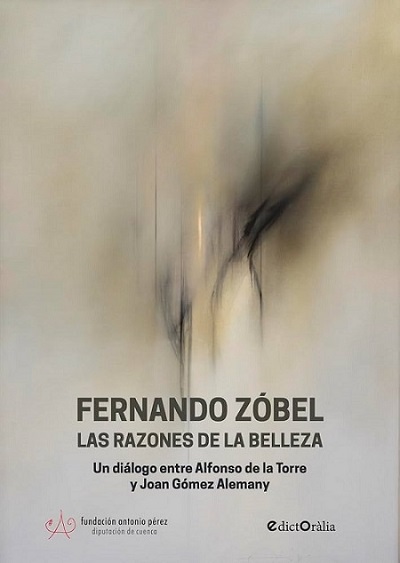
Music Inspired by Zóbel: A First Example by José Luis Turina
Por Joan Gómez AlemanyBy Joan Gómez Alemany
(Text published in the book Fernando Zóbel. The Reasons for Beauty by Alfonso de la Torre and Joan Gómez Alemany. EdictOràlia Publishing. Valencia, 2024)
So far, the most ambitious composition (and one of the first) dedicated to Fernando Zóbel was created by the composer José Luis Turina. Due to its scope, this work will be analyzed first and in more detail, before continuing with other, smaller-format pieces that are no less interesting. His work, titled Exequias, in Memoriam Fernando Zóbel, was composed in Cuenca between September and December 1984 and premiered in April 1985 during the XXIV Religious Music Week. The composer himself briefly explains the motivation behind his piece:
|
I heard the sad news of the death of the painter Fernando Zóbel, and a few days later, I attended his burial at the San Isidro cemetery in Cuenca. This event led me to abandon -or perhaps postpone- my not very clear plans for the commissioned work for the Religious Music Week and replace them with a tribute to Zóbel's memory, an idea that captivated me from the start due to the many connections it involved: the relationship between Cuenca and Zóbel, between Zóbel and music, and my own musical connection with Cuenca and Zóbel... I met Fernando Zóbel in July 1982, at the premiere of my opera Ligazón, held at the Church of San Pablo in Cuenca. That same month, the first International Music Course for Young Performers was held at the Cuenca Conservatory, where I was then a professor and secretary [1]. |
This piece, for Gregorian choir, mixed chamber choir, and an orchestra of flutes in C and G, bass clarinet, bassoon, two horns, two trumpets, two trombones, piano, percussion, and a small string ensemble, lasts approximately 45 minutes. Fortunately, it has been published by Verso Records and recorded by the Córdoba Orchestra and the Ziryab Choir, conducted by José Luis Temes. Interestingly, Temes wrote a Treatise on Contemporary Solfège, and on its cover, one can see a work by Zóbel himself.
Regarding Exequias, in Memoriam Fernando Zóbel, it can be said that before each movement, a Gregorian choir sings the melody traditionally associated with the funeral mass (Missa pro defunctis), namely the Requiem (a word derived from Requiem æternam dona eis, which can be translated as "Grant them eternal rest"). This material is then paraphrased (and modernized) by the orchestra. This establishes a close connection between voice and instrument, as the voice has been the pillar of Western music preserved in readable scores, that is, the music of codices and medieval manuscripts (Greco-Roman music has not been preserved or is unreadable). The voice was the primary form of musical education (and still is in conservatories today), while instruments came later. At first, instruments were banned in churches (except for the organ, which was allowed), and they were introduced by doubling the vocal lines. It is interesting that Turina does not directly title his work "requiem," even though that is the first word sung by the choir. Additionally, we hear Gregorian melodies and the titles of the movements correspond to parts of the requiem. Instead, for his composition’s title, he prefers the word "exequias" (funeral rites), which also refers to a funeral service, although this term doesn’t directly imply the Christian creed like the former. However, the main reason for this choice is explained by the composer himself in his notes on the composition:
|
The original idea, purely instrumental, was meant to be a "Procession to the Cemetery", but it gradually evolved, enriched by the introduction of material from Gregorian liturgy, which led me to compose a "Requiem Mass" based on the current liturgy (Introitus, Graduale, Alleluia, Tractus, Offertorium, and Communio), to which I decided to add one more piece: Processio ad coemeterium. The structure of the ancient requiem (think of the famous requiems by Mozart, Verdi, Berlioz), more gloomy and dramatic, did not fit my purposes as well as the current version, which is more hopeful (highlighting a major difference: the substitution of the Dies irae with the Alleluia). I also decided not to use the term "Requiem" as the title of the work, to avoid unfavorable comparisons, and instead opted for the word "Exequias" [2]. |
We will now analyze each movement of Exequias, in Memoriam Fernando Zóbel in more detail. The first movement is the Introitus. This introduction, or entry, is composed by Turina with some features that will develop throughout the work, albeit with contrasting elements. At this very beginning, the spatiality of the music is present -something always associated with it and especially connected to architecture (but also to visual arts). The string orchestra, divided by soloists, moves from the highest to the lowest voices in the form of an 11-part Ricercare. These features directly influence the way the sound is spatialized and composed as if it were layers or lines of a painting (very much in the style of Zóbel’s paintings).
As we can both hear and see in the score (available on the composer's website), the music begins with the first violin playing a kind of paraphrase of the Gregorian melody previously heard from the choir, but now it is developed with ornaments and a virtuosic language typical of the strings. This first violin is followed by a second and a third violin, then moving to the viola section (in this case, only two). Two second violins join in next, followed by two cellos, with the third second violin added, and finally, the movement ends with a solo double bass. We move from the high register of the strings to the low, creating a descending diagonal, as if the coffin were being lowered into the grave. However, this diagonal is not perfect, as Turina breaks it by introducing the violas before the second violins and bringing in the third one after the cellos. This results in a texture that is less linear (and predictable), resembling more of a zigzag pattern.
Once the string section unfolds, a brief "veil" from the wind instruments (bass clarinet, bassoon, and two trumpets), lasting just two bars, serves as a sonic bridge for the entrance of the mixed choir. The choir paraphrases the Gregorian melody, as the orchestra did, but in a very different language. The chords heard from the choir have a style similar to Fauré's Requiem, creating an interesting clash of styles: an orchestra with an atonal language versus voices with very sweet tonal harmonies. This contrast in musical strategies is something we've observed in relation to Zóbel's work as well. Additionally, the Gregorian chant introduces another significant difference, highlighting the multi-temporality of the piece, which combines languages that span across several centuries. Gregorian chant (which is traditionally male-only singing) is historically linked to the time of Pope Gregory (from whom it gets its name), around the year 600, although its origin is earlier and hard to pinpoint. Mixed-voice choir music (both male and female voices) with tonal harmonies corresponds to a stylistic period that primarily developed between the 17th and 19th centuries. Lastly, the contrapuntal atonality of the strings (very much in the serialist style) can be dated to the early 20th century. All these elements combined reflect José Luis Turina's contemporary approach. His style is characteristic of his time, often referred to as "music about music," intertextuality, or postmodern music. As Tomás Marco writes, «where the fusion of tradition and avant-garde occurs most naturally and convincingly is in some authors of the next generation, such as José Luis Turina, who establishes a brilliant dialogue not only between various techniques and aesthetics but also between the formal and the expressive» [3].
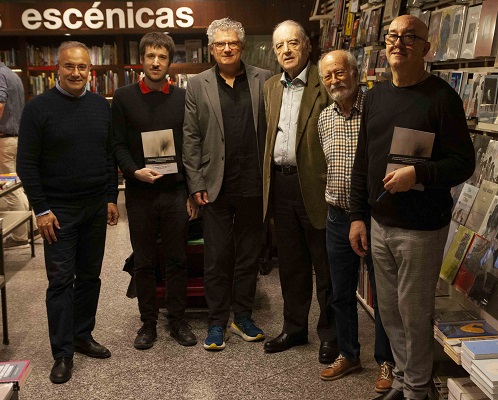
With Jesús Carrascosa, Joan Gómez Alemany, Josep Lluís Galiana, Tomás Marco y Alfonso
de la Torre, after the presentation of the book at the La Central bookstore in Madrid
In the Introitus, after the introduction of the strings and the appearance of the mixed choir, a dialogue develops between the two (though the voice is more present and dominates the foreground). The difference in timbre and language makes this "dialogue" somewhat fictitious, as the sensation is more of a superimposition of blocks rather than an exchange between equal or similar parts. This has a certain plastic quality, as we can almost "hear" large brushstrokes being layered on top of each other without any transition or blending.
The first movement of the composition ends in a manner opposite to its beginning, a very visual resource. While the work begins with the highest-pitched instrument (the violin), in clear contrast, it concludes with the lowest (the double bass), almost in the style of reverse symmetry. Additionally, the theme of the ricercare (or canon) is presented in retrograde, meaning the notes are played in reverse order, as if read from left to right (not right to left, as at the start). Thus, the Introitus creates a large visual arc, growing and shrinking like a cloud. The comparison with Zóbel’s painting is quite evident. Through purely sonic means, Turina evokes a spatial sensation from the very beginning of the work, something that recurs throughout the piece.
The Graduale, purely instrumental and without choir, begins with a flute that, in a solo role, performs a free and rhapsodic rhythm. When accompanied by percussion (such as congas and bongos, possibly of Cuban origin with African roots), it creates a kind of music that feels somewhat "exotic," not typical of the sacred austerity commonly associated with requiem music. This flute is not Baroque, like the one Zóbel used, but a flute in G (slightly lower-pitched than the usual concert flute in C). This change in timbre, with its lower tone adding a bit of "earthly" body to the sound, further enhances the feeling of a music associated with a tone uncommon in Western music. Later, a bass clarinet joins the flute, engaging in a dialogue through virtuosic and agile scales. The clarinet ultimately concludes the piece, accompanied by percussion, emphasizing the duality of timbre in the Graduale.
It is interesting that the third movement of this "requiem" is an Alleluia, a song of jubilation and gratitude, derived from the Hebrew "Praise Yahweh." This song is usually joyful, and precisely for that reason, it is traditionally omitted in the requiem mass (in our culture, something not very joyful...) -in contrast to ordinary masses where it is included. Turina makes an exception here to emphasize (as we read in his quoted words) that these Exequias differ from the original requiem structure. Therefore, its more hopeful, less somber side is highlighted. Consistently, Turina writes a beautiful piece of great praise for this Alleluia, where an ecstatic choir is heard in its most complex and grand dimensions. This is why it is divided into multiple voices, a total of 20 (5 per section), creating a very rich polyphonic texture (including some canons). The orchestra occasionally adds percussive timbres to emphasize the sound structure, but without a doubt, the voice leads this movement, which is the richest in vocal polyphony among all the Exequias.
The next movement, Tractus, is again purely instrumental. As the piece unfolds, we can see that the composer alternates between movements with instruments and movements with voices, adding variety to the composition. This generates a somewhat symmetrical and staggered structure that can enhance the "plastic" aspect of the sound. Generally, the Tractus has a pointillistic texture characteristic of serial music, also employing some fanfares performed by brass instruments. Particularly in the middle of the piece, the piano takes on a prominent role, executing counterpoints in a Baroque style. Toward the end of the piece, this instrument plays very high-pitched, repetitive figures that blend with a curtain of bells, thus concluding the Tractus. This is the longest, brightest, and most virtuosic instrumental movement of the entire work. It begins with very drawn-out and somber low sounds (especially from the bass clarinet and bassoon), and then gradually ascends toward high-pitched and fast sounds, like those of the piano and bells. This creates a long, sinuous, ascending line, very spatial, which can be associated with the initial words sung by the Gregorian choir: De profundis clamavi ad te, Domine, Domine, exaudi vocem meam (From the depths I cry to you, Lord, Lord, hear my voice).
The fifth movement, Offertorium, is composed of two blocks, one between the strings and the choir, creating an impossible dialogue between them. This emphasizes the opposing sound worlds, for example, through the timbral difference between the instrument and the voice, the contrast between the atonal style of the orchestra and the tonal-modal (derived from the Gregorian language) of the choir, or lastly, the dynamic intensity, as the orchestra consistently plays loudly, while the choir produces much softer sounds. This antithesis could well be a musical metaphor for the first words pronounced by the Gregorian choir: Illumina oculos meos nequando obdormiam in morte (Illuminate my eyes lest I fall asleep in death). Illuminating death or opening one’s eyes while sleeping could be beautiful oxymorons that we hear in Turina’s music.
Additionally, the motivic cells in the strings emphasize jumps up and down, creating a zigzag texture that seems to be in a loop. This is further reinforced by the fact that the piece begins and ends with the same string motifs. Thus, it creates a sensation of circular music that doesn’t seem to have a clear or progressive direction, but rather revolves around itself. This might also explain why the piece ends with a simple interruption, not a resolution or cadence emphasizing its conclusion, but rather it suddenly arrives at silence, unexpectedly. A possible image for the closure of this movement could be that of a sigh offered to the air that makes the music disappear.
The Communio, the sixth movement of the work, once again features a flute as the solo voice, this time in C. It seems fitting to note that if Turina emphasizes this instrument, it is because it is clearly associated with Zóbel. Moreover, here there is no accompaniment. The flute plays its solo role in its entirety, presenting itself in "communion" with the listener. Its sound, in the context of the requiem, could be a kind of transfiguration of Fernando Zóbel himself. Though his heart has stopped beating, his spirit continues to (re)sound among the living.
The final movement, the only one not preceded by a Gregorian choir, is Processio ad coemeterium (which could be translated as "procession to the cemetery"). This is the climax of the piece, where all resources are brought together in a sort of celestial apotheosis. Only in this seventh and last movement is the complete ensemble of instruments and voices employed, unlike the other movements, which used a reduced or sectionalized ensemble. Additionally, the Gregorian choir is heard for the only time alongside the orchestra, suddenly inserted within a very rhythmic orchestral texture (especially due to the tremolos in the strings), which contrasts sharply with its calm declamation. The mixed choir, on the other hand, is more active and exclamatory, blending better with the orchestra. Everything unfolds in a very brilliant texture, achieved through fast and repetitive motifs, generating a sound like a great peal of bells, much like a religious procession. For this reason, the music seems to suggest a somewhat optimistic vision of the afterlife, especially considering that the name Zóbel, through his exemplary life and work, has transcended his physical mortality to perpetuate itself in posterity. Nonetheless, in this Processio ad coemeterium, we do not hear excessively joyful music (such as in a jubilee), and therefore, this complex texture ultimately dissolves until reaching the simple sound of the solo flute (as it could not be otherwise) and the pizzicati of the strings. These, as a perfect final point of the work (and of existence), are the last and extinguished sound of these Exequias in memory of Fernando Zóbel.
_________________
[1] Official website of the composer: https://www.joseluisturina.com/ingles/exequias.html
[2] Ibid.
[3] MARCO, Tomás. Musical Thought and the 20th Century. Madrid: Sociedad General de Autores y Editores, 2002, p. 442.