
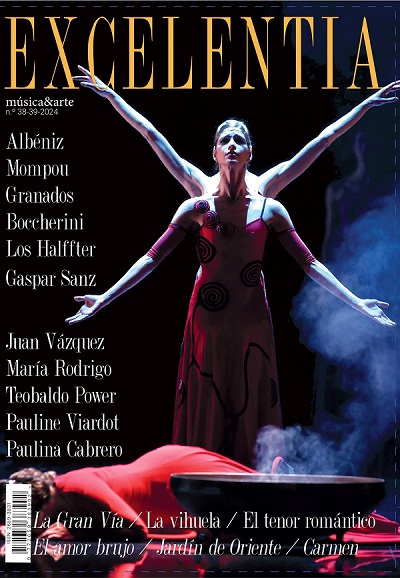
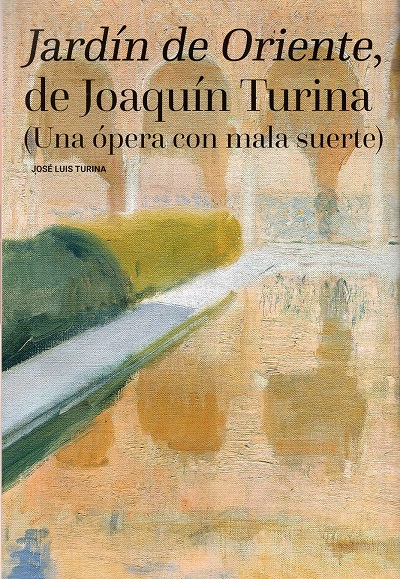
Cover of issue no. 38–39 of Excelentia magazine
(Madrid, September 2024)
Jardín de Oriente, de Joaquín Turina (Una ópera con mala suerte) / "Jardín de Oriente" by Joaquín Turina (An opera with bad luck)
Article published in issue no. 38–39 of Excelentia magazine. Madrid, September 2024After completing his Parisian period in 1914 and settling permanently at his residence on Calle Alfonso XI, 7 in Madrid, the echo of Joaquín Turina's successes in the French capital (such as the premiere of the Quintet op. 1 in 1907, the Quartet "De la guitarra" op. 4, and a good number of piano works) opened the doors of Madrid's Teatro Real to him in 1913, where La procesión del Rocío was premiered in March of that year by the Madrid Symphony Orchestra conducted by Enrique Fernández Arbós.
Meanwhile, the great success of the premiere at Madrid's Circo Price on February 5, 1914, of the three-act zarzuela Las Golondrinas, with music by José María Usandizaga, marked the first collaboration of a composer with the couple formed by María de la O Lejárraga and Gregorio Martínez Sierra. It was the beginning of a fruitful relationship between them and the leading Spanish composers of the time, from which some undisputed masterpieces have survived, such as Manuel de Falla's El amor brujo and El sombrero de tres picos.
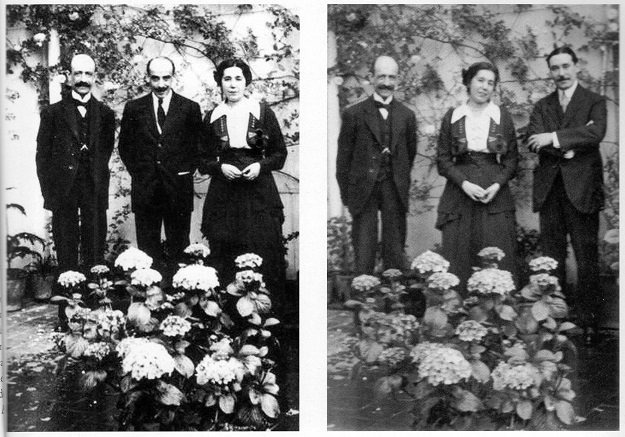
Left: Falla, Martínez Sierra, and Lejárraga. Right: Falla, Lejárraga, and Turina
Joaquín Turina was not so fortunate, however. The premiere in October 1914 of his first collaboration with the couple, the zarzuela Margot, was an outright failure, carefully orchestrated by the "reventadores" (saboteurs). Nor did La mujer del héroe, premiered in December 1916, fare any better; the composer himself decided to exclude it from his catalogue. Greater fortune came with the incidental music for Navidad, premiered at Madrid's Teatro Eslava just a few weeks later, which was a notable success.
The most ambitious collaboration between Turina and the Martínez Sierra couple was undoubtedly the opera Jardín de Oriente. Work began in 1915, but the opera did not reach its definitive version until 2022 -a curious chronological parallel with the vicissitudes of Manuel de Falla's El amor brujo, also composed in collaboration with them. To prepare, María Lejárraga and Turina made a short trip through North Africa, with the aim of listening to and noting down Arab songs and dances to serve as inspiration for the opera. Out of this journey came, a few months later, the piano suite Álbum de viaje op. 15, consisting of several pieces whose titles (such as "El casino de Algeciras", "Gibraltar" or "Fiesta mora en Tánger") recall some of the places visited. The first movement changed its original title, "La compañera de viaje", to "Retrato", no doubt due to the scrupulous objections of his close friend Manuel de Falla, scandalized that such a trip had taken place, despite its strictly professional purpose.
A few months after returning from North Africa, between May and July 1915, Turina composed Laberinto (originally titled Los moros y la pastora, later El amor dormía), a one-act opera with the official libretto by Gregorio Martínez Sierra and the real one by María de la O Lejárraga, intended to be premiered in Barcelona at the end of that same year by Emilio Sagi Barba's company. The plan fell through due to a fire that, just weeks earlier, had destroyed the Teatro Principal, where the premiere was to take place. Set aside for some years, Turina returned to the score -today kept at the Juan March Foundation in Madrid- in 1922, using it as the basis for Jardín de Oriente, which was being considered for performance at the Teatro Real the following season.
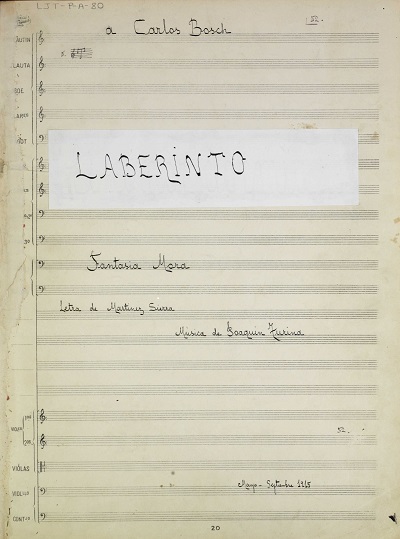
Cover of the Laberinto manuscript
In that sense, Laberinto can be seen as a first attempt at a broader project, of which it eventually became a substantial part. Somewhat incomprehensibly (though deliberately, since the autograph score begins with a page marked "No. 1"), the stage action starts with the entrance of the three women -Galiana, Zaida, and Celinda- after the fire that has destroyed much of the Sultan's Palace. To give full dramatic meaning to this scene, Turina prefaced it in Jardín de Oriente with an entire "First tableau" of 487 measures, depicting the preceding action: calm in the harem -including Galiana's aria "Esperando está la rosa," whose text had to be added in the final version of the libretto-, followed by the assault, fire, and chaotic flight of its occupants.
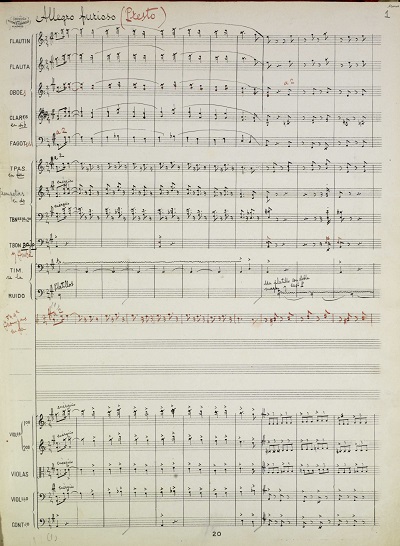
First page of the Laberinto manuscript
From that point on, the two versions are practically identical in the vocal parts -with minor variants at certain moments- though greater differences can be observed in the orchestration: sometimes more elaborate, sometimes simplified, especially in the accompaniment to the voices. The Danza also shows the omission of some short sections. The greatest difference, however, lies in the final scene, where Jardín de Oriente acquires greater dramatic tension, relaxing into a closing section entrusted to the Spirit of the Fountain. Absent from Laberinto, this addition provides a more convincing conclusion to the work.
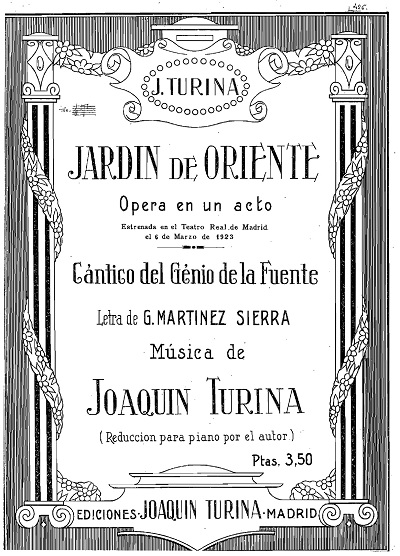
Cover of the author's edition of the Cántico del Genio de la Fuente
As for the differences in orchestration, these clearly derive from the very different instrumental forces that Turina employed in each case. While in the first version he limited himself to an orchestra consisting of 2 flutes, 1 oboe, 2 clarinets, 1 bassoon, 2 horns, 2 trumpets, 3 trombones, timpani, percussion, and strings, for Jardín de Oriente -taking into account the possibilities offered by the Teatro Real- he envisioned a larger orchestra: woodwinds in threes, 4 horns, 3 trumpets, 3 trombones, tuba, timpani, percussion, harp, and a more substantial string section. Curiously, in the Laberinto manuscript one finds, alongside the original instrumentation in black ink, a later version in red ink that slightly expands the forces with 1 oboe, 1 bassoon, 2 horns, and a tuba. Also striking is the presence, in the final version of Jardín de Oriente, of a "dance violin," which for no fewer than 290 measures (from no. 46 to 335) carries a part that, although it begins clearly as a solo, ultimately ends up redundantly doubling the principal melody of the entire section -already performed by the rest of the orchestra- without any apparent justification, whether from an orchestral or dramatic perspective.
In Turina's meticulously kept Diaries, recorded since 1913 in pocket notebooks now held at the Fundación Juan March in Madrid, one can follow day by day the development first of Laberinto and later of Jardín de Oriente. Thanks to these notes we can deduce that the idea for the opera emerged in mid-March 1915 [13.3: "Martínez Sierra with a thousand matters"; 14.3: "More projects from Martínez Sierra"], and that Turina and the couple must have worked on the project throughout that month and the next [25.3: "Lecture and collaboration with María"; 24.3: "Meetings with Gregorio"; 11.4: "Meeting with María M. Sierra"]. Once this initial stage was completed, María Lejárraga and the composer undertook, between April 12 and 16, the North African journey already mentioned. By the first week of May he was already at work on Los moros y la pastora [3.5: "Long meeting with the M. Sierra... Moros y pastora..."; 5.5: "Lunch and meeting at Martínez Sierra's house…"; 8.5: "Meeting on moros with M. Sierra..."; 9.5: "Collaboration with M. Sierra..."]. A few days later, on the 22nd of that month [22.5: "... dinner at Gregorio's house. Discussion and variation of Moros"], a disagreement between text and music authors led to a change in the dramaturgy of the work [24.5: "Meeting on Moros with Gregorio and María"]. This did not prevent the work from being completed the following week, on May 27 [27.5: "... end of Moros"], although two days later he notes [29.5]: "Start again Moros". He continued working on it intensely over the following month, composing the Danza between June 18 and 21, and beginning on June 28 the orchestration of what had been completed so far. He carefully recorded in the following days the page numbers he reached in the score, stopping the orchestration on July 17 upon reaching page 69. It is significant that during June and July he noted repeated encounters with Gregorio, without mentioning María's name during this part of the process. In any case, there are more than sufficient grounds to deduce that Gregorio was responsible for the dramaturgy of the different projects, while María undertook the actual writing of the texts -even if only his name appeared in the publications and registrations of the many works on which they collaborated.
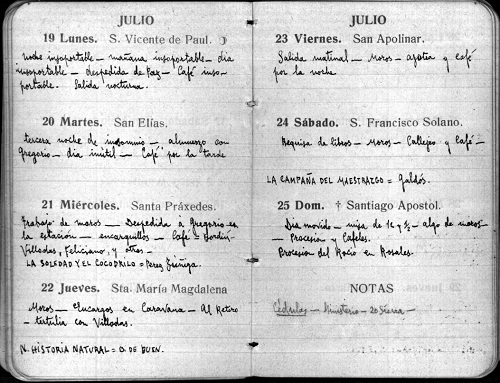
Pages from Turina's Diary corresponding to the week of July 19–25, 1915
On July 21 he resumed composition, noting July 30 as the date of its conclusion [30.7: "End of Moros"], and on August 2 began orchestrating this final portion of the work, which he completed on August 28 [28.8: "Orch. – End of Moros – 152 pages"]. A reading session held at Sagi-Barba's house on September 3 seems to have prompted a change in the ending, for on September 13 he noted: "I begin the new scene of Moros", which he finished the next day [14.9: "The new scene of Moros is finished"], orchestrating it over the two following days [15.9: "Variation in the orchestration of the ending of Moros"; 16.9: "Orchestration of the new section of Moros"]. On September 18 he revised the score, though this cannot be taken as its definitive completion, since on October 10 he specifies: "Work and reading of Moros with the collaborator," meaning María Lejárraga. The following day he made a new "Arrangement of Moros", two days later held a "Hearing of Moros for maestro Martínez", and finally, on the 13th, registered it at the Sociedad de Autores under the title El amor dormía. However, this nearly eight-month process was unexpectedly thwarted by the aforementioned fire on November 3 that destroyed Sagi's theater, the Teatro Principal in Barcelona, where the premiere -apparently already under the title Laberinto- was scheduled to take place, but which never reached the stage. Even so, the composer did not entirely abandon the project. Five years later, while working as maestro concertador at the Teatro Real, between December 13 and 20, 1920 he undertook a "re-orchestration of Laberinto" (surely the one in red ink in the score), though still without the chance of seeing it programmed as an opera. That opportunity would arise a few months later.
Thus, on September 16, 1921, he recorded in his Diary: "I begin the revision of Laberinto", which in fact turned out to be more an intention than a reality, since almost two months later, on December 14, he wrote: "I begin again the first tableau of Laberinto", on which he worked for only a few days before abandoning it once more due to the demands of his intense duties as répétiteur at the Teatro Real. Between those two dates there were a number of meetings and dinners with the Martínez Sierra couple, from which undoubtedly emerged the new concept and libretto of that first tableau, which would already be the definitive one.
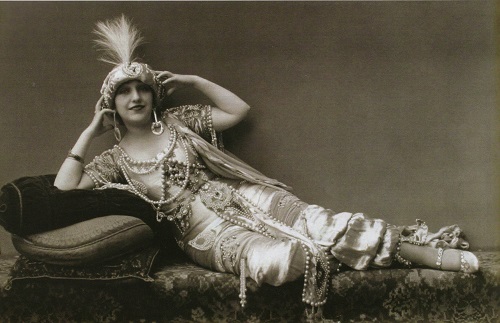
Matilde Revenga (soprano) as Galiana. On the back of the photograph one can read
the following dedication: To the illustrious Maestro Turina as an affectionate
remembrance of the night, unforgettable for me, of the premiere of his
beautiful opera Jardín de Oriente. With much gratitude, Matilde Revenga
This renewed interest in revisiting the opera stemmed, as his son-in-law Alfredo Morán explains in his important biographical study Joaquín Turina a través de sus escritos (Alianza Música, Alianza Editorial, Madrid 1997), from the fact that:
|
Joaquín Turina, who knew very well the atmosphere of the Teatro Real and all those who moved within it, had been observing certain shifts in policy on the part of the Amézola management with respect to the still-distant 1922–1923 season. This evolution was not the result of any initiative of their own, but was instead forced by public opinion, including the press, in favor of a democratization of opera as a spectacle and advocating for a more eclectic repertoire on its stage, one that would also make room for Spanish works. Hence Turina's interest in having Laberinto ready for a possible premiere in the event that what was then only a faint rumor might take shape. But his eagerness, very much against his will, had to wait, exactly as the year before, until the end of the opera season -ongoing since November 19- in order to reclaim his time and devote it to his music. Thus, once the season was over and once again free of the Teatro Real, on March 1 [1922] he resumed -he says definitively- the first tableau of Laberinto. He would continue working on the opera until June 8, when a new "... halt in Laberinto for lack of a libretto" forced him to stop for a while. We do not know for how long, but we can pinpoint with precision October 19 as the date of completion of the music. As for the orchestration, it was carried out -already under the title Jardín de Oriente- between November 3, 1922, and January 24 of the following year. |
|
"24/II... Dinner at Martínez Sierra's house to patch together the plot of Jardín de Oriente". "5/III... Comments, preparations, and dress rehearsal of Jardín de Oriente. Disorientation. Intentions not to write any more operas". At the time of the premieres of Turina's earlier stage works, we pointed out the evident difficulty he faced in being unable to carry out his work without a completed libretto beforehand. Jardín de Oriente was no exception. Turina himself reveals this situation in the two lines we have just read, dated February 24: "... patch together the plot". Eleven days before the premiere, "... patch together the plot"? As can be seen, his words are expressed with no reproach whatsoever, but as if it were the most natural thing in the world -perhaps because he was already accustomed to it-, yet it is clear that he felt pained at having to write such words. We insist: at that late stage, still "patching together the plot"! when the score had already been completed a month earlier? From there, perhaps, came his sense of "... disorientation" and his "... intentions not to write any more operas". |
|
"A sultan spurns the blandishments of the women in his harem because his heart drives him toward Galiana, the beautiful maiden who comes to him precisely when Omar, leading his warrior host, assaults the city and the palace. Odalisques and favorites flee to the mysterious garden. Galiana reads in the waters of the fountain her fate: near it she will meet either death or happiness, if she beholds the man whom the crystalline surface has shown her, as in a sweet dream. Omar too shares this superstition. Drawn to the garden by the laments of the harem women, he encounters the very woman revealed to him by the magical waters of the fountain. When the remnants of the defeated sultan's men rush in to kill Omar, Galiana interposes herself and falls wounded in generous sacrifice for her beloved. But the dagger has not fulfilled its treacherous work, and the two lovers intone the hymn of love that destiny had promised them when it foretold their happiness". That night [of the premiere] Turina wrote in his Diary: "6/III... A pessimistic day; restless and worried. Premiere of Jardín de Oriente, a success. I go out onstage five times. Parade of friends". [...] [And after the premiere] In just two lines of his Diary the composer summarized what had taken place at the Teatro Real on that memorable evening: "7/III... Very good press coverage, except for El Imparcial. A day of calm. Congratulations in abundance.". [...] |
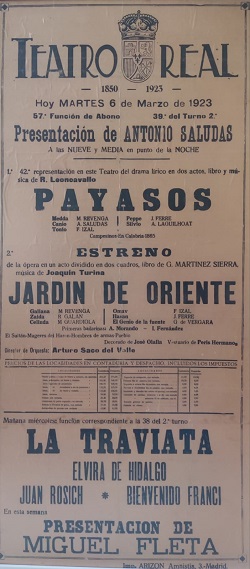
Poster for the premiere of Jardín de Oriente
(Madrid, Teatro Real, March 6, 1923)
With regard to the critical reception of the work, the following excerpts from the main newspapers may be cited. Thus, José Forns wrote in El Heraldo de Madrid on March 7:
|
"[...] More than an opera proper, it is a mixture of opera, pantomime, and dance, in which dramatic action and the performers' brilliance are sacrificed to visuality and plastic effect, not always achieved. One seems to sense in Mr. Martínez Sierra, the author of the libretto, a certain indecision, born of the prejudice of wishing to incorporate into his work all the elements of stage art he had admired. We would almost venture to affirm that his creation was originally conceived as a ballet or pantomime, later expanded. [...] Maestro Turina has made the most of the poem offered to him. In the first place, he manages to convey to his music the conventional orientalism required by the setting, mixing in some brief motifs of popular flavor, which recur throughout the two tableaux. As a result of the nature of the libretto, the score, which follows it faithfully, also proves somewhat fragmentary, giving the impression of symphonic poems strung together. The monologues -some as beautiful as that of the soprano when she reads her fate in the fountain- are so brief that the public scarcely has time to form a judgment on them. It is a pity that a composer of Joaquín Turina's undeniable temperament has not found a wider field in which to unfold his brilliant personality. [...] The daring and rich harmonization, and the colorful and transparent orchestration, so characteristic of the author of La procesión del Rocío, lend the whole a singular appeal, once again revealing the solid technique and refined taste of the distinguished Sevillian musician. [...]" |
|
"The subject, showy and decorative, is entirely devoid of interest; it is a mere pretext for leaving all responsibility to the musician. [...] In Jardín de Oriente are once again reflected all these qualities: ease, fluency, orchestration full of timbral lightness; simple, short, lively ideas wrapped in a kindly charm; flashes of Moorish character, such as the prayer he preserved in authentic form, heard and notated in a mosque back in 1915, during a trip made with Martínez Sierra through North Africa, where the first germs of this work seem to have been born". |
|
"[Turina] had no libretto on which to base his score. A musical drama cannot be made where no drama exists. Barely two pages of text has the libretto that Mr. Martínez Sierra has written (we shall not say troubled himself to write) for Jardín de Oriente. [...] The talent of Mr. Turina -already established in symphonic music and admired in dramatic- was on this occasion forced to build without a solid foundation. The poet's art, the dramatist's work, are indispensable to the musician. In Jardín de Oriente, Turina performs feats of balance over the void, obliged to prolong them excessively. He begins beautiful melodic themes which he develops or abandons and takes up again as dictated by his skill and mastery: oriental and popular themes, where the charm of rhythm is joined to the grace of color, and his wisdom in orchestration always stands out". |
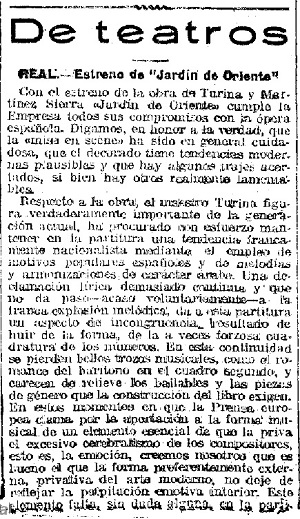
Review in El Imparcial (Madrid, March 7, 1923)
|
"With the premiere of the work by Turina and Martínez Sierra Jardín de Oriente, the company fulfilled all of its commitments to Spanish opera. Let us say, in the interest of truth, that the "mise en scène was", on the whole, careful, that the sets showed plausible modern tendencies, and that some costumes were well chosen, though others were truly regrettable. As for the work itself, Maestro Turina -undoubtedly a figure of great importance within the present generation- strove earnestly to sustain in the score a distinctly nationalist tendency through the use of Spanish folk motifs and melodies and harmonizations of an Arabic character. A lyrical declamation that is excessively continuous and avoids -perhaps intentionally- the full outpouring of melody lends the score an aspect of incongruity, the result of a flight from form, from the sometimes necessary symmetry of musical numbers. In this continuity, beautiful passages are lost -such as the baritone's romance in the second tableau- and both the dances and the genre pieces required by the construction of the libretto lack sufficient prominence. At a moment when the European press is clamoring for the return to musical form of an essential element denied by the excessive cerebralism of many composers -namely, emotion-, we believe it is desirable that form, predominantly external and typical of modern art, should not cease to reflect inner emotional pulse. This element is lacking, without question, in Turina's score, and herein lies its weakness, depriving it essentially of vitality. Martínez Sierra's poem, though well-oriented, suffers from frequent lapses into prose, which the lyrical declamation highlights rather than conceals. The first tableau, essentially mimetic, is drawn under the influence of the Russian ballet, whose allure is difficult to resist in similar contexts. The second tableau, with its somewhat disjointed action, achieves a true atmospheric success and includes choral interventions which, in the score, remain embryonic but which might have offered powerful scenic effects. [...]" |
And even María Lejárraga herself, the unquestionable true author of the libretto, seems to have wished to erase the opera's premiere and all related matters in an eloquent passage from her book Gregorio y yo:
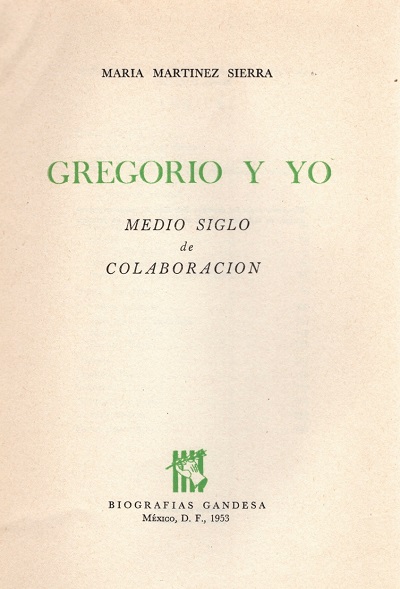
Cover of Gregorio and I, by María Lejárraga
(signed María Martínez Sierra)
(Ed. Biographies Gandesa, Mexico City 1953)
|
"We also wrote a one-act opera, Jardín de Oriente, which was premiered at the Teatro Real in Madrid under the dreadful conditions that house has always reserved for works by Spanish composers. The world-famous star Conchita Supervía, a close friend of Turina, had promised the maestro to debut the work, but at the last moment, capricious as every great artist, she went back on her commitment. The orchestra of the Teatro Real of Madrid has always been justly renowned, but the chorus was lamentable and the corps de ballet even more so; the company took no pains whatsoever with the staging, and used old sets that bore no relation to the character of the work. Sung correctly, but without brilliance, it obtained a good success, was performed two or three nights... and I do not believe it was ever staged again". |
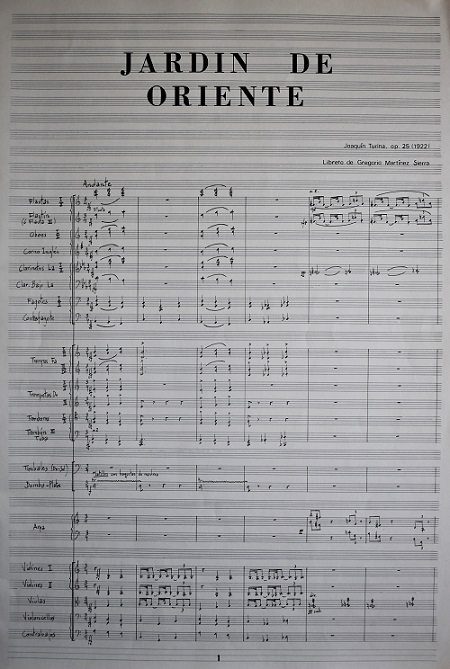
First page of the handwritten reconstruction of the score of
Jardín de Oriente (Madrid, 1981)
That reconstruction was undertaken by me throughout 1981, a task as absorbing as it was demanding, requiring great concentration to transform into full orchestral score the half-meter-high stack of orchestral materials -fortunately preserved in the SGAE archive- that piled up for months upon my desk, and from which, patiently and meticulously, the final score gradually emerged, at a time when computer-assisted music engraving was still unthinkable.
The absence of a full orchestral score had prevented the realization, in 1974 -the twenty-fifth anniversary of the composer's death- of Rafael Frühbeck de Burgos's project to conduct it with the Orquesta Nacional de España in concert version. One had to wait until 1982 -the centenary of the composer's birth- for the work, now with a newly prepared score, to return to the stage at the Teatro de la Zarzuela in Madrid on February 23, 25, 27, and 28, in a production directed by Juanjo Granda and with María Orán and Antonio Blancas in the principal roles, the Orquesta Sinfónica de Madrid in the pit, and Enrique García Asensio conducting.
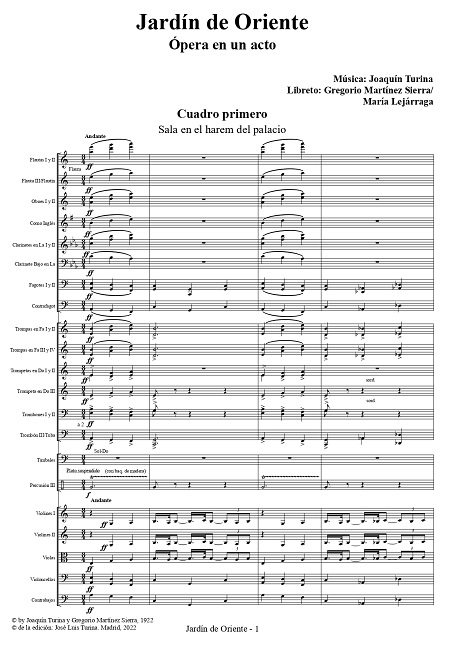
First page of the electronic edition of the score of
Jardín de Oriente (Madrid, 2022)
From that handwritten score, and thanks to so valuable a tool as the Finale program, it has been far simpler to prepare a new edition of the score of Jardín de Oriente, completed during the summer of 2022, in which certain errors noted in the earlier manuscript copy have been corrected. This score, accompanied by a newly prepared set of orchestral parts and by the edition of a piano-vocal reduction based on Joaquín Turina's manuscript, was initially conceived for a recording project which, in keeping with the persistent bad luck that has dogged this opera, ultimately failed to materialize.
___________________
1. A.M.C. (Ángel María Castell): "La ópera Jardín de Oriente del maestro Turina," ABC, March 7, 1923, p. 22
Madrid, May 2024
First page of the article published in Excelentia magazine