

La empleabilidad de los jóvenes músicos en España / Employability of young musicians in Spain
Paper presented at the Panel during the 5th AEOS/BBVA Foundation Conference 2018(Palacio del Marqués de Salamanca, Madrid, November 28, 2018)
Introduction
Statistical study
Conclusions
Video of the presentation
I. Introduction
I am very grateful to the Spanish Association of Symphony Orchestras for inviting me to take part in this Panel, and I also wish to congratulate the BBVA Foundation for the excellent organization of these Conferences.
First of all, we should all be pleased that the AEOS has included, in a conference focused on professional orchestras, a debate on the employability of young musicians in Spain. For a long time now, all orchestras have been concerned about the aging of their audiences, the decline in season ticket sales, and strategies to attract new audiences in light of young people's reluctance toward the symphonic world. Yet, rarely has there been discussion about the situation of young musicians who train for many years with the aim of entering orchestras professionally.
In the past 20 years, Spain has undergone a profound transformation in terms of music education: from being at the tail end of Europe, our country has risen to the forefront -albeit with caveats in many respects, of course-, as shown not only by figures and statistics, but especially by the growing number of young Spanish musicians who hold important positions in leading European orchestras.
I have devoted my entire professional life equally to composition and teaching in terms of vocation, but much more to the latter in terms of the time spent (naturally, as it has been my paid work). For this reason, in the next few minutes I would like to briefly outline my teaching career, with the request that it not be interpreted as an attempt to place myself at the center of attention, but rather as something essential for fully understanding the meaning of this paper.
In the late 1960s (I was a very late bloomer in terms of vocation), I enrolled to begin music studies at the Municipal Conservatory of Music of Barcelona -in those years, it was still possible for someone my age to start them officially-, and I remember as if it were yesterday that the municipal clerk, after filling out countless stamps -those younger in the audience surely won't know what those were- handed me a small octavo-format booklet and said, "Here, read this when you get a chance". On the subway ride home, I leafed through it, but found everything so complicated, so abstruse and unintelligible, that I decided to ignore it and save it for later. On the cover was the following title: General Regulations for the Conservatories of Music; and of course, it contained the full text of Decree 2618/1966 of September 10, popularly known as the "Plan of ''66". This was my first contact with a legal text, and at the time I could not have imagined the extent to which it would shape my future.
It was not until several years later, nearing the end of the 1970s, when, already a student at the Royal Higher Conservatory of Music of Madrid, I retrieved that booklet from where I had stored it and began reading it with considerable interest, hoping to find out exactly which subjects I needed to complete in order to finish my composition studies -having by then definitively abandoned violin and piano-, since until that moment no one, neither in Barcelona nor in Madrid, had informed me about the curriculum leading to that qualification. To my surprise, not only was I missing quite a few courses, but many of them were not even part of my plans, as they were more suited to instrumental specializations than to theoretical-practical ones (such as the two years of chamber music, for example). Fortunately, my six years of violin study allowed me to meet the requirement for the elementary diploma in a string or wind instrument (many years later, the Royal Higher Conservatory of Music of Madrid issued a completely arbitrary resolution, valid only there and not in the rest of the country, declaring that, for the purposes of obtaining the title of Professor of Harmony, Counterpoint and Fugue, Composition and Orchestration, the piano was considered a string instrument -a doubly absurd decision, since for that degree at least five years of piano were already required in order to take the 2nd and 3rd years of Instrumental Sight-Reading and Accompaniment). This left many of my fellow students, most of them pianists, without a degree because they could not meet that requirement.
Each reading of Decree 2618/1966 was a source of surprises, since its convoluted wording, forcing the reader in each section to jump to other articles, prevented a clear understanding of a regulation I suffered under as a student, and later again, as a teacher, in the 1980s, when most of my teaching career unfolded.
My teaching career began in 1981, when I was appointed professor of Harmony, Counterpoint, Composition, and Music History at the Professional Conservatory of Music of Cuenca, while also serving as the school's Secretary -until 1984, when I was named Academic Director-, which required me to revisit the Decree countless times to resolve the ongoing problems arising from its difficult application to the various academic situations of the students.
In 1985, I sat for the competitive examination for a professorship in Harmony and Accompanied Melody at the Royal Higher Conservatory of Music of Madrid. From 1990 onward, I held this position at the Professional Conservatory of Music "Arturo Soria", after the Conservatory's facilities in the Teatro Real were dismantled to make way for the lengthy renovations that culminated in its reopening as an opera house in October 1997. Both at the RCSMM and later at the "Arturo Soria" Conservatory, I again suffered from the lack of clarity in Decree 2618/1966, having to handle overcrowded classes (I had several groups of more than 40 students, whose work I had to correct twice a week) that mixed teenagers with already-retired people in their sixties -a complete chaos due to the very different interests among them, all brought together in a single type of institution, the conservatories, since there were no Music Schools to handle non-formal music education. One could fairly say that the regulation itself had ultimately undermined the very level of instruction it was meant to support -overly demanding for amateurs and wholly insufficient for future professionals.
As a student first -I was among the delegates who made up the Student Association of the RCSMM- and later as a teacher in faculty meetings, I repeatedly voiced my disagreement with that situation in public. Perhaps for that reason, at the end of 1992, I was invited by the Subdirectorate of Artistic Education at the Ministry of Education to join, as an advisor, the Technical Office for Music and Performing Arts, which had already been working for a couple of years on the reform of music, dance, and drama education within the framework of the LOGSE (Organic Law of October 3, 1990, on the General Organization of the Education System). Although this law did not yield the expected results in terms of general education, it did so with regard to special-regime education.
After a few days of hesitation, the thought of “Why not?” prevailed, and I decided to take on the challenge of contributing, to the best of my abilities, to dismantling a harmful regulation and attempting to build, on its ruins, something well-structured that would help our country make up for lost time and reach, within a few years, the same level as other European Union countries -a goal we have achieved in many cases, both quantitatively and qualitatively even surpassing them.
The reform was gradually implemented throughout the 1990s and the early years of the 21st century, and the measures adopted amounted to a full-scale "clean-up" operation of the many vices accumulated over decades. The most important measures were:
- A rational structuring of studies into four years of elementary level, six years of intermediate level -divided into three cycles of two years each- and four years of advanced level.
- The effective separation of levels, so that higher conservatories offered only higher-level instruction.
- Full equivalence of the higher-level degree to a university licentiate, with the possibility of pursuing third-cycle studies.
- The creation of the Music School model, which allowed for the separation of non-regulated education from regulated education, the latter being provided by conservatories.
- An increase in the number of instructional hours for instrumental lessons, which went from just a few minutes in the most overcrowded centers to 60 minutes in the professional level and 90 minutes in the higher level.
- The inclusion of orchestra as a core subject in the curriculum for intermediate and higher levels, which required rationalizing the teaching staff in the centers -ending the existence of professional conservatories dedicated solely to piano, guitar, or trumpet- in order to make such instruction possible, and thus to open up more positions.
Nevertheless, the inclusion of higher-level artistic education within the university framework was not achieved, nor was the creation of a legal framework specific to higher artistic education centers. The draft for such a framework -prepared in 1995, when Gustavo Suárez Pertierra was Minister of Education, and already enjoying considerable consensus- was forgotten when the PSOE lost the general elections of 1996 and the Partido Popular came to power. The fact that no progress has been made since then is the reason why higher artistic education centers are still governed by the organizational criteria of secondary education -an absurdity that shows no signs of being resolved in the near future.
Once the Royal Decree on the basic aspects of the higher-level music curriculum was approved in 1995 (1), the change in government led to the dissolution of the Technical Office for Music and Performing Arts, and thus my return to my teaching post at the conservatory -a hiatus that lasted from January 1997 until September 1998, when I was again invited to continue the reform work, which had stalled during that time due to the inability to find a sufficiently qualified team to carry it forward. In 1999, the Order establishing the higher-level music curriculum for the entire Ministry of Education's jurisdiction was approved (2), and as we were working on the rest of the applicable regulations -the Royal Decree on specializations, the one on access to professorships, etc.-, I received an invitation from the Director General of the INAEM, Andrés Amorós, to take on the artistic direction of the Spanish National Youth Orchestra (JONDE).
Once again, I took some time to think it over, and after the inevitable “Why not?” I gladly accepted the offer, as I considered JONDE to be an excellent educational project perfectly aligned with my pedagogical interests. Throughout my professional life, I have managed my dual identity as composer and teacher quite well, although I have often had to "set aside" the former to serve the latter, which has been my main source of income and thus my principal profession.
At present (I am only a few months away from retirement, and I often catch myself behaving like a repentant smoker who repeats, out loud, "I've quit smoking! " to convince both himself and others that there is no turning back; in my case, I say: "Next year I retire! " so that neither I nor anyone around me -especially in administration- has any doubts about the firmness of my decision), the bureaucratic burden has grown so heavy that managing JONDE is ceasing to be a passion and becoming a straightforward job -hard work and not always rewarding. I therefore see retirement as a liberation that will allow me to resume composing with greater energy, a pursuit greatly diminished in recent years. For this reason, this will probably be one of my last public interventions as Artistic Director of JONDE, and as I look back and reflect on my past as a student, teacher, and administrator, I can say without a doubt that this orchestra provides a privileged observatory for gauging the health of higher music education in our country -through the annual entrance examinations and the selection of orchestra members that result from them.
II. Statistical study
An initial table clearly shows the quantitative increase these auditions have experienced over a considerable number of years -from 1996 to the most recent tests, held between 2017 and 2018, to fill the pool of instrumentalists for the current JONDE roster. It should be noted that the traditional spring and autumn auditions held each year -each renewing half of the orchestra's specializations- have now been replaced by a single annual call, meaning that those who pass are guaranteed membership in the orchestra for a full two years.

Fig. 1
It is clear that in any specialization whose trajectory we follow over a 24-year period, we will notice a significant increase in the number of applications. Violas, for example, have gone from 12 applicants to 114 during this time. And if we take into account that the candidates from approximately 1996 to 2004 all belonged to the 1966 Plan (since the new plan cannot be considered fully generalized and the former one extinct until 2004), we will realize that those applicants had completed a higher degree in which chamber music -and with it, the string quartet, no less- had been denied to them, since only the Violin, Cello, and Piano specializations could take the two higher-level years of that subject. This was due to the persistence, in the 1966 Plan, of the same irrational distinction between "aristocratic" specializations -those of the classical piano trio- and "plebeian" ones -all others, whose total course of study was eight years compared to the ten of the "privileged" ones -thus maintaining a nineteenth-century tradition that survived in the different curricula (those of 1917, 1942, and 1966), in which the two-year higher level was merely a survival of the old concept of "virtuosity", reserved for only a few instruments. This was not the only factor marking the difference: let us recall that some specializations (such as percussion or accordion) had only one year of elementary level, compared to four for violin, cello, or piano and three for the other specializations. It was, in short, a regulation as complex as it was full of absurdities, which needed to be definitively eradicated in order to lay the foundations for an academic structure similar to that of the rest of the countries around us.
In the application form that candidates seeking to join JONDE must complete in order to participate in the auditions, they are asked, in addition to strictly personal details, for a series of academic data that make it possible to compile statistics, which have been published annually for the past eleven years in the Orchestra's Activity Planning Guide. These data include:
- The name of their instrumental specialization teacher.
- The degree they hold, if they have completed their studies.
- The arithmetic average of the grades obtained in different subjects (instrument, theory, ensemble work, etc.).
- The teacher(s) with whom they regularly pursue private studies, if applicable.
- Advanced courses and workshops attended.
With this information, it is relatively easy to produce the following "snapshot" of the current pool of instrumentalists, referring to the group formed after the entrance auditions of the 2017 and 2018 calls, based on the higher conservatories and private institutions from which they come, listed by Autonomous Community:

Fig. 2
With regard to the previous table, it should be noted that the difference between the 238 selected candidates and the 272 who actually make up the pool is accounted for by those who are pursuing higher or postgraduate studies abroad, and who for that reason are not included in these statistics.
The uninterrupted monitoring of these data over a ten-year period led to the decision that, in JONDE's Pedagogical Planning Guide for the 2016/2017 season, not only would the statistics for that period be included, but also an eloquent summary of the entire period (2007/2017), allowing for a quick reading of the results obtained by each of Spain's higher conservatories and music schools. The following charts show some of the most representative figures, beginning with those corresponding to the institutions that contribute the most students to JONDE's pool of instrumentalists:

Fig. 3
Higher Conservatory of Music of Aragon Aragón

Fig. 4
Higher Music School of Cataluña (ESMUC)

Fig. 5
Higher Conservatory of Music "Joaquín Rodrigo" of Valencia

Fig. 6
Royal Higher Conservatory of Music of Madrid

Fig. 7
Higuer Center of Music of the Basque Country (Musikene)
These five higher conservatories (Aragón, Valencia, Catalonia, Madrid, and the Basque Country) contributed a total of 147 members to the 2016/2017 pool, representing 54% of the total and 61% of the 238 who were pursuing higher studies in Spain. The remaining 91 came from the other 21 higher conservatories and institutions, with results ranging from 0 members in the case of those in Córdoba, Granada, Jaén, and the Canary Islands, to 11 from the "Alfonso X El Sabio" University of Madrid, which -despite offering degree programs only since as recently as 2015- has already established itself as the leading private higher institution in terms of selected students, surpassing even the "Reina Sofía" School of Music of the Isaac Albéniz Foundation in Madrid (7 selected). Here is the trajectory of some of them:
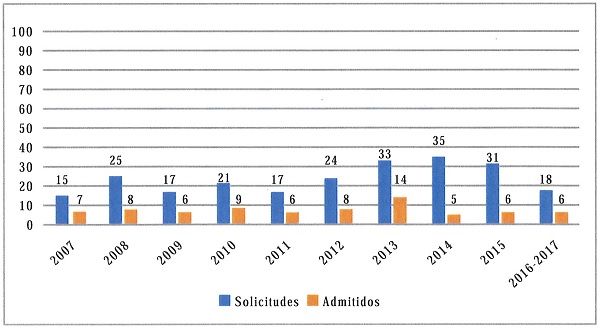
Fig. 8
Higher Conservatory of Music "Manuel Castillo" of Seville

Fig. 9
Higher Conservatory of Music of Castilla & León

Fig. 10
Higher Conservatory of Music "Bonifacio Gil" of Badajoz

Fig. 11
Higher Conservatory of Music of La Coruña

Fig. 12
Higher Conservatory of Music "Manuel Masotti Littel" of Murcia

Fig. 13
Higher Conservatory of Music "Eduardo Martínez Torner" of Oviedo
The statistics published in the annual Pedagogical Planning Guide are sent, along with the guide itself, to all members of the pool, as well as to all conservatories and higher music institutions and to the general directorates of academic organization of the various educational authorities, with the intention that they be considered as a tool to both confirm the achievements attained through educational planning and to correct any deficiencies observed.
The following table presents a summary of the entrance auditions corresponding to the 2017 and 2018 calls, which make up the current pool of instrumentalists. It shows: a) the total number of applicants per specialization; b) the total number of candidates admitted to the test, once those who did not meet the established requirements had been excluded; c) the number of candidates who, once admitted, gave sufficient advance notice of their intention not to take the test; d) the number of admitted candidates who failed to appear at the test without giving advance notice -these are penalized by being excluded from the next auditions to be called; and e) the total number of selected candidates (272) that make up the current pool.

Fig. 14
The male-female ratio of the 2017–2018 pool is shown in the following table, which clearly displays the predominance of women in the string specializations and of men in brass and percussion.

Fig. 15
And since this information is available, it is possible to determine the percentage of applicants who declare that they are regularly taking private instrumental lessons alongside their official studies. The data come from the spring 2019 call, currently underway:

Fig. 16
As the auditions for each specialization are held every two years, the specializations not included in that table correspond to the previous call (spring 2018), so such data were not available for the preparation of this paper.
In this regard, and although the percentage is very high, it should be borne in mind that the actual figures may be even higher, as it is very likely that some candidates do not report this aspect of their training when completing the application form. In any case, many of the private studies undertaken are with foreign instrumentalists who, for many years now, have been members of Spanish symphony orchestras created in the 1980s and 1990s, and who, in addition to their orchestral work, carry out a significant amount of unofficial pedagogical work in the region in which they reside.
One last statistic shows that the quantitative and qualitative increase in young Spanish musicians is not limited to the national sphere, but has long been recognized internationally, given the considerable success achieved by our young people in the auditions for the two leading European youth orchestras: the EUYO (European Union Youth Orchestra) and the GMJO (Gustav Mahler Jugendorchester). As can be seen in the following table, the number selected for both is very high (25 selected and 44 reserves for the EUYO, and 8 selected and 38 reserves for the GMJO in 2018), and is proportional to the number of applicants and admitted candidates to the auditions, which for years has been the highest in Europe.

Fig. 17
From JONDE we cannot go further in a statistical study that would account for the greater or lesser success of the musicians who have been part of it in terms of their professional future -whether as orchestral musicians, teachers, or, in some cases, administrators. Once their time in the orchestra ends and they begin their professional careers, very few remain in contact with us to the extent that would allow us to gather any meaningful data. Unfortunately, it is not possible to go beyond noting that a large percentage of former members can be found in most professional Spanish orchestras, as well as in many professional European orchestras -where they can even be found serving as soloists in several of them.
III. Conclusions
The employability referred to in the title of this Panel means the set of skills that enable a person to obtain and retain a job, but the very definition by the Real Academia Española implies that skills are of little use if they are not accompanied by a set of attitudes that make them effective.
At JONDE we are very aware of the importance of this aspect in the comprehensive training of the orchestral musician, and we make every effort to develop in our members, during their time with us, a sense of professional ethics that we consider to be of the utmost importance for their future -especially in the current circumstances of intense competition, given the great disparity between the huge demand and the very limited supply of positions. Because although their skills are undeniable -and the above statistics are clear proof of this- the same cannot be said of attitudes, which in many cases can be markedly improved.
That is why we not only strive to provide them with the highest-level musical training possible, but also try to instill in them a "stand-partner attitude" (responsibility, respect -for the conductor, for the orchestra's managers, for colleagues, for the orchestra's materials-, willingness to work, a spirit of cooperation, etc.) which, in their future professional lives, will be as important as musical competence.
In short, time spent at JONDE -or at any other youth orchestra- should serve as a kind of vaccine to protect its members from the more routine aspects of such a demanding profession, so that they never forget that music must always be approached with the same enthusiasm, energy, and passion with which they do so now.
Because -and I will end with a joke, not without a touch of dark humor- we must not forget that the great success of youth orchestras is due to three causes:
a) they are young;
b) they play very well; and
c) they still like music.
Thank you very much.
Notes
(1) Royal Decree 617/1995, of April 21, establishing the basic aspects of the higher-level music curriculum and regulating the entrance examination for these studies (Official State Gazette, June 6, 1995).
(2) Order of June 25, 1999, establishing the higher-level music curriculum (Official State Gazette, July 3, 1999).
November 2018
Video of the presentation
|
|