

Veni, Creator Spiritus
Speech delivered on June 15, 2018, at the graduation ceremony of the 2018 class of the Royal Superior Conservatory of Music of MadridMr. Director General of Universities and Higher Artistic Education; Madam Director and members of the Center's management team; Faculty; students, friends, and everyone present:
Recalling Napoleon Bonaparte's famous speech to his soldiers during the Egyptian campaign, several centuries of history look upon us in this solemn graduation ceremony. With this initiative -so fortunate and recent- of the Royal Superior Conservatory of Music of Madrid, which was absolutely unthinkable when I was a student here, an event with deep roots and tradition is incorporated into academic life, carefully following the structure typical of the university environment.
Thus, the hymn Veni, Creator Spiritus that opens the ceremony is nothing other than an invocation to a higher spirit -call it what you will- to grant the grace of enlightenment to all present, and especially to those who today reach the final point of their academic training and take one step further into the professional realm for which they have been preparing throughout all these years.
The truly pedagogical aspect of the ceremony -and that is why it stands out- is that its formal structure does not prevent us from perceiving how the tradition we have inherited, which allows us to live and enjoy a particular culture, is always in permanent renewal. It does so without losing its recognizable identity but adapting to the moment in which we make it our own and participate in it. Regardless of whether the hymn Veni, Creator Spiritus dates from the 9th century or from an earlier or later time, or whether its author was or was not Bishop Rabanus Maurus, to whom it is attributed, what matters is that its liturgical function was associated with the feast of Pentecost, which commemorates the coming of the Holy Spirit upon the apostles. Hence its use in situations requiring special enlightenment, such as the start of the papal conclave or, more modestly, the ceremonies marking the opening and closing of the university academic year. But in the mid-16th century, Antonio de Cabezón felt the need to take the Gregorian melody out of that context to compose an original work starting from the first notes of each verse, in which the original monody and Renaissance polyphonic modality are perfectly combined. Many other composers, contemporaries or later ones (such as Palestrina, Tomás Luis de Victoria, or centuries later, Hector Berlioz and even Gustav Mahler in the first movement of his Eighth Symphony), did the same. We can even find traces of this practice in literature, as in the Spanish translation of the Latin text's free verses into rhymed hendecasyllabic quatrains, made two centuries later by Friar Diego Tadeo González, in the purest late 18th-century style:
|
Ven, Creador, Espíritu amoroso, ven y visita el alma que a ti clama y con tu soberana gracia inflama los pechos que criaste poderoso. … Ilustra con tu luz nuestros sentidos, del corazón ahuyenta la tibieza, haznos vencer la corporal flaqueza con tu eterna virtud fortalecidos. |
Come, Creator, loving Spirit, come and visit the soul that calls on you, and with your sovereign grace inflame the hearts that you powerfully created. ... Illuminate our senses with your light, drive away the lukewarmness of the heart, help us overcome bodily weakness strengthened by your eternal virtue. |
The different parts of this ceremony are woven together by a careful selection of music from the 15th, 16th, and 17th centuries, which imbue the event with a characteristic modal flavor, typical of the time in which it originated. Only at the end will solemnity give way to playfulness with the joint singing of Gaudeamus igitur, a jovial student song from the 18th century which, despite being irreverent and politically incorrect in some parts, has become by force of tradition the university anthem par excellence.
When I received the draft program of this ceremony and saw that the event concluded with the collective singing of the Gaudeamus, whose score also closes the printed program, I could not avoid a certain surge of emotion upon realizing that the harmonization chosen for this occasion is the same one sung in the 1960s by the choir of the "Jaime Balmes" Institute in Barcelona, where I studied and where my musical vocation awakened rather late. The four-part arrangement by Joan Casulleras i Regás, a professor of Mathematics and later director of the Barcelona Milà i Fontanals Institute -and an excellent musician- was undoubtedly the most suitable for dissemination among basic-level choral groups, which is why it became hugely popular in the years immediately following its creation and publication. It is easy to imagine that encountering this arrangement again after so many years at this event adds emotional value to the honor of being invited by the management of this Center to sponsor it, which I deeply appreciate.
At the Royal Superior Conservatory of Music of Madrid I completed my training, which had begun at the Superior Conservatory of Music of Barcelona. Here I decided to orient my professional career toward Composition, and here much of my later teaching career developed, during which I was part of a faculty that now includes many colleagues of my generation and even some students from my time as a teacher. Later circumstances led me down other paths, always related to music education, until more than seventeen years ago I took on the artistic direction of the Spanish Nacional Youth Orchestra (JONDE), an essentially pedagogical project. The JONDE can be evaluated in many ways, but my favorite is to consider it a privileged observatory to gauge firsthand the state of higher music education throughout the country. Applicants to JONDE (about 1,200 annually), as well as those finally selected (around 250 in recent calls), come from all the superior conservatories of Spain, making it relatively easy to continuously monitor, year after year, their origins and the proportion in which these centers are represented in the Orchestra's Instrumentalist Pool.
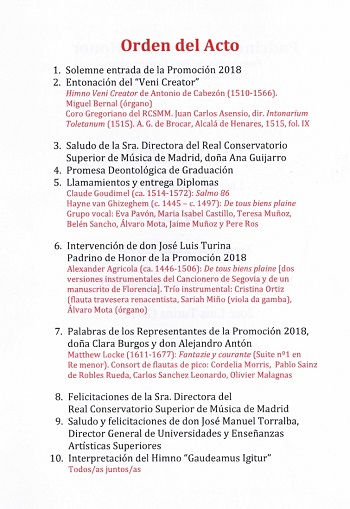
Program of the acto
Well, even at the risk of seeming unrefined to speak of numbers in a ceremony like this, I cannot avoid bringing here some figures that speak highly and clearly of the Royal Superior Conservatory of Music of Madrid. I will be brief because they are very eloquent. Of the 245 members currently active in the Pool, 47 (one fifth) come from this center, and some of them are here today receiving the Degree they rightly earned after many hours of study. And if we take a look at the statistics from the last ten years, between 2007 and 2017 a total of 909 candidates who were or had been studying their advanced instrumental degree at the Madrid Conservatory participated in the annual admission tests; and of that number, no less than 467 -one out of every two- were admitted to join the orchestra. Followed at a considerable distance by the superior conservatories of Catalonia, Aragon, and the Basque Country, with 337, 310, and 300 admitted candidates respectively, the Royal Superior Conservatory of Music of Madrid maintains year after year its hegemony in the current landscape. I cannot now forget that many years ago, in November 1994, when I served as an Advisor at the Ministry of Education and Science, and amid that true whirlwind of orders, decrees, reports, and responses to parliamentary questions, I was entrusted with drafting the speech that then-Minister Gustavo Suárez Pertierra was to deliver on the occasion of the opening at this center of the exhibition dedicated to the centenary of the deaths of Arrieta and Barbieri. To my utter astonishment, what was supposed to be a draft from which some Chief of Staff was to prepare the final speech, was read in full by the Minister, without changing a comma, including the following paragraph:
"The Royal Superior Conservatory of Music of Madrid carries a responsibility that goes beyond mere compliance with regulations: its past prestige demands it. Our society expects from its Professors and Chairs not just teaching of a quality comparable to the rest of the world, but rather an enthusiasm for the significance of their educational mission, which in these challenging transitional years must contribute to completely transforming the current Spanish landscape, which has been forced to look abroad for what conditions for the development of teaching have prevented from happening here: qualified professionals, in sufficient numbers to meet the demands of the country's musical life".
Mission accomplished, since the leap made by musical education in our country over the last twenty years is unanimously recognized by all sectors of the profession, both national and foreign. Our musicians regularly collaborate with the main young European orchestras in a clearly majority proportion, and for all the above the Madrid Conservatory deserves the credit for making the greatest quantitative and qualitative contribution to this great success in our recent musical history.
Congratulations to all, teachers and students, and especially to those of you receiving your graduation today, which you have earned through your effort, talent, and passion for music. Those of you who are part of the JONDE may have heard me say more than once that the main mission of youth orchestras, beyond contributing to a greater musical training of their members, is to take advantage of the enthusiasm with which they arrive to inject a permanent vaccine reminding them always, even in the toughest moments of a professional life that is demanding and often routine, that one must always approach Music with the same energy, the same rigor, and the same love as now, driven by the vital force of a youth that seems to know no limits. This, which also applies to centers that offer higher studies and therefore makes perfect sense in a ceremony like this, is the best guarantee for a full and fruitful professional future.
I will conclude by returning to the tradition I referred to at the beginning of my speech. Throughout all these years of training, you have received the most effective tools to serve and transmit it to future generations. The musical tradition we have inherited is possibly the greatest treasure of universal culture, and now it is your responsibility -whether you are instrumentalists, composers, conductors, musicologists, or pedagogues- to dedicate yourselves to it, not only to keep it alive but also to renew it and insert it into the historical, cultural, and social moment to which we belong, as Cabezón, Palestrina, Tomás Luis de Victoria, Hector Berlioz, or Gustav Mahler once did. But never forget that alongside tradition, you also owe yourselves to the present of which you are a part, and renewing the former also means serving the latter by dedicating equal effort to the creation of your time, secure in the knowledge that many new works will one day become part of the same tradition that includes the great masterpieces of the past.
I envy your youth, because along with your talent it will bring you great spiritual wealth in the coming years. So enjoy it, since you are young. Or, said in Latin, so we all understand, and so that the meaning is fully inserted into the historical-cultural tradition of this ceremony: Gaudete igitur, iuvenes dum estis.
Thank you very much.
June 2018