Españoles en las jóvenes orquestas europeas / Spaniards in Europe's Youth Orchestras
Editorial published on March 27, 2017, in the online magazine Press-Music (www.press-music.com)The day after the second concert in Madrid by the Gustav Mahler Jugendorchester, Antonio Moral (director of the CNDM) was having breakfast while scrolling through Facebook and came across a post that began like this: "About 20 years ago, J. L. Turina (artistic director of the JONDE), I remember him saying to me: 'Here in Spain, there are no violas. We have a big problem because only two applied for the Gustav Mahler Jugendorchester auditions, and neither was accepted'.'" While the gist is similar, that wasn't quite what he heard me say. What I actually said was something more along the lines of: "On several occasions, the professors who travel around Europe as jury members for the European Union Youth Orchestra (EUYO) and the Gustav Mahler Jugendorchester (GMJO) auditions have told me that, 20 years ago, during auditions held in Spain, they would select a couple of candidates simply to ensure there was some Spanish representation in those orchestras. But in recent years, they can hardly believe what is happening in this country: not only is Spain the country with the highest number of applicants, but it is also among those providing the most selected players (and reserves)".
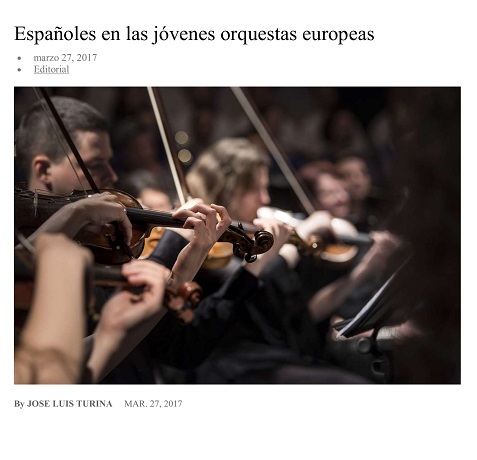
Clearly, what caught Antonio Moral's attention was the viola section: out of a total of 14 violists, 10 were Spanish (9 women and 1 man, as he notes); but that striking figure is just a third of the total Spanish representation in the GMJO's lineup for this year's Easter tour: 31 in total, spread across the various sections. In other words: a quarter of the entire orchestra!
That may sound simple, but it has taken many years to reach such a situation. At some point, someone will have to analyze what has happened in the training of our musicians that has led to such overwhelming results. Clearly, the reasons are numerous and varied, but one undeniable fact is that the most recent generations of young musicians are emerging from our higher education institutions -and from foreign institutions where they pursue postgraduate studies- at levels of quantity and quality never seen before (at JONDE we've been observing this for quite some time), and they are the admiration of the rest of Europe, which has spent years in awe, still struggling to believe what is happening here.
While we await that analysis, nothing beats the objectivity of a few statistics: for the 2016 EUYO auditions, 652 (!) Spanish candidates applied, of whom 25 were selected as full members and 32 as reserves. For the GMJO, 469 Spaniards auditioned, with 27 chosen as full members and no fewer than 118 (!) as reserves... All of this is well above the figures for countries like Germany, the United Kingdom, the Netherlands, or France, which boast long-standing musical traditions. Could anyone have imagined this 20 years ago?
Since I began by correcting the start of Antonio Moral's Facebook post, it's only fair to end these lines by quoting its closing words verbatim: "So don't let the doomsayers in this country of ours tell me that music education in Spain hasn't changed in recent years and is still stuck in the Paleolithic, as we hear so often. Enough said!"
March 2017