
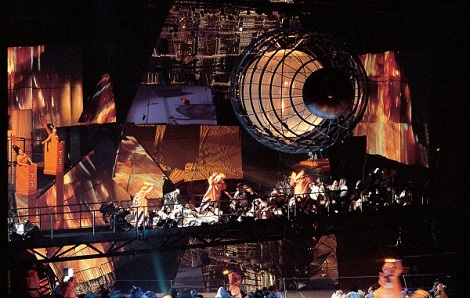
Scene of 2nd act of D.Q. (Don Quixote in Barcelona)
La sociedad del entretenimiento / The entertainment society
Editorial published on January 1, 2017 in the online magazine Press-Music(Commented on by Jorge Fernández Guerra in the article The filth of entertainment, published on January 3, 2017 in the Opinion section of the digital magazine Doce notas)
I bid farewell to 2016 and wished for a prosperous 2017 with an email sent to all my contacts, in which I didn't want to miss the opportunity of commemorating the 400th anniversary of the death of Cervantes and Shakespeare by sending, as a musical greeting, two YouTube links: one to a fragment of my opera D.Q. (Don Quixote in Barcelona), with a libretto by Justo Navarro and staged by La Fura dels Baus, premiered at the Gran Teatre del Liceu in Barcelona in October 2000; and the other to the complete recording of my Four Shakespeare Sonnets, performed by sopranist Flavio Oliver and the RTVE Symphony Orchestra conducted by Adrian Leaper, in a concert held at the Teatro Monumental in April 2008.
But that New Year's greeting carried, hidden beneath the tinsel, a dose of poison: to leave on record, "as if by chance", that neither of the two works received the slightest attention throughout 2016 (with a few isolated exceptions), not only from concert programmers (something for which a composer must be well prepared), but also from the self-proclaimed "professionals" of information (whether through radio, television, or the daily and specialized press), for whom neither of the works seemed to have ever existed -or if they did, they were not even deemed worthy of a passing mention in a simple and perfunctory review of musical works based on Cervantes or Shakespeare, as many such reviews have appeared throughout the year that has just ended.
Sometimes I wonder if the economic crisis is nothing more than the perfect pretext to justify all the others, because the coincidence between the reduction of goods and resources and the spiritual poverty of those who have the duty to manage them -or at least to report on how that work is carried out- is more than suspicious. It is clear that we live in the entertainment society (the "civilization of spectacle", as Vargas Llosa defines it), and that the obsession with "share" and audience ratings has already taken its toll on concert programming, regardless of whether funding comes from public or private sources. If what truly matters is not the value of what is offered, but selling every last ticket, then it's obvious that what must be programmed is the same old fare, which has a loyal market ready to devour it again and again. And if that is already hardly acceptable, even less so is the media neglect to which culture and those who create it are continually subjected, with no other objective than to herd the sheepish masses into the pen of the most superficial.
In this context, it is clear that the contemporary creator is condemned to inevitable failure, to sacrificing themselves in a battle that, under current circumstances, is lost from the outset. But that is one thing, and another is not to rebel against such an utterly unjust situation. The opposite would be to silently concede to those who are convinced that, deep down, we get what we deserve.
December 2016
La suciedad del entretenimiento / The filth of entertainment
By Jorge Fernández Guerra
Article published on January 3, 2017 in the Opinion section of the digital magazine Doce Notas


Just two days ago, on the very first day of this brand-new year 2017, composer José Luis Turina published a text, The entertainment society, in a recently launched digital music magazine, PressMusic.com, based in Catalonia.
In this text, Turina spoke about a bitter Christmas greeting he had sent via email to his personal contact list (to his friends, essentially), in which he slipped in a harsh observation: that the recently concluded fourth centenary of the death of Cervantes and Shakespeare had passed us by while ignoring two of his most notable works dedicated to those writers. Turina mentioned a "dose of poison" in his text. Perhaps the difference between bitterness and poison lies precisely in the dose.
Naturally, the Madrid-born composer has every right -and every reason- to point out this incongruity, which demands the greatest creative efforts from our artists, only to shelve them mercilessly. The two works Turina cites are no small matter: the opera D.Q. (Don Quixote in Barcelona), premiered at the Liceu in Barcelona in 2000 with a production effort marked by the signature of La Fura dels Baus, back when this collective still didn't know -or didn't want- to restrain itself when allocating scenic resources.
The opera was a grand spectacle and a notable success, marred only by some dissonances that seemed to suggest the composer should have been Catalan. It was announced that it would be staged in more than one national theater, at least. That never happened, and the enormous effort by everyone involved (Turina, composer; Justo Navarro, librettist; La Fura; the performers…) ended up as nothing more than a firework display. Then came 2004 (the 400th anniversary of the first edition of Don Quixote), 2014 (the 400th anniversary of the second edition), and finally 2016 (the 400th anniversary of the author's death) -and still nothing. One could add that Cristóbal Halffter's monumental opera Don Quixote, premiered a year earlier at the Teatro Real in Madrid, suffered a similar fate.
José Luis Turina also cites his Four Shakespeare Sonnets, premiered in 2008 by the RTVE Symphony Orchestra, conducted by Adrian Leaper with sopranist Flavio Oliver as soloist. This work, too, fully aligned with the Shakespeare centenary, has not been requested.
This void is not a personal vendetta against a beloved composer; it is rather a symptom of a cultural gap that deserves more than one reflection. Turina raises the tone of his complaint to target the "professionals" of information. It is understandable to empathize with the composer's lament, though it is difficult to share a grievance aimed at a sector that is likely collapsed -if not zombified.
In fact, the tone of José Luis Turina's claim points to an especially dramatic situation: our society (I speak for Spain for now, though I would have no problem extending this well beyond our borders) has completely lost touch with decades of effort invested in building that subtle and delicate thing known as cultural self-esteem. Indeed, the entire "celebration" of the Cervantes-Shakespeare year deserves no better adjective than "mediocre," whichever way you look at it.
But alas! If only this were limited to Cervantes-Shakespeare. It seems that the doctrine of "shock," applied to culture, has left everyone (or almost everyone) catatonic in a country terrified by the absence of a future and, consequently, afflicted by oblivion of the past and vertigo of the present. Cervantes? Who's that?
We can dissect, down to the milligram, the outpouring of stupidity emanating from a state of generalized catalepsy; but the fine details will not help us understand the phenomenon of apathy and disinterest associated with a crisis that is already lethal for our ability to self-configure as a society. Just yesterday, writer David Torres wrote in his blog for the digital newspaper Público: "The New Year's Concert epitomizes the worst vices of that label falsely called classical music. […] Considering the umpteenth repetition of the belches of Léhar, Nicolai, and the Strausses as the most important or eagerly awaited event of the year in this field shows just how embalmed, comatose, or out of the game classical music really is."
Turina concludes by proclaiming his right to rebel. He speaks of his own situation, of course. But he's right: if each of us rebelled for our own cause, we would have an army more fearsome than Spartacus's.