
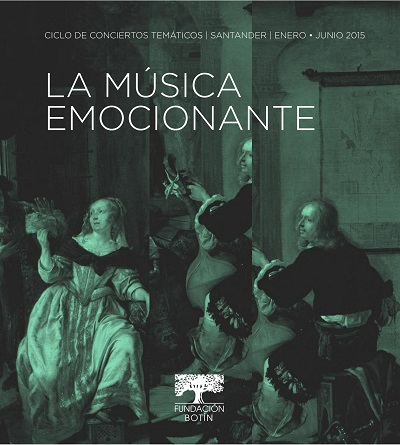
La Música emocionante / Thrilling Music
(Introduction to the concert series of the Botín Foundation. Santander, January–May 2015)I. The Trace of Emotion
Of all the various accounts describing the origin of music -some of them longstanding traditions with deep speculative significance- my favorite is the one Alejo Carpentier puts in the mouth of the Cuban musicologist protagonist of his novel The Lost Steps, at the end of Chapter XXIII:
...
But now everyone starts to run. Behind me, under a tangle of leaves hanging from branches that form a kind of roof, they've just laid down the swollen, blackened body of a hunter bitten by a rattlesnake.
Friar Pedro says he died several hours ago. Yet the Sorcerer begins shaking a gourd filled with gravel -the only instrument known to these people- to try to drive away the emissaries of Death. There is a ritual silence, a preparation for the chant, raising the anticipation of those who wait. And in the vast jungle, now filled with nocturnal terrors, the Word emerges. A Word that is already more than a word.
A word that imitates the voice of the speaker, and also the one attributed to the spirit possessing the corpse. One comes from the healer's throat; the other, from his belly. One is deep and murky, like the underground bubbling of lava; the other, with a medium timbre, is angry and dissonant. They alternate. They respond to each other. One groans when the other rages; the one from the belly turns sarcastic when the one from the throat seems to urge on. There are guttural portamentos extended into howls; syllables that suddenly repeat over and over, creating rhythm; trills abruptly interrupted by four notes that are the embryo of a melody. Then comes the vibration of the tongue between the lips, the inward snarl, the offbeat panting over the maraca.
It is something far beyond language, and yet still far from song. Something that knows nothing of vocalization, and yet is already more than word. As it continues, this cry over the corpse surrounded by silent dogs becomes horrible, terrifying. Now the Sorcerer confronts it, shouts, stomps his heels on the ground in the peak of an imprecatory fury that is already the deep truth of all tragedy -a primordial attempt to fight against the powers of annihilation that thwart human plans. I try to keep my distance, to remain apart from it.
And yet I cannot escape the horrendous fascination this ceremony exerts over me... Before Death's obstinacy, which refuses to let go of its prey, the Word suddenly softens and loses heart.
In the mouth of the Sorcerer -the Orphic healer- the Threnody chokes and collapses convulsively, for that is what it is, a threnody, leaving me stunned by the revelation that I have just witnessed the Birth of Music. (1)
Carpentier's narrative links the origin of Music to a deeply primitive moment in human history, suggesting the theory that Music arises from the removal -during certain ritual ceremonies- of the purely semantic part of spoken language. Once stripped of meaning, what remains is only its prosodic aspects: intonation, dynamics, rhythm, articulation, character... All of which are translatable and measurable in musical terms.
But this hypothetical wordless language, to which Carpentier attributes a mythical origin, finds historical grounding when we consider the various aspects of musical discourse organization, which -at least in the West- developed in close connection with language through the texts (mostly liturgical) that were set to music for use in various religious ceremonies.
All scholars agree that the Gregorian repertory represents an excellent alignment of music with the prosodic demands of the text it serves. It is the text that determines the accents, rhythm, inflections and breaths, as well as the tensions and releases; the music follows and adapts to all this, thereby enhancing what is already present, amplifying its expressiveness, emotion, or mystery. Toward the end of each phrase in the various Gregorian chants, descending stepwise motion defines the accents of the final words of the phrase, shaping a final melodic cadence that mirrors the falling inflection of spoken language at the end of a sentence. From this process of descending steps will eventually emerge, much later, the various horizontal lines that define the cadential structures of modal polyphony in the Medieval and Renaissance periods. These will later simplify vertically into harmonic cadences -stereotyped chord successions capable of evoking the desired emotional effect.
Would we have reached the same point without centuries of coexistence between language and music? In my view, clearly not. The influence of language on music was so profound that, once music was freed from the servitude of meaning -that is, once it was liberated from the text- it continued its independent life while maintaining for centuries a relationship as intimate as the one that gave it birth. Because despite the triumph of instrumental music in the Baroque period, the human need to sing a text and to accompany that singing with instruments remained so strong that there have been scarcely any composers in the history of music who never wrote a single vocal line during their careers. And of course, those vocal works reflected the tastes and styles of their time.
Lauda, frottole, canzoni, madrigals, motets... Over time, these gradually lost ground to the rise of purely instrumental forms -fugues, suites, toccatas, sonatas, concertos, symphonies...- in which, even though wordless, one can still recognize the persistence of the prosodic elements typical of poetic language, especially in its two most musically relevant features at the time: meter and rhyme.
When I was a professor of Harmony and Analysis, I used to greatly enjoy -and I believe my students did too- closely examining one of the pieces from Schumann's Album for the Young: specifically, No. 41, titled Nordisches Lied or Song of the North. Dedicated to Danish composer Niels W. Gade, the piece spans just 20 measures of music (the first eight of which are shown as an example), and every four bars features a melodic motif of four notes (G-A-D-E, echoing the dedicatee's surname in German notation), which is answered in the following two bars by its transposition a fourth higher: C-D-G-A. With such minimal material, Schumann weaves a miniature masterpiece of simplicity, whose harmonic complexity is easily grasped even at early stages of study. It serves as an excellent example of a short musical form closely tied to poetry. Because ultimately, Song of the North, like so much music of similar character, is nothing more than music for a poem without words -but a poem clearly structured in ten octosyllabic verses, organized in a basic rhyme scheme: A-B-A-B-A-B-A-B-A-B. One might also say that the "A" endings tend to push the music forward -via dissonance resolution, passing tones, and so on- while the "B" endings rest, more or less conclusively, on varying homophonic cadences. Or in poetic terms: the odd-numbered verses allow no caesura, while the even-numbered ones bring the phrases to a close, more or less definitively, depending on whether the sense is of a comma, a semicolon, or a full stop.

Any theme from any Concerto by Vivaldi or Mozart, any Symphony by Beethoven or Tchaikovsky, any Song Without Words by Mendelssohn, any Nocturne by Chopin, or any Intermezzo by Brahms can be sung by any human being, whether sight-read by a musician or simply hummed by a layperson; which is to say, any of these thousands of musical ideas could easily be set to a text that anyone, without much effort, could assign to it. This can certainly lead to comic or even downright ridiculous results -it's not so different, in fact, from translating the lyrics of a vocal work into another language. But sometimes, this can give rise to genuinely interesting outcomes: for instance, when a composer "recycles" a vocal work by keeping the music but replacing the text; or -pushing things even further- when the composer supplies the writer (usually a librettist) with a string of nonsense words or numbers that strictly follow the rhythm and accentuation of the melody, so that the librettist may later "reverse-engineer" them into the final text. (2)
It seems clear, then, that the analogy with language is an obligatory reference point when attempting to find in music something beyond the mere arrangement of sounds in time. Speculations about its possible meaning have been made since time immemorial, at times leading to bold propositions like the one put forward by Deryck Cooke in The Language of Music (3); but in any case, there seems to be broad agreement that this supposed meaning, due to its natural lack of semantic content, is confined to the emotions expressed by the music -or more appropriately, experienced by the listener upon hearing it. It is a slippery terrain, to be sure, because although theories like Cooke's are based on the idiomatic structures of Western musical language -such as the use of specific degrees of major or minor scales to "represent" certain affects-, ultimately it is each individual's cultural background that determines how those auditory stimuli are understood. Therefore, there can never be absolute certainty about how the emotional message the composer believes they are transmitting through music actually reaches and is understood by different listeners. (4)
In any case, music -whether or not it originates from spoken language- is perceived through physiological and psychological mechanisms similar to those of speech. And if we add to that the fact that, at least in the West, its syntactic and phraseological structures are often very similar, it's hardly surprising that there is near-unanimous consensus in recognizing that, while devoid of meaning, music undeniably possesses sense. In the words of Boris de Schloezer, "In music, meaning is presented as immanent to the signifier, content to form, to such an extent that, strictly speaking, music does not have a meaning -it is a meaning". (5)
Of course, applying a similar logic can lead to a conclusion that places emphasis on the opposite end of the reasoning. That is the case of Raymond Monelle, whose closing remark at a lecture given during the First Preparatory Meeting for the Creation of the School of Linguistics, Logic, and Language Arts, held in Madrid in 1990 (6), was the following: "In short, one could well say that music is a signifier without a signified, which, by simplification, makes it the signifier of a signifier". (7)
Signified, signifier… If we add to this the fact that synchronic and diachronic perspectives are entirely valid concepts for approaching the theoretical study of music, one might say that the allure of terminology drawn from Saussure's linguistic theory has so dazzled those who have sought to unravel the mystery of explaining music through its seemingly close analogy to language, that few have managed to see the forest for the trees. The scholars mentioned thus far are merely a small sample of the vast legion of researchers -coming from very diverse fields such as musicology, psychology, aesthetics, and philosophy- who have immersed themselves in the attempt to apply to music the methods, criteria, and postulates typical of language, under the mistaken belief that doing so would ultimately shed light on why music is the way it is, and how it works (8). Mutatis mutandis, even renowned linguists have failed spectacularly in describing the prosodic mechanisms and traits of spoken language when attempting to fit them into the mold of the various organizational structures of musical discourse -especially regarding intonation and cadential, phrase-ending situations. The problem, in both cases, lies in the failure to approach the study by discarding the nonessential and focusing on what is essential to each of the two forms of expression. In my view, the profile of a researcher dealing with this issue must include a substantial level of expertise in both fields. But judging by the results, one might venture the conclusion that musicologists generally lack sufficient command of linguistics and its related disciplines, while linguists typically lack a deep enough understanding of music to engage with the matter properly. As a result, both camps, endlessly turning the same wheel, remain stuck in a maddening superficiality -one that, given the current state of human knowledge, is also profoundly boring.
It's possible that, by that time -midway through the 20th century- there was a pressing need to bring some order and rationality to the prevailing theoretical chaos. In any case, the reaction against this whole world of tangential approaches to the musical phenomenon was not long in coming, and it arrived with force. In this context, the figure of Suzanne Langer stands out. A significant portion of her Philosophy in a New Key (9) is devoted to studying music from the standpoint of its communicative power -as a means of expressing purely emotional aspects that, while acknowledging the validity of certain associations and conventions, are entirely unrelated to any form of signification. This implies that its study as a form of discourse -a succession of stimuli following the logic of an organic process capable of provoking affective responses- must be undertaken exclusively from within the framework of music's own laws, without the need to invoke other disciplines, no matter how long music may have historically been associated with them.
This, in a way, required revisiting the work of the man who can be considered the pioneer of scientific research on music: Hermann von Helmholtz (1821–1894), whose On the Sensations of Tone as a Physiological Basis for the Theory of Music (10) was the first to explore acoustic perception and its influence on musical listening and understanding. His work offers an intelligent synthesis of physics, physiology, and musical psychology proper. Helmholtz's research opened the door, already in the first half of the 20th century, to a series of scholars who pursued this line of inquiry -among them J. Dewey (Art as Experience, 1934), J. L. Mursell (The Psychology of Music, 1937), C. E. Seashore (Psychology of Music, 1938), and M. Schoen (The Psychology of Music, 1940). This period also saw the emergence of major theoretical schools -sometimes in sharp opposition to one another- within this field of research, such as mentalism, behaviorism, and, most notably, the Gestalt theory (or theory of form) articulated by K. Koffka in Principles of Gestalt Psychology (1935), which had a profound influence on Leonard B. Meyer and other authors whose research followed the path of the psychology of musical perception.
Although we will delve more deeply into this new and decisive direction in the second part of this study, it seems appropriate to conclude this first section with a few reflections -ideas to be left hanging in the air- that might anticipate what is to come and encourage further reading.
The emphasis we have placed on the relationship between music and language has served one main purpose: to make clear that, while the close connection between the two disciplines is undeniable, there is a limit beyond which other approaches must take over -ones better suited to satisfying humanity's natural curiosity for what lies beyond palpable evidence. Of course, musical discourse seems to tell us something, both because its structure follows syntactic rules and because the very nature of that discourse conveys an undeniable narrative quality. However, the story being told is not translatable into words -and therefore not analyzable using linguistic criteria- because it operates on a level of communication that transcends what is verbally intelligible.
Music is, without a doubt, the best vehicle for transmitting emotions, and it is only within that context that it should be studied -specifically, in terms of the techniques it uses to achieve that goal and how effective it is in doing so. The metalanguage we use to explain it should not become an end in itself, as has so often been the case -simply because the theory of music is so rich in concepts, rules, and foundations that its very formulation can become a world in itself, one that is sometimes difficult to escape. But the theorist must know how to separate the wheat from the chaff and avoid being misled by false siren songs, no matter how seductive they may be. The same effort to cut through to the essential must also be made by both the performer and the composer. The performer must approach the score with an open mind, ready to uncover its deepest secrets in order to convey its message as accurately as possible. The composer, for their part, must be aware of the historical moment in which they are working and resist the biased pressures of the aesthetic trends surrounding them. By the simple law of the pendulum, the 20th-century composer found themselves in a time when Reason had to take precedence over Feeling, especially after the excesses of post-Romanticism, thus fulfilling the age-old law of generational conflict. For decades, a radical change of style was championed, and creative work was standardized under the banner of rigor, with emotion declared the primary enemy to be fought. The result was a deep rift between the sender of the message and its potential receivers -listeners who, weary of such imposture, began to look to the past for what the present denied them, and with that, their waning faith in the future.
The lesson could not have been clearer or more forceful: the reversal of historical values -the idea that new music should replace the old, as had always been the case throughout history- could only lead to a hypertrophy of tradition. Rather than contenting itself with the almost exclusive cultivation of Classical and Romantic repertoire and their followers, this hypertrophy expanded that repertoire backward, rather than into the logical future that might have been expected. Thus, while contemporary music lingers on in the "reserves" of specialized concert series, we are witnessing the proliferation -and warm reception- of soloists and ensembles who have made historically informed performance the alternative to traditional repertoire that contemporary creation never quite managed to become.
The reason lies in the astonishing contemporaneity of that music, which fills the modern listener with energy, nostalgia, or tenderness… because it strikes directly at the heart of emotion -unchanged since the dawn of humankind. And despite the idiomatic inflections imposed by stylistic fidelity, its message is just as powerful and valid today as it was at the time of its creation. This is not necessarily the case with other artistic expressions rooted in language, such as poetry or theater. How else can we explain the fact that, for a modern staging of a play by Calderón, Shakespeare, or Molière, the text must often be adapted to make it "accessible" to today's audience -while, in contrast, musicians performing the repertoire of those same eras strive to deepen their understanding of the original style, even requiring the use of historical instruments that, by all rights, should have long been obsolete?
The concerts making up this first cycle of La música emocionante (Thrilling Music), thoughtfully structured with musical intelligence and pedagogical sensitivity, offer ample examples of all the above. The selection includes a broad range of composers, works, eras, and styles, with emotion as the common thread and most striking feature. From Monteverdi and Guerrero to Ligeti and Tomás Marco, the sequence of works spanning over four centuries is a faithful reflection of the shared human desire to clothe -in ever-changing garments- what is, in essence, the bare core of the human mind and the driving force behind our progress as a species.
I hope that these reflections will contribute to your listening and appreciation of the music, and that they will be further enriched by the study that follows.
NOTES
(1) Alejo Carpentier, The Lost Steps. (First edition: Ed. Ediapsa. Mexico, 1953).
(2) I would like to cite here a "monster" -as this unnatural procedure is often called- that I experienced very directly while composing the score for D.Q. (Don Quixote in Barcelona), a production of the same name by La Fura dels Baus. The central part of the second act includes an aria sung by Don Quixote from within the cage in which he has been locked up for display. Without yet having the text, I composed the music I wanted for that moment and later provided Justo Navarro, the librettist, with a "monster" -at his own request, so as not to be influenced- made up solely of numbers. Thus, the "sentence" "3-2-6-3 / 34-16 / 22" ended up becoming the stanza "Yo sé quién soy / y no soy quien quiero ser / y lo sé. (I know who I am / and I am not who I want to be / and I know it,") which opens the aria.
(3) Deryck Cooke, The Language of Music (Oxford University Press, 1959). In this book, Cooke establishes a veritable "vocabulary" of up to 16 melodic-harmonic patterns, common to Western tonal composers, for expressing various emotional states. According to Cooke, for instance, the major third always expresses joy or triumph; the major sixth, nostalgia; the minor sixth, anguish; the augmented fourth, hostility...
(4) In fact, Cooke's universalist stance was heavily criticized by many scholars in the field of the Psychology of Music. Especially harsh was J. A. Sloboda, who in The Musical Mind: The Cognitive Psychology of Music (Oxford University Press, 1985) argued that the perceptual mechanisms linking certain intervals with specific emotions may not be natural but rather developed through convention. A more moderate position was taken by P. Kivy, who in The Corded Shell: Reflections on Musical Expression (Princeton University Press, 1980) proposed two categories for relating music and emotion: "contour" and "convention." The first refers to "natural connections" (e.g., slow tempo/sadness), while the second relates to associations where the connection is not evident but is instead "a habitual association of certain musical features with certain emotional characteristics" (p. 77).
(5) Boris de Schloezer, Introduction à J. S. Bach. Essai d'esthétique musicale (Paris, Gallimard, 1947), p. 44.
(6) This conference, promoted by linguist Agustín García Calvo, aimed to lay the ideological groundwork for a school that would bring together disciplines related to Language (such as Linguistics, Logic, Mathematics, and -among the so-called Language Arts- Music). After a second edition a few months later, the initiative seemed to fizzle out and was eventually forgotten. Nonetheless, it had the merit of bringing together a group of experts in Madrid for a few days and revealing just how divergent the views on Language were, depending on each participant's field of expertise.
(7) Born in Bristol in 1937 and passed away in Edinburgh in 2010, musicologist Raymond Monelle authored several notable studies on musical semiotics. His principal work is The Sense of Music: Semiotic Essays, published in 2000 by Princeton University Press.
(8) Perhaps the most representative work of this trend in recent years is A Generative Theory of Tonal Music, by Fred Lerdahl and Ray Jackendoff (The Massachusetts Institute of Technology, 1983), which attempts to explain the organization and function of tonal music through the application of generative grammar principles developed by Noam Chomsky beginning with Aspects of the Theory of Syntax (MIT, 1965). As in previous cases, the analogy here does not lead to meaningful conclusions, but rather to a mechanical application of descriptive methods akin to Chomsky's formal abstract grammar -already strongly contested by the time Lerdahl and Jackendoff published their work.
(9) Suzanne Langer, Philosophy in a New Key (New York, Mentor Books, 1942)
(10) Hermann von Helmholtz, Die Lehre von den Tonempfindungen als physiologische Grundlage für die Theorie der Musik (1863) [On the Sensations of Tone as a Physiological Basis for the Theory of Music].
October 2014