
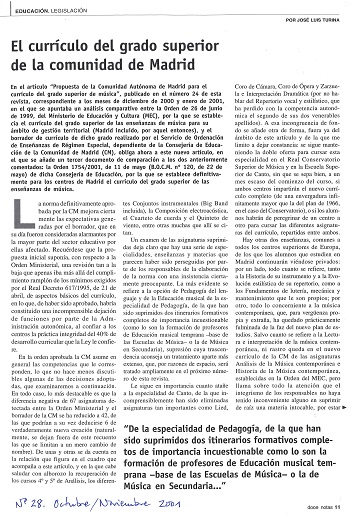
El currículo del grado superior de la Comunidad de Madrid / The Advanced music Curriculum of the Community of Madrid
(Doce Notas magazine, October 2001)My article "Proposal from the Autonomous Community of Madrid for the Advanced Music Studies Curriculum", published in Issue 24 of this magazine, corresponding to December 2000 and January 2001, provided a comparative analysis of the June 26, 1999 Order from the Ministry of Education and Culture (MEC), which established the advanced music studies curriculum within its territorial jurisdiction (including Madrid at the time), and the draft curriculum for the same level prepared by the Special Regime Education Management Service under the Ministry of Education of the Community of Madrid (CM). This analysis now necessitates a follow-up article, adding a third comparison document to the previous two: the May 11, 2001 Order 1754/2001 (published in the Official Gazette of the Community of Madrid, No. 120, on May 22) from the same Ministry, which definitively establishes the advanced music studies curriculum for Madrid-based institutions.
The curriculum ultimately approved by the CM indeed improves upon the expectations generated by the draft, which had been deemed alarming by a large portion of the affected educational sector. Recall that the initial proposal significantly downgraded the curriculum compared to the Ministerial Order, barely meeting the minimum requirements set by Royal Decree 617/1995 of April 21, which defined the basic aspects of the curriculum. If approved, this would have constituted an inexplicable abdication of responsibility by the regional government, as it would have entrusted institutions with almost the entirety of the 40% curricular development mandated by law.
In the approved order, the CM generally assumes its assigned responsibilities, although certain decisions remain highly debatable, as we will examine below. What stands out most is that the negative gap of 67 subjects identified between the Ministerial Order and the CM's draft has been reduced to 42, of which six are genuinely new creations (naturally, this count excludes those involving mere name changes). These are detailed in the accompanying table, where the reinstatement of 4th and 5th-year Analysis courses, various instrumental ensembles (including Big Band), Electroacoustic Composition, String Quartet, and Wind Quintet, among others, can be enthusiastically celebrated.
An examination of the eliminated subjects reveals a series of specializations, courses, and disciplines that appear to have been systematically targeted by those responsible for drafting the regulation, raising serious concerns. The most evident case pertains to the Pedagogy of Language and Music Education option within the Pedagogy specialization, where two complete and unquestionably significant educational tracks have been eliminated. These include the training of early childhood music educators -the foundation of music schools- and music educators for secondary education. The significance of this suppression merits separate, more extensive analysis, which interested readers can find in other pages of this same magazine.
Second in importance are the changes affecting the Voice specialization, from which crucial courses such as Lied, Chamber Choir, Opera and Zarzuela Choir, and Dramatic Interpretation have been inexplicably removed. This does not even account for Vocal and Stylistic Repertoire, which has lost its second, distinguished appellation under the regional administration. This substantive inconsistency is compounded by procedural confusion: there continues to be a dual offering for studying this specialization at both the Royal Conservatory of Music and the Advanced School of Singing, even though, with less than a month before the start of the academic year, it is unclear whether both institutions will offer the new, more comprehensive curriculum (far more extensive than the 1966 plan for the Conservatory). Students may be forced to navigate between both institutions to complete the required subjects, which are apparently divided between them.
Two other areas of study, which are standard across all advanced music institutions in Europe, will remain unavailable to students in Madrid. First, courses relating to the History of their Instrument, the Stylistic Evolution of its Repertoire, and Basics of Instrument Building, Mechanics, and Maintenance. Second, courses addressing Contemporary Music, which have been almost entirely erased from the new curriculum -an embarrassing omission both locally and internationally. Aside from Contemporary Music Reading and Interpretation, no trace remains in the CM's new curriculum of subjects such as Analysis of Contemporary Music and History of Contemporary Music, which were established in the MEC's Order. Most shockingly, however, is that the curriculum's architects have unhesitatingly eliminated a mandatory subject established by Royal Decree 617/1995, which constitutes a minimum requirement for all state curricula: the course titled Contemporary Music, assigned to the Composition specialization and comprising at least 135 instructional hours. These hours are now conspicuously absent. We hope that the current educators in this specialization, who should be the most concerned, will be the first to demand that the educational authorities strictly comply with the regulations to rectify this deficiency and reinstate such a vital subject.
Among instruments, the organ is particularly disadvantaged. Not only has Basics of Organ Construction been removed, but students will also lack instruction on the History of their Instrument, the Stylistic Evolution of its Repertoire, or the Musical Forms specific to it. Similarly, no institution in the Community of Madrid will offer instruction in Philosophy of Music or the increasingly relevant subject of Psychology of Musical Perception. Particularly troubling and irresponsible is the elimination of the course Didactics of Chamber Music within the Instrumental Pedagogy specialization. This omission is especially egregious given that Royal Decree 989/2000 of June 2, which defines the specializations of the Faculty of Music and Performing Arts, mandates that all instrumental teachers should teach this subject.
Regarding the structure of its regulatory content, the new curriculum closely adheres to the MEC's Order, with minor and more significant adjustments. Among the latter are the removal of an additional provision prohibiting enrollment in these studies under any modality other than official registration, and another regarding the establishment of an Evaluation Commission for the Curriculum at each institution. There are also occasional absurdities, such as the stipulation in Article 12, directly copied from the Ministerial Order, that the credits for the final-year research project "will be added to the credits established for each specialization in Annex I of this Order". In reality, the credits are already counted within the total credits in Annex I, meaning they are not truly "added", resulting in a reduction of necessary subjects to complete the total credits. This discrepancy, though within the minimum requirements, substantially lowers the number of credits established by the MEC Order.
Finally, although the CM Ministry of Education has taken responsibility for curricular development (rather than delegating it to the institutions, as was the case in the earlier draft), the significant reduction in the teaching load across various specializations compared to the MEC Order has been achieved at the expense of areas traditionally shared by institutions (elective subjects) and students (free-choice subjects). These areas are now limited to just two courses of each type in the final two years, for a total of only four subjects. Such a meager offering is clearly inadequate for an advanced program leading to a qualification equivalent in all respects to a university degree, a standard that these studies still fall short of achieving.
I. Subjects from the MEC Order of June 26, 1999, eliminated in Order 1754/2001 of May 11, from the Ministry of Education of the Community of Madrid
Accompaniment
Analysis of Contemporary Music
Breathing Technique and Muscle Control
Chamber Choir
Classical Repertoire of the Principal Instrument (Jazz)
Complementary Symphonic Instrument
Composition Workshop
Conducting the Instrumental Ensemble
Didactics of Chamber Music
Didactics of the Chosen Pathway (Pedagogy)
Dramatic Interpretation
Ethnomusicological Editing Techniques
Fundamentals of Luthiery
Fundamentals of Mechanics and Maintenance
Fundamentals of Organ Building
Historical Performance of Early Music
History of Contemporary Music
History of Electroacoustic Music
History of Ethnomusicology
History of Flamenco Studies
History of Music with Audiovisual Media
History of Orchestration
History of the Organ and Stylistic Evolution of its Repertoire
Improvisation of Movement and Coreographic Fundamentals
Introduction to Audiovisual Composition
Jazz Rhythms
Lied
Methodology of Pedagogical Research
Methodology of Research in Traditional and Popular Music
Movement and Traditional Dances
Music Theory of Flamenco
Opera and Zarzuela Choir
Organ Music Forms
Philosophy of Music
Poetic-Musical Forms
Psychology of Education and Development in School Age
Psychology of Musical Perception
Psychopedagogical Foundations of Special Education
School Instrumental Ensemble and its Didactics
Stylistic Evolution of the Repertoire
Traditional Dances
Traditional Music from Other Cultures
II. Newly Created Subjects (excluding those involving a simple name change)
Basic Instrumental Techniques
Historical Singing
Music Theory
New Technologies
Pedagogy
Psychopedagogy
III. Subjects from the MEC Order of June 26, 1999, eliminated in the draft curriculum but reinstated in Order 1754/2001 of May 11, from the Ministry of Education of the Community of Madrid
[Orchestral] Repertoire with Accompaniment
[Theory and Practice of] Flamenco Improvisation
[Theory and Practice of] Jazz Improvisation
Analysis (4th and 5th years)
Archival and Library Science
Baroque Ensemble
Big Band
Body Technique
Brass Group
Choral Conducting
Computer Techniques (now "Music Informatics: Databases and Applications")
Contemporary Solo Repertoire
Ear Training
Educational Dance
Electroacoustic Composition
Ensemble
Flamenco Dance
Fundamentals of Ethnomusicology
Harmonization and Arrangements
Historical Dances
Improvisation on the Principal Instrument
Percussion Ensemble
Plectrum Instrument Ensemble (formerly "Plucked Instruments")
Renaissance Ensemble
Rhythmics
Saxophone Ensemble
Score Reduction
Second Instrument
String Quartet
Traditional and Popular Dance
Wind Quintet
Related Document:
Proposal from the Autonomous Community of Madrid for the Curriculum of the Advanced Degree in Music
Article published in Doce Notas magazine, December 2000