
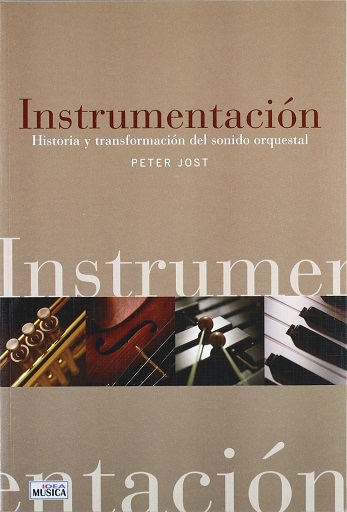
Instrumentación. Historia y transformación del sonido orquestal / Instrumentation. History and transformation of orchestral sound
(Review of the book of the same title by Peter Jost (1), published in Doce Notas magazine, April 2005)The restless and active publisher Idea Books enriches its music section with a new title that joins those already published, establishing, along with Alianza Música, the most significant offering in the current Spanish publishing landscape in this field. In addition to original editions and translations, Idea Música has recently released titles that are essential in the world of music theory and education. These include the reissue of Zamacois' Tratado de Armonía or some of Riemann's works (all reproduced facsimile editions of the original publications by the never sufficiently considered Editorial Labor, though this origin is not acknowledged in the new edition for reasons unknown). Also noteworthy is the reproduction of the Spanish translation of Schoenberg's El Estilo y la Idea, originally published in 1963 by Editorial Taurus. The new title under discussion is none other than the essay Instrumentation. History and Transformation of Orchestral Sound by Peter Jost, published in 2004 by Bärenreiter in its original German edition.
It is clear that this work should be classified as an essay, not a treatise, as Jost's goal is by no means to compile technical procedures but rather to delve into some of the fundamental concepts in the evolution of instrumentation. After a lengthy introduction aimed at separating the wheat from the chaff, Jost establishes the distinction between instrumentation (as the arrangement of instruments which constitutes an element of composition in its own right) and orchestration (the re-instrumentation of a work conceived for a different instrumental ensemble). From this starting point, he focuses on defining a series of concepts that can later serve as criteria for assessing the use and evolution of instrumentation across various periods and styles. Particularly intriguing are those concepts related to divided and integrated sonorities, as well as those derived from the instrumental application of compositional elements typically unrelated to instrumentation (form, harmony, analysis).
It is a shame that the author limits himself to the orchestral realm, as a slightly broader scope (can one truly argue against the instrumental essence of Bach's Sonatas, Partitas and Suites for violin and cello, to cite a clear example?) would have made the essay much more comprehensive and its conclusions far more universal. The reading experience is also somewhat hindered by the pedagogical tone of the numerous "proposals for reflection" scattered throughout the text, proposing at times abstruse questions that remain unanswered, as well as the very limited number of musical examples, which often require additional consultation of scores -not always an easy task- to fully understand the text. However, none of this detracts from the highly positive assessment of the book, which is further enhanced by Francisco Fernández del Pozo's excellent translation.
(1) By Peter Jost (translated by Francisco Fernández del Pozo)
Idea Books, S.A., 2005 (Idea Música section)
Madrid, February 2005