

The old building of the Audiencia, the first headquarters of the
Professional Conservatory of Music of Cuenca
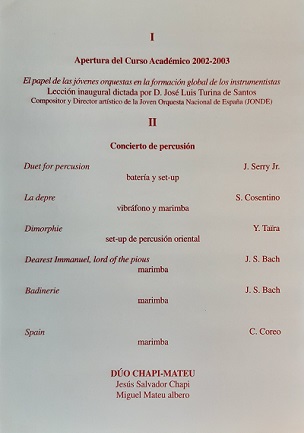
El papel de las jóvenes orquestas en la formación global de los instrumentistas / The role of youth orchestras in the holistic training of instrumentalists
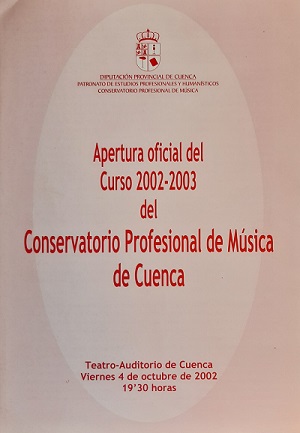
(Masterclass delivered at the opening ceremony of the 2002-2003 academic year at the Professional Conservatory of Music of Cuenca, October 4, 2002)Director, professors, and students of the Professional Conservatory of Music of Cuenca, and dear friends:
It is both an honor and a privilege to address you today to present a series of reflections on a topic of great relevance, one that I find myself particularly connected to at this point in my professional career. This occasion also brings me personal and intimate satisfaction, as it takes place during the inauguration of the academic year of an institution to which I was deeply tied at the very beginning of my career, over 20 years ago. As a professor of various disciplines -harmony, counterpoint, composition, musical forms, and music history- and as secretary first, and later as academic director, I had the opportunity to experience many significant and enriching moments in the building on Calle Palafox. These experiences played a decisive role in shaping my subsequent development as a professional educator, a field to which I have devoted fifty percent of my career, sharing the other half equally with composition.
Twenty years later, as Alexandre Dumas might say, circumstances have brought me back to Calle Palafox in Cuenca, though this time as the director of one of the most successful and impactful initiatives of our administration: the National Youth Orchestra of Spain. I have had the honor of overseeing its artistic management since February 2001. Over the months that have passed since then, I believe I have gathered enough experience to base this address on the role that youth orchestras play in the holistic training of instrumentalists. While I will refer broadly to youth orchestras in general, I will, for obvious reasons, make more frequent mention of the National Youth Orchestra of Spain -better known as JONDE- in particular.
The National Youth Orchestra of Spain was established in 1983 at the initiative of the National Institute of Performing Arts and Music (INAEM), with the aim of creating a space to bridge the gap between the final stages of musical education and professional life. The fact that this initiative came from the Ministry of Culture and not from the Ministry of Education -remember that a unified ministry for Education, Culture, and Sports was not created until 1996- eloquently demonstrates that, in the minds of its founders, the pedagogical nature of a youth orchestra like JONDE, likely due to the medium- and long-term nature of its objectives, was not prioritized over the more immediate goal of serving as a talent pool to support the burgeoning symphonic activity in Spain. This activity, as we know, began to take off in the mid-1980s with the widespread establishment of an important network of auditoriums and the symphonic ensembles necessary to provide them with an active and continuous musical life.
|
|
Thus, the scarcity of orchestras that had characterized Spanish musical life until then began to give way to the emergence of new orchestras that, progressively and consistently, have enriched the Spanish symphonic scene over the past fifteen years. Following JONDE's example, the different Autonomous Communities established their own training grounds for instrumentalists in the form of youth orchestras, providing their members with an excellent educational complement to that offered by official academic institutions. The Jove Orquestra Nacional de Catalunya (JONC), the Orquesta Joven de Andalucía (OJA), and the Joven Orquesta del Principado de Asturias (JOSPA), to name just a few, coexist alongside other youth orchestras closely linked to professional symphony orchestras. Examples include the Orquesta Joven de la Sinfónica de Galicia and the Orquesta-Escuela de la Orquesta Sinfónica de Madrid, a model that more directly facilitates the rapid integration of young performers into the professional world.
All Spanish youth orchestras, like their international counterparts, follow a similar working approach, which varies quantitatively depending on the budgetary constraints of each organization. Activities are structured around what are known as "encounters" (or working periods) which, in the case of JONDE, occur four or five times a year. These encounters are always scheduled during periods that minimize disruptions to the academic activities of its members, who, given their age, are presumed to be actively pursuing their studies. Therefore, Christmas, Easter, and summer vacations are the most suitable times for these encounters, which typically last two to three weeks. Each encounter is divided into three distinct phases.
In the first phase, the proposed repertoire is rehearsed in sectional practices, guided by professors -both national and international- specializing in each section. In the second phase, the guest conductor for the encounter takes charge of full orchestra rehearsals. Finally, in the third phase, the concert tour takes place. For JONDE, these tours span various theaters and auditoriums across Spain and, at least once a year, include a series of international concerts aimed at participating in major festivals and international events.
Over nearly twenty years, JONDE has showcased the results of its work through tours across almost all of Spain as well as in Belgium, Russia, Ukraine, France, the United States, Italy, the United Kingdom, Portugal, Luxembourg, Germany, the Netherlands, and Austria. The orchestra has performed in prestigious concert halls such as the Théâtre des Champs-Élysées in Paris, the Philharmonic Hall of St. Petersburg, Carnegie Hall in New York, the Royal Albert Hall in London, the Concertgebouw in Amsterdam, and the Konzerthaus in Berlin. It has also participated in international festivals such as Santander, Granada, the Canary Islands, and the BBC Proms, as well as in events like the Ibermúsica "World Orchestras" series in Madrid, Expo '92, Madrid-European Capital of Culture, Xacobeo '93, Expo Lisbon '98, Musikfestpiele Saarbrücken (Germany), Robeco Summer Concerts (Amsterdam), Expo Hannover 2000, the Cuenca Religious Music Week, and the Schleswig-Holstein and Young.Euro.Classic festivals in Berlin, from which it has just returned as of the writing of these lines.
As expected, with the exception of the assistant conductor and the resident composer, JONDE's members represent the various instrumental sections typical of a symphony orchestra: 16 woodwinds (4.4.4.4), 14 brass instruments (5.4.4.1), 5 percussionists, and 60 string players (16.14.12.10.8), in addition to two harpists and a pianist responsible for piano, celesta, and, where applicable, organ or synthesizer parts.
Admission to the orchestra requires candidates to pass an annual audition, which guarantees the successful applicant a position for one year, renewable for up to two more years, provided they do not exceed the maximum age limit (23 years). In all cases, candidates must reapply and pass the audition annually. The audition consists of three exercises. The first, an eliminatory round, involves the performance of a repertoire piece. The second focuses on performing the orchestral excerpts determined by the jury from a previously published list. The third and final exercise evaluates sight-reading skills using a passage from the orchestral or chamber repertoire for the candidate's instrument. Once the audition is completed, selected candidates are ranked by score, with the highest-ranked individuals filling the available positions. Any remaining candidates are placed on a reserve list.
The National Youth Orchestra of Spain seeks to promote the holistic development of its members, who, due to their age and technical and musical level, are nearing the completion of their studies. This is achieved through the pursuit of the following objectives and the implementation of the necessary practices and activities:
- First and foremost, to provide its members with a better and deeper understanding of the symphonic repertoire by programming works that, given the scale of the ensemble -which has occasionally reached up to 110 instrumentalists- encompass everything from the Baroque and Classical periods to the more complex pieces of the Romantic, Post-Romantic, and Contemporary eras. In order to equitably engage the majority of its members across different encounters, JONDE's programming, like that of similar orchestras, often includes pieces that, due to quantitative factors such as the number of performers or the spatial requirements for their preparation, are rarely, if ever, included in the repertoire of most educational institutions. Over the past year, JONDE has tackled works ranging from Don Juan by Richard Strauss to Petrushka by Stravinsky, as well as the widely educational Bolero by Ravel and the rarely performed Ascension by Olivier Messiaen. The latter was rehearsed at the facilities on Calle Palafox under the direction of Josep Pons for the orchestra's performance during the most recent edition of the Cuenca Religious Music Week.
- Secondly, and in a true exercise of symphonic humility, it is considered equally -if not more- important to delve into the chamber music repertoire. This is because it is within chamber music that instrumentalists can most effectively develop the habit of listening and learn to properly execute and appreciate their role within the ensemble. In this regard, JONDE places equal emphasis on both types of repertoire, dedicating a generous portion of its activities to chamber music. For this purpose, it enlists a faculty of great experience and prestige in this demanding field of performance.
- Regarding both the symphonic and chamber repertoire, and in pursuit of a higher level of specialization beyond what members are presumed to have acquired at their educational institutions, JONDE places special focus on contemporary creation. Works from both the essential 20th-century repertoire and more recent compositions are regularly programmed for its encounters. In the latter case, priority is given to Spanish composers, who are invited to spend several days with the orchestra, analyzing the programmed piece they authored and supervising the various sectional and full rehearsals. This closer interaction between composers and future professional performers fosters a deeper appreciation of composers' work through direct and meaningful contact. In recent encounters, the orchestra has had the honor of hosting the active and enthusiastic presence of composers such as Ángel Oliver, Jordi Cervelló, Carles Guinovart, Joan Guinjoan, Josep Soler, Agustín Bertomeu, Alejandro Civilotti, Agustín Charles, and Antón García Abril. Additionally, it is worth noting that in recent years, the orchestra has introduced the figure of a resident composer, who becomes a member of the ensemble for one year, attending encounters, conducting analysis sessions on the programmed repertoire, and committing to composing two pieces -a symphonic work and a chamber piece- that are subsequently rehearsed and premiered by JONDE. In 2002, this position was held by composer Gabriel Erkoreka, and in 2003, it will be filled by the young composer Roberto López, winner of the Composition Field Competition of the Youth Institute, to which the position of the resident composer will be formally linked from this year on.
- Moreover, given the pre-professional nature of youth orchestras, the aim is that, during the average two-year tenure of its members in the orchestra, they experience as many "orchestral situations" as possible. To this end, the content of the encounters is diversified as much as possible and adapted to the various circumstances they may later encounter in their professional lives: from conventional "seasonal" orchestras (both symphonic and classical chamber orchestras) to pit orchestras (opera, zarzuela, ballet), not forgetting studio recordings. Recent examples of JONDE's dedication to the latter two modalities include the production of Il Trovatore by Verdi at the Palacio de Festivales de Cantabria in September of last year, and the recording of a commemorative CD celebrating the centenary of the birth of Alicante composer Rafael Rodríguez Albert, which was recently presented during the ongoing International Festival of Contemporary Music in Alicante.
- Building on these fundamental premises, which form the backbone of the ensemble's activities in terms of repertoire, the National Youth Orchestra of Spain aims to provide its members with comprehensive training. This training spans aspects ranging from instrumental technique -through its refinement- to the analytical and historical understanding of the pieces studied, as well as other practical musical skills. Among these, sight-reading holds a prominent place as a critical tool for the proper development of their future professional careers. I think this is an area where instrumental instruction seems not to have fully established a defined space in its didactic programming, as evidenced by the significant shortcomings observed during the admission exams for various specialties. Sight-reading is a distinctly separate component of these exams and often proves decisive in determining the precise ranking of admitted candidates, especially when technical or musical interpretations of the repertoire piece show little difference between applicants. This scenario is common in woodwind and brass specialties but less so in string instruments, where the disparity in candidates' levels tends to be much greater. To address this, complementary activities during the encounters often include sessions focused on reading symphonic and chamber works, both from the repertoire and new compositions. These sessions help participants develop fluency in sight-reading and hone the reflexes necessary to tackle the immediate challenges posed by various aspects of musical writing.
- Analysis sessions, as mentioned earlier, aim to provide information that, without delving unnecessarily into technical details (more appropriate for composers than performers), equips participants with the keys to understanding the works as a whole. These sessions cover aspects such as general harmonic and formal traits, the composer's intentions and the extent to which they are realized, and noteworthy instrumentation and orchestration elements. When possible, these tasks are entrusted to the composers themselves, the resident composer, or specialists in the life and work of a particular author whose characteristics and peculiarities warrant such an approach.
- In one of the recent encounters, JONDE launched a complementary activity that was enthusiastically received by its members: classes in Basic Conducting Technique. These classes were skillfully taught by Juan José Olives, Professor of Conducting at the Conservatorio Superior de Música de Zaragoza. With the participation of a chamber group formed by members of the orchestra specifically for this purpose, these classes provided a group of voluntary active students with foundational knowledge of various aspects of conducting technique (e.g., anacruses, fermatas, dynamics, character). These skills will undoubtedly enable them to better understand and critically evaluate the challenges of conducting, as well as to assess the role of the numerous conductors they will work with in their future professional careers.
- Alongside these activities, which are essential for the development of musical skills and abilities, JONDE places special emphasis on practical knowledge of the body -the primary tool for any instrumentalist and a source of countless conflicts and problems that can be very difficult to resolve if not approached rationally and consciously. Every encounter dedicates a significant number of hours to both collective and individualized attention to disciplines such as the Alexander Technique and Yoga. Recently, a course on Music Medicine and Stage Fright Prevention was conducted, achieving remarkable participation despite its voluntary nature. The course covered topics addressing both physiological and psychological aspects of great variety and relevance.
In summary, it is clearly evident that there is a significant difference between the time dedicated to preparing the programmed works (10 to 15 days, with a team of specialized instructors, analysis and informational sessions, and the provision of orchestral material a month in advance) and the time allocated for the same task in the professional world (barely a few hours, without prior information, and practically sight-reading). In this sense, the work carried out during the 2–3 years that members remain in the orchestra is crucial for developing a comprehensive understanding of the structure of a musical piece and for forming a general approach to it. This understanding can later be applied to any work, even if professional dynamics prevent the same level of intensive preparation and depth of study.
Naturally, all these training activities represent only a portion of the broader technical development that youth orchestras aim to foster in their members. There is another aspect, one that deeply concerns those of us involved in these ensembles, as it directly impacts the future fluidity of professional activity -both in relationships among performers and between performers, their audiences, and various sectors of society. This is the "ethical" aspect of the musician, without which a complete, holistic sense of their training cannot be achieved. Such training should encompass not just the performer but also the individual, as a component of a social environment that, in the case of music, is inseparable from professional activity.
Youth orchestras, as high-density training nuclei (as evidenced by the points discussed above), serve as an ideal framework for cultivating positive attitudes that should underpin ensemble musical work: from camaraderie and cooperation to humility, respect, and receptiveness as fundamental principles of social behavior. These principles, in turn, are the ideal vehicles for achieving the high degree of responsibility expected of any member of a symphonic or chamber ensemble. A member of a youth orchestra must understand and accept decisions regarding their participation made by those responsible for the ensemble's musical, artistic, and administrative management. Nothing is more detrimental than fostering the arrogance with which many young musicians join these orchestras, an attitude born from both undeniable talent and the ignorance and inexperience that, ultimately, can be considered synonymous. It is the responsibility of artistic and musical leadership to identify such attitudes and take the necessary measures to correct them, without creating unnecessary tensions that could lead to the toxic atmosphere found in many professional ensembles.
For example, all JONDE encounters begin with so-called "stand auditions", during which the artistic director and instructors from various specialties evaluate the members' mastery of the repertoire for the encounter, which they have had several weeks to study after receiving the materials. These auditions determine the roles assigned to each member and, for string players, their seating positions. All participants in the encounter are required to accept the decisions made by the jury. For many, this process represents the most challenging moment of the encounter, and the difficulty of accepting the results sometimes provides an important first step toward developing self-criticism and the respect necessary for decisions made by the artistic and musical leadership.
Achieving this is largely possible due to the close-knit environment of the encounters. Over a period of 15–20 days, depending on the encounter, the orchestra's members, along with the technical and artistic teams -including the music director and instructors- engage in intense daily schedules. These begin early in the morning and often extend into recreational activities late into the evening. For such close relationships to function smoothly, all participants must fully embrace their roles within the group, setting aside the egotism and arrogance that, unfortunately, are so prevalent in this profession. Such behaviors would make both artistic and social coexistence impossible during an extended and intensive period of isolation.
The National Youth Orchestra of Spain, like other youth orchestras sponsored by the education or cultural departments of various Autonomous Communities, plays a decisive role in the holistic development of its members, as has been outlined in the preceding sections. However, unlike the symphonic ensembles formed within professional and higher conservatories to support orchestral education -which primarily aim to meet the curricular requirements established for such training- youth orchestras have an additional role to fulfill. This role responds to the budgetary investment made by the State (in the case of JONDE) or the Autonomous Communities (for other ensembles) to ensure their operation. This role is none other than to give back to the society that supports them the fruits of this investment, in the form of concert activities that showcase the results of the work carried out and justify the continuation of such initiatives.
For this reason, youth orchestras should not be considered educational centers, as is often implied, but rather genuine symphonic ensembles where external activity, directed toward the public, is just as important as internal training behind closed doors. Collaboration with public and private cultural institutions responsible for organizing concerts -such as patronages, foundations, or festivals- is, therefore, essential for such orchestras. It is equally important that each encounter prepares a repertoire of complete works -not fragments selected for educational purposes, as might be the case for orchestral training in a conservatory- that can form the basis for a concert or a series of concerts, showcasing to the public the results of the work carried out during each encounter.
Moreover, youth orchestras must serve, given the high level of technical and musical qualification they provide to their members, as true platforms for launching their careers, facilitating their entry into the professional world whenever possible. For an orchestra like JONDE, it is neither difficult nor inconvenient to serve as a database regularly and increasingly consulted by professional orchestras. These organizations often rely on JONDE to recruit instrumentalists necessary for their operations, especially when unforeseen vacancies occur or additional personnel are required to tackle certain works in their respective seasons. This constitutes a solid first step into professional life.
Additionally, the National Youth Orchestra of Spain is a founding member of the European Federation of National Youth Orchestras, whose directors meet twice a year and maintain an active policy of instrumentalist exchange. This complements and enriches the exchanges already conducted with other Spanish youth orchestras, whose members are regularly invited to participate in JONDE's encounters. After all that has been stated, there should be no doubt about the decisive role youth orchestras play in contributing to the comprehensive training of the instrumentalists who join them. It is up to these young musicians to take full advantage of the remarkable opportunity they are given during their tenure. It is up to society to appreciate the myriad benefits their existence brings to the enjoyment of a high-quality musical life. And it is up to current and future policymakers to maintain the sensitivity shown by successive administrations to ensure their continuity.
Only with these elements can youth orchestras achieve the multifaceted objective that inspires them. In summary, their mission is to serve as a "luxury" transition to the professional world for a carefully selected group of instrumentalists based on their technical and musical abilities. To this end, they provide the best human and infrastructural resources, aiming to offer not only further development as instrumentalists but also intellectual and musical growth that aligns with the high qualitative standards of today's culture.
Thank you very much.
Madrid, 2002