
home > bibliography > José Luis Turina. Composer
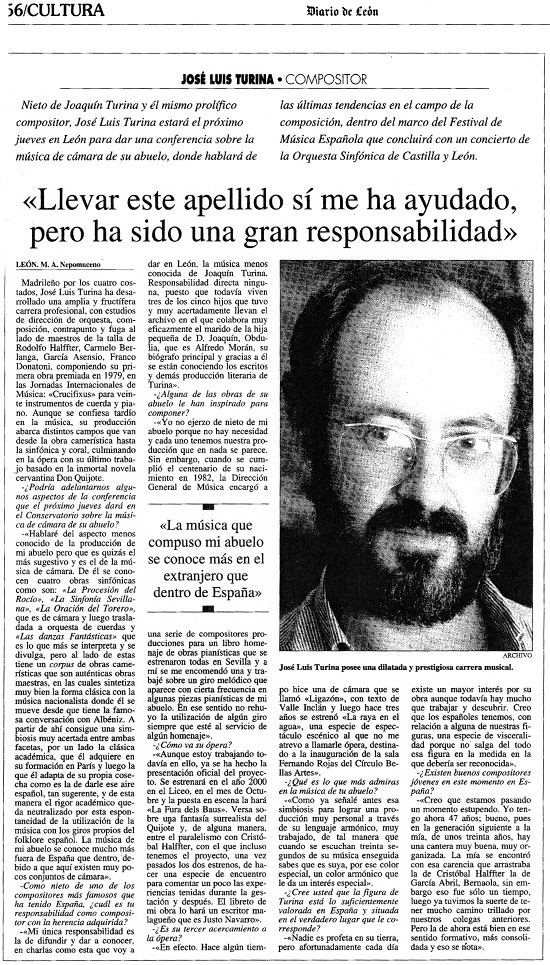
José Luis Turina. Compositor / José Luis Turina. Composer
Interview published in Diario de León. León, July 12, 1999By Miguel Ángel Nepomuceno
Grandson of Joaquín Turina and himself a prolific composer, José Luis Turina will be in León next Thursday to give a lecture on his grandfather's chamber music, in which he will also speak about the latest trends in the field of composition, as part of the Spanish Music Festival, which will conclude with a concert by the Castilla y León Symphony Orchestra.
«Carrying this surname has indeed helped me, but it has also been a great responsibility».
A Madrilenian through and through, José Luis Turina has had a broad and fruitful professional career, studying orchestral conducting, composition, counterpoint, and fugue under masters such as Rodolfo Halffter, Carmelo Bernaola, García Asensio, and Franco Donatoni. He composed his first award-winning work in 1979 at the International Music Conference: «Crucifixus» for twenty string instruments and piano. Although he admits he came to music relatively late, his output spans a variety of genres, from chamber works to symphonic and choral music, culminating in opera with his latest work, based on Cervantes'immortal novel Don Quixote.
-Could you give us a preview of some of the topics you'll address in Thursday's lecture at the Conservatory on your grandfather's chamber music?
-«I will talk about the lesser-known aspect of my grandfather's output, which is perhaps the most intriguing -his chamber music. He is known for four symphonic works: La Procesión del Rocío, Sinfonía Sevillana, La Oración del Torero -originally chamber music, later arranged for string orchestra- and Danzas Fantásticas. These are the most often performed and publicized pieces. But alongside them there is a corpus of chamber works that are true masterpieces, in which he masterfully synthesizes classical form with the nationalist music he embraced after his famous conversation with Albéniz. From that point on, he achieved a highly successful symbiosis between the academic classical style, which he acquired during his training in Paris, and the uniquely Spanish flavor he cultivated himself. This way, the academic rigor is offset by the spontaneity of musical turns derived from Spanish folklore. My grandfather's music is actually better known abroad than in Spain, mainly because there are so few chamber ensembles here».
-As the grandson of one of Spain's most famous composers, what responsibility do you feel you have as a composer toward this heritage?
-«My only responsibility is to spread and promote -through talks like the one I'll give in León- the lesser-known music of Joaquín Turina. Direct responsibility, none, since three of his five children are still alive, and they very wisely manage the archive, with the very effective collaboration of the husband of Don Joaquín's youngest daughter, Obdulia -Alfredo Morán- his principal biographer. Thanks to him, Turina's writings and other literary works are coming to light».
-Have any of your grandfather's works inspired you to compose?
-«I don't write as my grandfather's grandson -there's no need to, and each of us has our own output, which is quite different. However, when the centenary of his birth was celebrated in 1982, the Directorate General of Music commissioned a number of composers to produce works for a commemorative book of piano pieces, all premiered in Seville. I was assigned one, and I worked around a melodic turn that appears frequently in some of my grandfather's piano works. In that sense, I don't shy away from using a motif, as long as it's in the service of a tribute».
-How is your opera coming along?
-«Although I'm still working on it, the project has already been officially presented. It will premiere in October 2000 at the Liceu, with staging by «La Fura dels Baus». It's based on a surrealist fantasy of Don Quixote, and in a way, there's a parallel with Cristóbal Halffter -we even have plans, once both premieres are over, to hold a sort of meeting to share our experiences during and after the creative process. The libretto for my work will be written by a Málaga-born writer, Justo Navarro».
-Is this your third approach to opera?
-«Indeed. Some time ago I wrote a chamber opera called «Ligazón», with text by Valle-Inclán, and then three years ago «La raya en el agua» premiered -a sort of stage show (I hesitate to call it an opera) created for the inauguration of the Fernando Rojas Hall at the Círculo de Bellas Artes».
-What do you most admire in your grandfather's music?
-«As I mentioned earlier, that synthesis, which results in a highly personal body of work through his very refined harmonic language -so distinctive that after thirty seconds of listening, you immediately know it's his, because of that special color, a harmonic color that gives it a unique appeal».
-Do you think Turina's place in Spain is properly valued and recognized?
-«No one is a prophet in their own land, but fortunately there is increasing interest in his work every day, although there is still much to do and discover. I think we Spaniards sometimes have a sort of visceral tendency to hold back some of our figures from being as fully recognized as they should be».
-Are there good young composers in Spain at the moment?
-«I think we're going through a wonderful period. I'm 47 now; in the generation after mine, around thirty years old, there's a very good, well-organized pool of talent. My generation suffered the gap suffered by Cristóbal Halffter's, García Abril's, Bernaola's… but that was only for a while -later we were lucky to have much of the groundwork already laid by our predecessors. The current generation is stronger in that formative sense, more consolidated, and that shows».