
home > bibliography > "The libretto must always be respected"
"El libreto hay que respetarlo siempre" / "The libretto must always be respected"
By Luis García IberniInterview published in the magazine El Cultural magazine (Madrid, December 5, 1999)
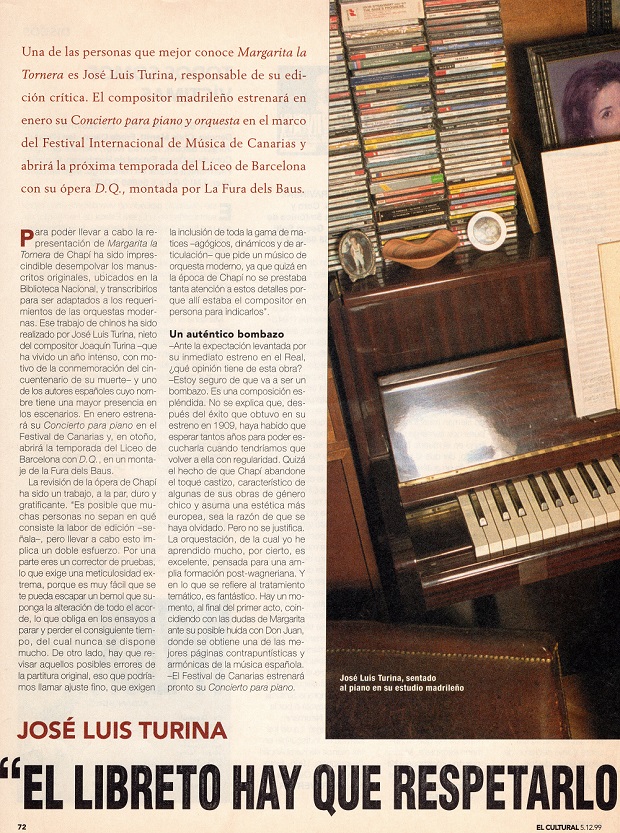
One of the people who knows Margarita la Tornera better is José Luis Turina, responsible for its critical edition. The Madrid-born composer will premiere his Concerto for Piano and Orchestra in January as part of the Canary Islands International Music Festival, and will open the next season at the Liceo in Barcelona with his opera D.Q., staged by La Fura dels Baus.
To bring about the performance of Chapí's Margarita la Tornera, it was essential to dust off the original manuscripts, housed in the National Library, and transcribe them to be adapted to the requirements of modern orchestras. This painstaking task was carried out by José Luis Turina, grandson of composer Joaquín Turina -who has had an intense year due to the commemoration of the fiftieth anniversary of his death- and one of the Spanish composers whose name is most present on stage. In January, he will premiere his Concerto for Piano at the Canary Islands Festival, and in the fall, he will open the season at the Liceo in Barcelona with D.Q., in a production by La Fura dels Baus.
The revision of Chapí's opera has been both a tough and rewarding job. "Many people may not know what the task of editing entails", he points out, "but carrying this out involves a double effort. On the one hand, you act as a proofreader, which requires extreme meticulousness because it is very easy to miss a flat note that could alter the entire chord, forcing rehearsals to stop and wasting precious time, of which there is never enough. On the other hand, you must review any possible errors in the original score, what we could call fine-tuning, which requires including the full range of nuances -agogic, dynamic, and articulation- that a modern orchestral musician demands, as perhaps in Chapí's time, these details were not given as much attention since the composer was present to indicate them".
A true sensation
With the anticipation surrounding its upcoming premiere at the Real, what is your opinion of this work?
- I am sure it is going to be a sensation. It's a splendid composition. It's hard to understand why, after the success it had at its premiere in 1909, weve had to wait so many years to hear it again, when it should be performed regularly. Perhaps the fact that Chapí moved away from the traditional style characteristic of some of his género chico works and embraced a more European aesthetic is why it has been forgotten. But that's no excuse. The orchestration, from which I have learned a lot, by the way, is excellent, designed for a large post-Wagnerian ensemble. And in terms of thematic treatment, it is fantastic. There is a moment, at the end of the first act, coinciding with Margarita's doubts about her possible escape with Don Juan, where one of the best contrapuntal and harmonic passages in Spanish music is achieved.
- The Canary Islands Festival will soon premiere your Concerto for Piano.
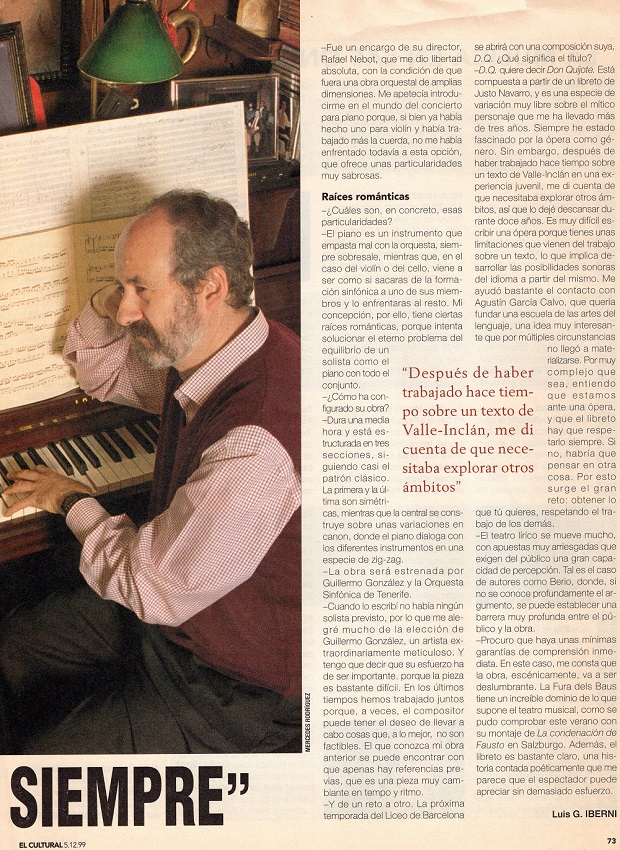
- It was commissioned by its director, Rafael Nebot, who gave me complete freedom, with the condition that it be a large-scale orchestral work. I was eager to delve into the world of the piano concerto because, although I had already written one for violin and had worked more with strings, I hadn't yet tackled this option, which offers some very interesting particularities.
Romantic roots
- What are those particularities, specifically?
- The piano is an instrument that blends poorly with the orchestra; it always stands out, whereas, in the case of the violin or cello, it's as if you're taking one of the members out of the symphonic ensemble and setting it against the rest. My approach, therefore, has certain romantic roots because it tries to solve the eternal problem of balancing a soloist like the piano with the entire ensemble.
- How is your work structured?
- It lasts about half an hour and is structured in three sections, following almost a classical pattern. The first and last sections are symmetrical, while the central one is built on a set of variations in canon, where the piano engages in a sort of zigzag dialogue with the different instruments.
- The piece will be premiered by Guillermo González and the Tenerife Symphony Orchestra.
- When I wrote it, no soloist had been decided, so I was very pleased with the choice of Guillermo González, an extraordinarily meticulous artist. I have to say that his effort is significant because the piece is quite difficult. Recently, we've been working together because, sometimes, the composer may want to do things that might not be feasible. Those familiar with my previous work may find there are hardly any references, as this piece is highly changeable in tempo and rhythm.
- And from one challenge to another. Next season at the Liceo in Barcelona will open with your composition D.Q.. What does the title mean?
- D.Q. stands for Don Quixote. It’s based on a libretto by Justo Navarro and is a very loose variation on the mythical character, a project that took me over three years. I've always been fascinated by opera as a genre. However, after working on a text by Valle-Inclán in a youthful experiment, I realized I needed to explore other fields, so I put opera aside for twelve years. Writing an opera is very difficult because you have constraints that come from working with a text, which implies developing the sound possibilities of the language from it. My interaction with Agustín García Calvo helped me a lot. He wanted to establish a school for the arts of language, a very interesting idea that, for various reasons, never came to fruition. As complex as it is, I understand that we're dealing with an opera and that the libretto must always be respected. Otherwise, we'd have to consider something else. This is where the great challenge lies: achieving what you want while respecting the work of others.
- Lyric theater is very dynamic, with highly risky ventures that demand a great deal of perception from the audience. Such is the case with authors like Berio, where, if you don't have a deep understanding of the plot, a significant barrier can arise between the audience and the work.
- I try to ensure there are minimum guarantees of immediate comprehension. In this case, I'm confident that the production will be visually stunning. La Fura dels Baus has an incredible command of what musical theater entails, as was evident in their production of The Damnation of Faust in Salzburg this summer. Additionally, the libretto is quite clear, a story told poetically that I believe the audience can appreciate without too much effort.