

Alma Maria Schindler (1879-1964)
Die Windsbraut
For Wind QuintetCommentary
Recording
Review
Download scores
Commentary
Die Windsbraut (The Bride of the Wind) is the title of a shocking expressionist painting that Oskar Kokoschka painted between 1913 and 1914, shortly before the breakdown of his scandalous romance with Alma Maria Schindler, Gustav Mahler's widow since 1912.

Die Windsbraut (1913-1914), by Oskar Kokoschka (1886-1980)
The painting and, above all, reading hes memoir entitled My Life suggested to me the composition of a work for the Azahar Ensemble, an excellent wind quintet formed during the tenure of its five members in the National Youth Orchestra of Spain, with the figure of such an extraordinary woman as a central axis. Or, rather, with that of the four sentimental relationships that he had with four very important figures of European culture, each representing a different discipline: the composer and conductor Gustav Mahler, the painter Oskar Kokoschka, the architect Walter Gropius, and the writer Franz Werfel.

Gustav and Alma Mahler (1898)

Oskar Kokoschka

Walter Gropius, Alma Mahler and their daughter Manon

Alma Mahler and Franz Werfel
These four passions are the basis of the four movements of Die Windsbraut, in which an attempt is made to reflect something of the personality of each one: in the first movement the music is somewhat neurotic, with the obsessive presence of the oboe quote from the beginning of the Lieder eines Fahrendes Gesellen and with a frequently exalted character that wants to get out of all formal cast. In the second, the figure of Kokoshcka is evoked through an agitated and very passionate section, full of impetus. The third movement is the most rational part of the work, in which everything is calculated to the millimeter -from the chord sequences to the duration of the five solos-, as befits the evocation of the main figure of the Bauhaus. In the fourth, finally, the figure of Franz Werfel is reflected by means of contrasting sections, whose character derives from some of his works, and which are systematically interrupted by the complete return of the section dedicated to Kokoschka, whose presence -in the form of letters- did not abandon Alma during all that time.


Program of the premiere of Die Windsbraut
(Santander, August 17, 2015)
Die Windsbraut was started at Bragança’s Domus Municipalis on August 17, 2012 and finished in Madrid on November 26 of that same year, after going through places as diverse as Llanes, Lliria and Mexico D.F. The score is dedicated to the Azahar Ensemble, which premiered it at the Pereda Hall of the Palacio de Festivales de Cantabria on August 17, 2015, within the 64th edition of the Santander International Music Festival.

Greeting the performers after the premiere of Die Windsbraut

First page of Die Windsbraut
Recording
Recording: Azahar Ensemble (Low quality recording taken live at the concert held at Vital Fundazioa Kulturenea in Vitoria, March 29, 2022)
Review
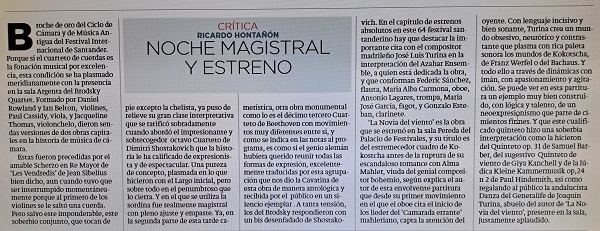
A masterful night and a premiere
By Ricardo Hontañón
(Review published in El Diario Montañés, Santander, August 22, 2015)
[...]
Among the world premieres featured in this 64th Santander Festival, a particularly important one was the performance of a work by Madrid-born composer José Luis Turina, interpreted by the Azahar Ensemble, to whom the piece is dedicated. The ensemble is composed of Frederic Sánchez (flute), María Alba Carmona (oboe), Antonio Lagares (horn), María José García (bassoon), and Gonzalo Esteban (clarinet).
'La Novia del Viento' is the piece that premiered at the Pereda Hall of the Festival Palace, its title referencing the haunting painting by Kokoschka created just before the end of his scandalous affair with Alma Mahler, widow of the brilliant Bohemian composer -as explained by the composer himself. From its very first movement, in which the oboe quotes the opening of Mahler's 'Songs of a Wayfarer', this captivating score immediately seizes the listener's attention. Using a sharp yet resonant musical language, Turina constructs an obsessive, neurotic, and contrasting world that evokes, through a rich sonic palette, the universes of Kokoschka, Franz Werfel, or the Bauhaus. All of this is conveyed with dynamic magnetism, passion, and agitation. This score exemplifies a very well-crafted work -logical and skillful- rooted in solid foundations of neo-expressionism.
The highly accomplished quintet delivered a superb interpretation of the work, as they did with Samuel Barber's Quintet Op. 31, the evocative quintet by Giya Kancheli, and Paul Hindemith's playful Kleine Kammermusik Op. 24 No. 2. As an encore, they delighted the audience with the Andalusian-flavored Danza del Generalife by Joaquín Turina, grandfather of the composer of 'La Novia del Viento', who was present in the hall and deservedly applauded.
Download pdfs
(Scores & parts without watermarks available at www.asesores-musicales.com )Score in C
Transposed score