
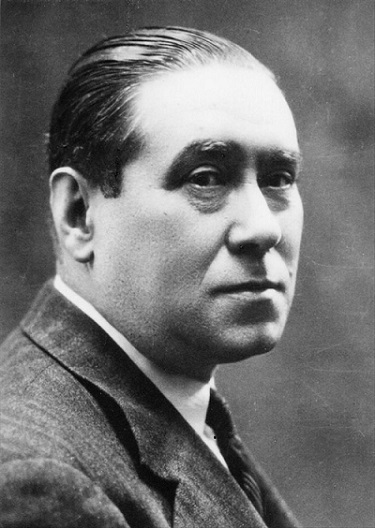
Joaquín Turina (1882-1949)at the age of 47
Portrait by Alfonso (January 23, 1930)
Notes for the CD Turina. Works for strings by Concerto Málaga
Booklet of the CD Naxos "Spanish Classics" 8.573391 (2024)Although Joaquín Turina did not compose any work specifically intended for a string orchestra as the primary recipient, in commemoration of the 75th anniversary of his death, Concerto Málaga has succeeded in bringing together eight works on this album. These works, originally written for various ensembles (piano, lute quartet, string quartet, quintet, piano sextet, orchestra), allow for transcription to a string section without losing any of their original flavour.
As if making a statement of intent, the album opens and closes with two of the composer's most well-known works, La oración del torero and Orgía (from Danzas fantásticas), framing a luxurious context into which six more pieces are inserted. All of these pieces are illustrative of Turina's best "savoir faire".
La oración del torero, Op. 34 (1925)
Few works in the recent history of Spanish music have a journey as interesting as Joaquín Turina's La oración del torero. The composer himself recounts its origin:
| One afternoon at a bullfight in the Plaza de Madrid, that old, harmonious, and charming square, I saw my work. I was in the horse patio. There, behind a small door, was the chapel, filled with devotion, where bullfighters came to pray a moment before facing death. At that moment, the subjective musical and expressive contrast presented itself in all its fullness -the distant clamour of the plaza, the anticipation of the festive crowd, juxtaposed with the solemnity of those who, before that altar, humble and full of endearing poetry, came to plead with God for their lives, perhaps for their souls, for the pain, for the illusion, and for the hope that they might leave behind forever in those moments, in that arena filled with laughter, music, and sunlight. |
La oración del torero ("The Prayer of the Bullfighter"), catalogued as Op. 34, was composed in 1925, during a moment of splendid and fruitful creative maturity for its author. It is worth noting that its composition was immediately prior to Trio No. 1 in D major, from the same year, and a few years after his two most important symphonic works, Danzas fantásticas, Op. 22, from 1919, and Sinfonía sevillana, Op. 23, from 1920. The work emerged as a result of a fruitful collaboration over several years with the Spanish lute quartet formed by the Aguilar brothers (Cuarteto Aguilar). Between their foundation in 1923 and their dissolution in the early 1940s due to exile, they promoted the creation of both original works and their own or authorised arrangements by many Spanish and foreign composers (including Joaquín Turina, Joaquín Nin, María Rodrigo, Ernesto Halffter, Manuel de Falla, Igor Stravinsky, Heitor Villa-Lobos, and others). Turina had previously made two arrangements of piano works for them: Fiesta mora en Tánger (from the "Travel Album" Op. 15) in 1924 and Desfile de los soldados de plomo (from the first series of Niñerías, Op. 21) in 1925.
Turina himself sensed that La oración del torero could have a broader reach than what the lute quartet allowed. This is evident in the fact that the day after completing the original version on 6 May 1925, he began working on a version for string quartet, which he finished a week later. At the request of Bartolomé Pérez Casas, a few months later he added a double bass part, completing the version for string orchestra. This version premiered on January 3, 1927, at the Teatro de la Comedia, performed by the Madrid Philharmonic Orchestra, and it is this version that opens the present album, and is undoubtedly the most widely known. An exceptionally inspired and formally rounded work, its extensive dissemination has led to various arrangements (wind quintet, symphony orchestra, band, and even the intriguing version by Jascha Heifetz for violin and piano).
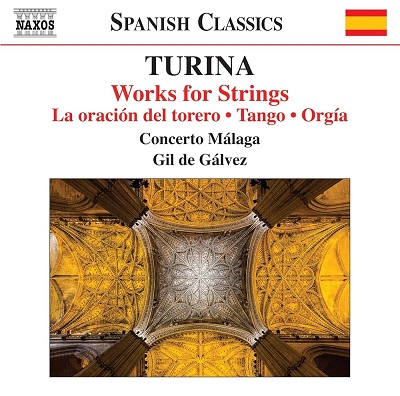
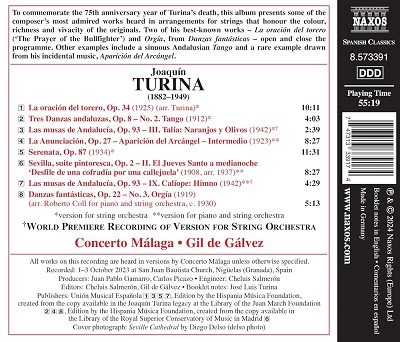
Front and back covers of the CD Turina. Works for Strings,
by Concerto Málaga
Tres danzas andaluzas, Op. 8, No. 2. Tango (1912)
The Tango is part of the Tres danzas andaluzas, Op. 8 for piano, composed in 1912, where it serves as the second movement. It exhibits a contrasting character between the initial Petenera and the spirited Zapateado at the end -the latter being the most well known of the three. In Joaquin Turina's archives, there were preserved manuscript parts of an arrangement for string quintet by an unknown author -there is no certainty that the composer himself made this arrangement. This is the version performed by Concerto. Málaga on the current album.
Las musas de Andalucía, Op. 93 - III. Talia: Naranjos y olivos - IX. Calíope: Himno (1942)
Between the months of April and October 1942. Turina composed a suite for voice and piano quintet titled Las musas de Andalucía. This suite consists of nine numbers, each dedicated to one of the Muses, and each employing a different instrumental ensemble (violin and piano, cello and piano, voice and piano, piano solo, etc.). The composer himself wrote an illuminating explanation of this work, which he read on the airwaves of Radio Nacional de España on the night of its premiere in Madrid on 28 December 1944:
|
It may seem strange at first glance, the relocation of the Greek Muses to Spanish soil. However, this is not the first journey they have undertaken. This time, I wanted to clothe them in Andalusian attire. I aimed to provide them with a broad interpretative sense, with a varied sonic nuance concerning tones and sound combinations. [...] In one of the National Episodes. La Corte de Carlos IV, Galdós recounts that a certain marchioness, living in a palace on Calle de Cañizares, hosted a splendid party where the famous actor Isidoro Márquez portrayed Othello. Galdós describes the palace with all its details and the impromptu little theatre, stating: "Goya had skilfully painted the curtain and frame that composed the facade. The Apollo playing, whether the lyre or the guitar, in the centre of the canvas, was a handsome and charming fellow, and, beside him, nine charming young women, in their attributes and postures, demonstrated that the great artist had remembered the muses". Here is the starting point of my muses, although instead of young women, I have made them Andalusian. |
Regarding the third one, Thalia, he adds:
| "Thalia", muse of Comedy and goddess of the fields. This is a note for a quartet, titled Orange Trees and Olive Trees. |
And concerning the ninth and final one, he points out:
| "Calliope", muse of Epic Poetry. A Hymn for quartet and piano concludes the cycle. |
Dedicated to Antonio de las Heras and Joaquín Rodrigo respectively, Thalia and Calliope were premiered, along with the other seven Muses, by their favourite performers: the soprano Lola Rodríguez Aragón and the "five lions" who comprised the Agrupación Nacional de Música de Cámara (Enrique Iniesta and Luis Antón, violins. Pedro Meroño, viola: Juan Ruiz Casaux, cello; and Enrique Aroca, piano).
La Anunciación, Op. 27 - Aparición del Arcángel - Intermedio (1923)
Though not very extensive, Turina's dedication to incidental and cinematic music is nonetheless of great interest. An eloquent example is the music composed in 1923 for the comedy La Anunciación by Tomás. Borrás, premiered at the Teatro Español on April 10, 1924. The critics noted the day after the premiere:
| "Turina's illustrations underscore, with restrained eloquence, the profound mysticism of the dramatic poem and contribute effectively to creating the required atmosphere". |
From the score for Borrás's comedy. Turina published, as Op. 27, the fragment titled Intermedio, Aparición del Arcángel for string sextet with piano, which is included in the present recording in a version for string orchestra.
Serenata, Op. 87 (1934)
Regarding the Serenade, Op. 87 for string quartet (heard here in a version for string orchestra), the composer himself states:
| "[...] it is a work I wrote during the summer of 1934 in Suances (Santander), with the purpose that it forms a pair with La oración del torero, exactly as if they were candlesticks or two vases. |
This somewhat nostalgic glance at his Op. 34, composed nine years earlier, is reflected in a certain stylisation of the music, in this case, more abstract and detached from any descriptive references, but no less Andalusian
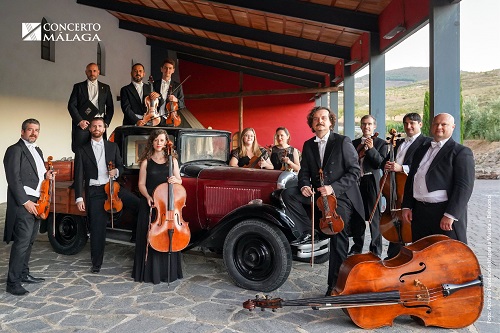
The String orchestra Concerto Málaga with its conductor, Gil de Gálvez
Sevilla, suite pintoresca, Op. 2-II. El Jueves Santo a medianoche. "Desfile de una cofradía por una callejuela" (1908)
On the contrary, there is nothing but meticulously portrayed images in El Jueves Santo a medianoche, the second movement of the suite Sevilla, Op. 2, composed in 1908. This piece signifies Turina's embrace of the advice given by Albéniz after listening to Quintet Op. 1, to compose distinctly Spanish music "with a view to Europe". Turina effectively and fruitfully blends popular flavour with the solid technique acquired at La Schola Cantorum in Paris, following one of the main aesthetic currents of the time, inheriting the cyclic constructive principles of the Belgian composer César Franck.
Danzas fantásticas, Op. 22-No. 3. Orgía (1919)
The album concludes with Orgía, the final of the three Danzas fantásticas, Op 22 from 1919, so widely known that it needs no further commentary. It is worth noting that it is a superb version for piano and string quintet, created around 1930 by Roberto Coll. This rendition captures all the vigour, contrasts and brilliance of the symphonic version crafted by Joaquín Turina based on the original piano composition, completed only a few months earlier.
Madrid, October 2023